

For most women in the modern world, pregnancy is pretty safe. We have access to incredible prenatal care that includes diagnostics and monitoring, and when things become complicated, we have measures, including labor induction, c-sections, and incredible care for babies born premature, who in earlier eras might not have had a chance.
However, these rates of successful and safe pregnancies are just high enough to make it easy to overlook just how dangerous pregnancy can be, even now, and the March of Dimes’ latest report is raising the alarm. Currently, more than 10% of pregnancies in the U.S. won’t make it to 37 weeks (full-term), and in some states, those stats are even worse.
In fact, the latest stats show that the U.S. has a lot of work to do to make pregnancy and birth safer for both mothers and babies.
The U.S. Rates A D+ For Preterm Birth
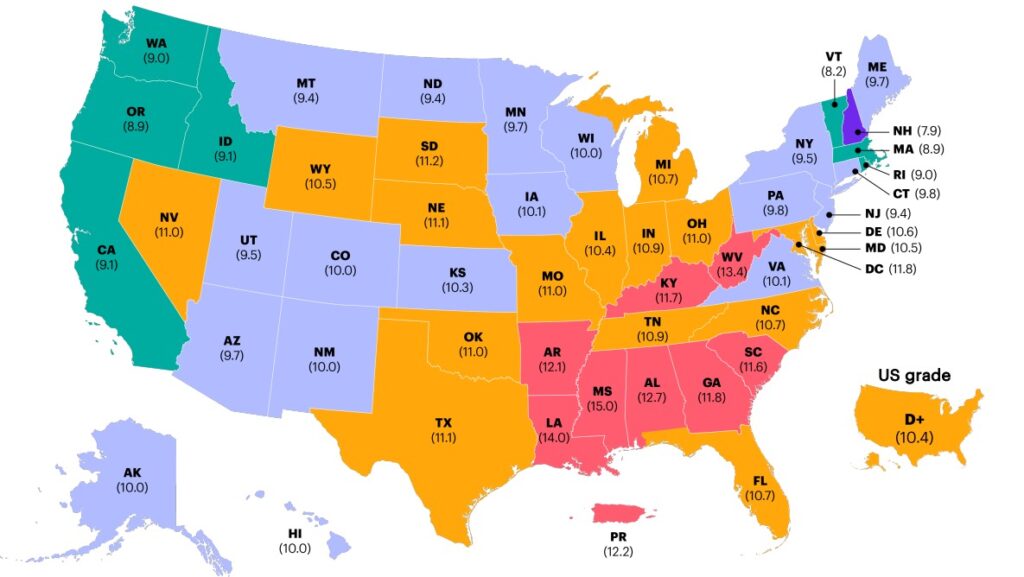
The March of Dimes cites a Healthy People 2030 goal to keep preterm births below 9.4%. Only 11 states are currently at that level, with a majority of states still showing premature birth rates over 10% in the most recently available data.
Missouri has the most alarming preterm birth rate, at 15%, and New Hampshire has the lowest, at 7.9%. Most of the highest preterm birth rates are across the southeast: Louisiana (14%); Arkansas (12.1%); Alabama (12.7%); Georgia (11.8%) and South Carolina (11.6%), but as you can see in the map above, preterm birth rates remain high in a majority of states.
In 2024, 21 states had higher preterm birth rates than in the previous year, while only 19 had lower rates. The nation’s overall preterm birth rate has held steady at 10.4% since 2022, a modest decline from 2021 (10.5%) but a significant increase over the past decade: in 2014, the rate was 9.6%.
What this means for babies can range widely. Some may have a short NICU stay and no additional problems, but for many, preterm birth can mean long-term health problems and higher risks of severe outcomes, including death.
Infant Mortality Remains High Too
The March of Dimes report also highlights the infant mortality rate. In the U.S., we’re losing more than 5 babies out of every thousand in their first year.
In 2013, this was higher, at 6 infant deaths per 1,000 live births (0.6%), and was steadily declining, reaching a low of 5.4 infant deaths per 1,000 live births in 2020 and 2021. The numbers are climbing again, reaching 5.6 deaths per 1,000 live births in both 2022 and 2023 (the latest data available in the report).
Compared with other countries with similarly developed economies—those in the Organization for Economic Co-operation and Development (OECD)—the U.S. ranks 33rd out of 38, according to the United Health Foundation.
“The average rate of infant mortality among OECD countries was 4.0 deaths per 1,000 live births in 2021. At 5.4 deaths per 1,000 live births, the U.S. ranked No. 33 of the 38 OECD countries, falling between the Slovak Republic (4.9 deaths per 1,000 live births, No. 32) and Chile (5.8 deaths per 1,000 live births, No. 34). Japan and Norway (both No. 1) had the lowest rates, with 1.7 deaths per 1,000 live births.”
The State Of Maternal Mortality In The U.S.
Maternal mortality in the U.S. peaked during COVID, rising quickly from 20.1 maternal deaths per 100k live births in 2019, to 32.9 in 2021, and as of the latest data (2023) has dropped back to pre-pandemic levels: 18.6 maternal deaths for every 100k live births.
That’s still nearly double the average maternal mortality in OECD countries (10.3 maternal deaths per 100k live births) and 6 times the level of some, according to the organization’s most recent stats.
“Countries including Iceland, Ireland, Norway, Poland, the Slovak Republic, Denmark, Switzerland and Italy had 3‑year average MMRs of lower than 3 deaths per 100 000 live births.”
Contributing Factors Worsening Outcomes For Moms & Babies

Why, in the United States, are we seeing such shocking outcomes for moms and babies?
The March of Dimes identifies several factors that contribute to worsening outcomes. Most center around access to healthcare.
Their stats show that 16.1% of babies (or about 1 in every 8 babies) were born to mothers who did not receive prenatal care until the fifth month of their pregnancy or later. That works out to a mom being seen about half the recommended number of times before giving birth.
Almost a quarter of moms aren’t starting their prenatal care until at least the second trimester, meaning they’re going the first 3 months of pregnancy without any checks on fetal health or maternal health. They may not know if they have low iron, vitamin deficiencies, high blood pressure, or other conditions that could complicate their pregnancy.
Unfortunately, as many as a third of U.S. counties are what the March of Dimes terms “maternity care deserts” — places where there is no prenatal care available at all, and women must travel to find care.
Then there are insurance coverage issues. When applying for Medicaid, for instance, approval can take up to 30 days, and that’s not counting delays due to personal circumstances such as work schedules or missing documents.
There’s a severe shortage of prenatal providers, and it could be getting worse. Hundreds of hospitals nationwide have shut down their obstetric departments, and many OB/GYNs have left the practice altogether, or left states that have implemented strict anti-abortion laws that they feel detract from their ability to serve their patients.
The March of Dimes recommends that the nation take several steps to address the problems, including expanding Medicaid, reimbursing Medicaid patients for doula services, and improving paid family leave.
