

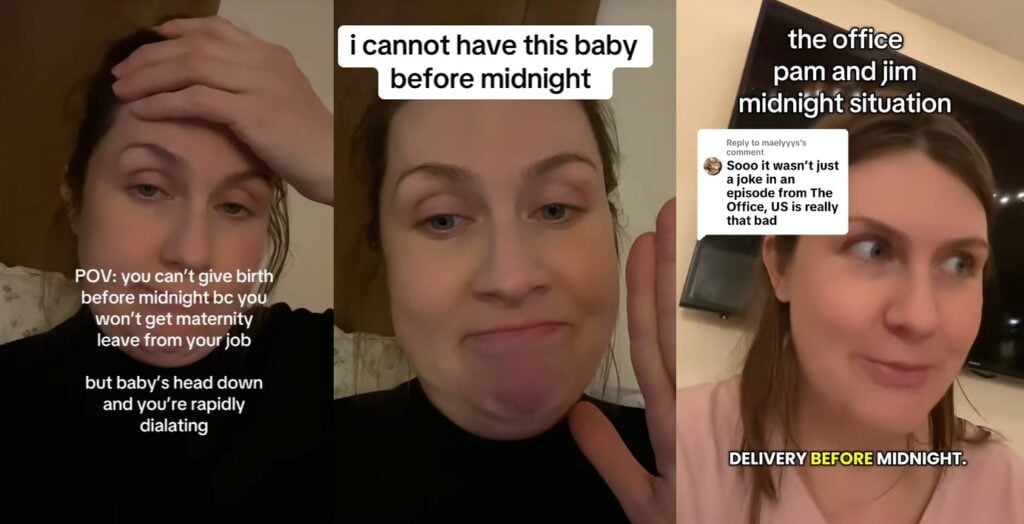
For one mom, it was labor progress vs. labor protections as she fought to hold back from giving birth for a few extra hours, in order to ensure that her job would be protected.
In the U.S., federal labor protections (that is, protections for workers) don’t kick in until the 12-month mark. That’s a firm, hard line. By contrast, due dates during pregnancy can change over time and are just a prediction, not a sure thing.
That’s why, when one mom realized that her baby was coming the day before her FMLA protections would kick in, she had to fight to hold on.
The Viral TikTok That Brought The Story Public
Al Sienkiewicz goes by the handle @tales_of_a_working_mama on TikTok, and that’s where she shared her story.
“I’m sitting here praying to the lord that I make it to midnight. I’m not even religious,” she said.
Here was the problem: it was December 9th, 2025, and she was in labor. She’d just been told at a prenatal appointment that she was already 4 centimeters dilated, and that it seemed things might progress quickly.
Unfortunately, at that point, she was one day short of a full year of employment at her new job, and the FMLA law would guarantee her 12 weeks of time off with her newborn, and ensure that her position (or an equivalent one) would still be hers at the end of that time.
Watch below to see how the mom, who already had a toddler son, described her situation as she hoped to hold the baby in until midnight.
Why Is FMLA Law Relevant?
The U.S. has relatively minimal protections for workers. Corporations can offer more paid leave, more job protection, and other benefits than the law requires, but the Family and Medical Leave Act (FMLA) sets the minimum requirements.
Sienkiewicz is also protected to a degree by New York’s employment law, which would guarantee her 6 weeks at 60% pay, even if she hadn’t met the one-year cutoff date. Other laws and protections are a patchwork across the country, and employee policy is a factor as well.
For Sienkiewicz, reaching the one-year mark meant she would receive 12 weeks at full pay, rather than 6 weeks at 60%. Many working moms will not receive pay for their leave, and this pressure still forces many back to work before they’ve even had 12 weeks postpartum for their bodies to heal and their bonding to begin.
In fact, a 2024 publication in the Maternal & Child Health Journal found that about 17% of moms return to work before the 6-week mark, and that those with lower incomes tend to have shorter leaves. Furthermore, it found a correlation between shorter leave times and less adequate postpartum care.
In The End, It Worked Out For This Mom
The viral TikTok mom made it. She shared an update later, in which she reported that she had arrived at the hospital at 3:15 am, and that her baby was born in less than an hour.
She didn’t name and shame her employer, though she does mention in another video that she works in retail. Since we don’t know the employer, we don’t know their policies or how they mesh with FMLA and New York worker protections.
It’s important to clearly establish that employers are not prevented from adopting policies that provide their workers with stronger protections. Corporations can choose to offer more leave than FMLA requires, better compensation, and more guarantees that a job will still be waiting upon return.
However, in practice, there’s very little protection for workers outside of the legal minimums.
What Can Moms-To-Be Take From This Situation?
First, if you’re trying to conceive, check your employment situation. This mom wasn’t due until more than a week after her one-year employment date, according to Newsweek, but her pregnancy progressed more quickly.
No one should have to delay getting pregnant for fear of losing their job, but currently, that could be a risk for those who change employment less than a year before giving birth. Check how FMLA applies to you (side note: if your employer has fewer than 50 employees, you may not be eligible for FMLA protections at all), and whether any additional state-level worker protections or company policies are relevant.
You can also reach out to your elected representatives and let them know that moms need stronger protections if they’re expected to balance work and family life.
