

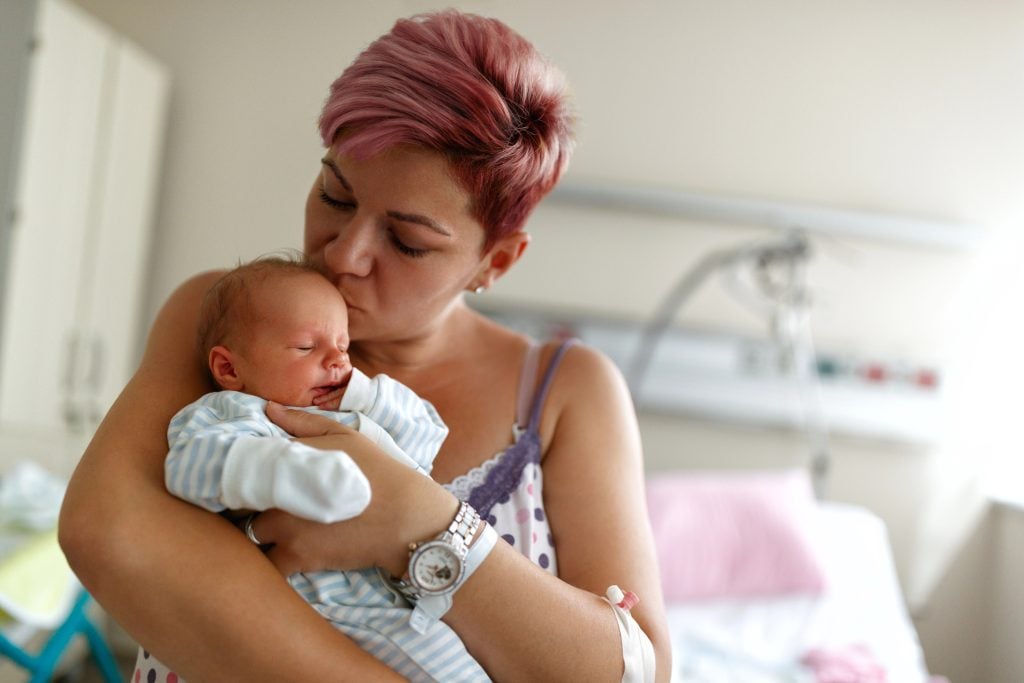
Specific policies and birth plans can vary, but in most typical hospital births, the newborn will be placed on mom’s chest for skin-to-skin within moments of birth. Baby will stay there for a while, then a provider will scoop him up for a handful of early checks and preventative treatments.
These include a physical exam, a heel prick for a drop of blood that will be screened for several conditions, eye ointment, a Hepatitis B shot, a hearing screening, and a Vitamin K shot.
However, an increasing number of parents are being swayed by health misinformation, and babies may suffer for it, as new statistics show more newborns are being denied that shot of Vitamin K.
Why Does The Vitamin K Shot Matter, Anyway?
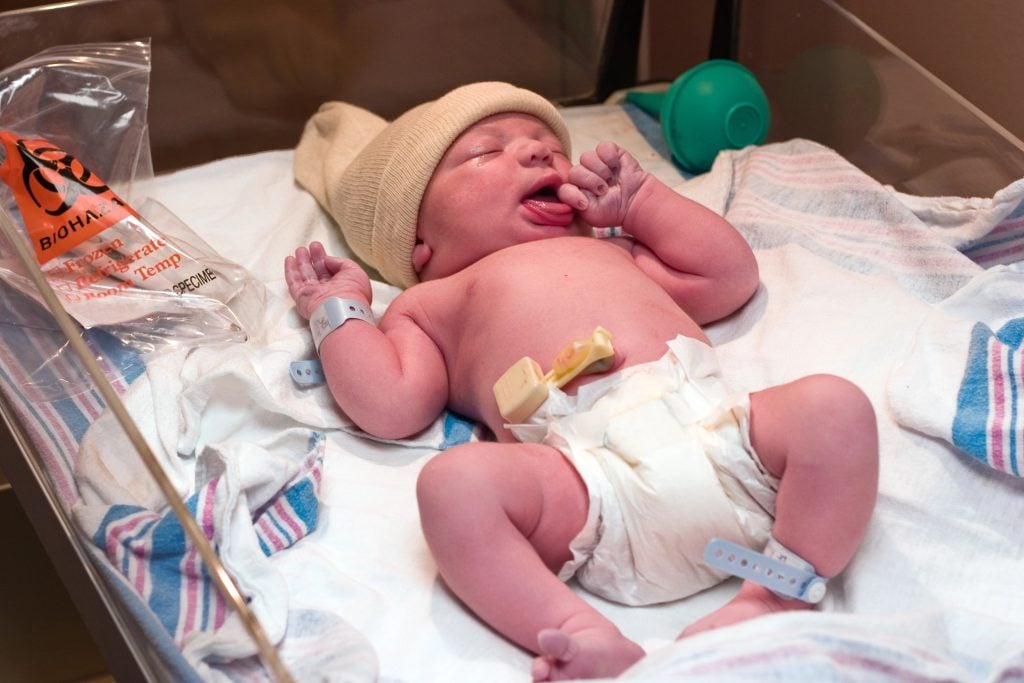
An injection of Vitamin K at birth has been a standard of care for newborns since 1961, when the American Academy of Pediatrics (AAP) first began recommending it, according to the CDC.
The body uses vitamin K for blood clotting, and when it’s insufficient, the risk of internal bleeding increases. Babies are not born with much Vitamin K because it’s not efficiently transferred from the mother during pregnancy, and because they don’t yet have the bacteria in their intestines that help produce it. They also may not get sufficient Vitamin K from breastmilk.
Babies who do not get the Vitamin K shot are at risk of Vitamin K deficiency bleeding (VKDB) for the first 6 months of their life, and there are often no warning signs that a parent can watch for to rush treatment. About half of babies who get VKDB will bleed into their brains, and without the Vitamin K shot, between 1 in 250 and 1 in 60 babies are likely to develop VKDB, according to the CDC’s statistics.
What Has Changed?
There have always been some babies who did not receive the shot, even though it has been recommended for generations. A parental rejection of the shot has been more common in non-hospital births, but in 2017, a National Institutes of Health team’s data shows that a percentage of babies born in hospitals (2.92%) were not given the Vitamin K shot.
Though the team didn’t assess the reasons these babies skipped the shot, it is offered as routine, so it can be presumed that parental refusal would be the primary reason a baby didn’t receive the treatment.
The concern, though, is that the ongoing statistics suggest more parents are refusing the Vitamin K shots for their newborns. By 2024, the same study found that 5.18% were not documented as receiving the shot.
Though the NIH acknowledges that the study did not document reasons, the researchers attribute the decrease in Vitamin K receipt to parental refusal, with Dr. Kristan Scott of the Children’s Hospital of Philadelphia, who led the study, expressing concern for the risk to babies.
“There may be a growing perception among parents that vitamin K is unnecessary,” Scott says. “Unfortunately, opting out of vitamin K for a newborn is akin to gambling with a child’s health, forgoing a straightforward and safe measure that effectively prevents severe complications.”
Why Are Parents Afraid Of A Vitamin K Shot?

There’s been a significant increase in anti-medicine rhetoric in recent years.
The anti-vax movement is growing, especially since COVID-19, and some parents who are also refusing necessary newborn vaccines may consider the Vitamin K shot to fall into the same category, although it is not a vaccine. Some parents even refuse the ointment that is routinely applied to newborns’ eyes after birth to prevent infection!
There was also one study decades ago (in 1990) that hinted at a possible tenuous association between the Vitamin K shot and some types of childhood cancer. When these associations appear in a study, researchers examine the data more closely to determine whether there is a genuine link. In this case, many more studies have found no actual connection between the Vitamin K shot and cancer, the CDC explains.
What Parents Should Take From This
There is a risk of serious bleeding that could cause permanent harm when babies do not receive the Vitamin K shot.
This could happen in as few as 1 baby out of every 250, or as many as 1 in every 60. Of those who do suffer bleeding (VKDB) from a Vitamin K deficiency, about half will have bleeding in their brains.
There can be some signs of VKDB to watch for, such as black stools and easy bruising, but for many babies who suffer VKDB, there will be no warning signs. This could happen at any point in the first six months of life.
The Vitamin K shot is considered safe and recommended for all babies. There is no evidence that it increases any risks or dangers; it only reduces the risk of serious bleeding.
If you think there may be a reason that your baby should not receive the Vitamin K shot, discuss it with your obstetrician and your pediatrician before birth, and with healthcare providers at the hospital. They can help to assuage any fears.
