

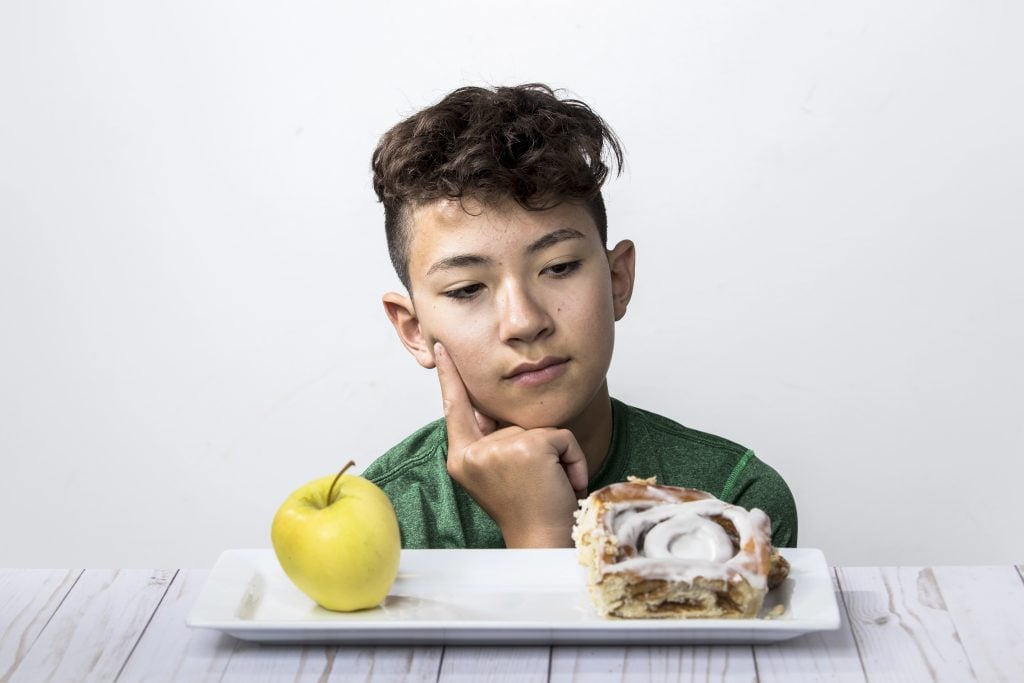
National Eating Disorder Awareness Week has begun, and it’s a good time for parents to check in with their kids about their body image and dietary habits.
Almost 3% of kids have diagnosable eating disorders during their teens. These have long been understood to be more common in girls, who can face heavy peer pressure about their appearance and body type, but eating disorders are becoming more common in boys, and may be easier to miss.
Here’s what parents should know about eating disorders in teen boys, and what to watch for.
Eating Disorders In Boys Are Becoming More Common

Eating disorders in children are on the rise overall, and particularly in boys. Experts have considered a variety of factors. Some possible causes for the increase include increased stress and anxiety in adolescents since COVID, shifts in social pressure, and, significantly, past underreporting.
This last factor is a big one, because it’s at least slightly less taboo now to admit to these problems, so it’s hard to get a real grasp on how many boys in the past suffered from eating disorders but went unnoticed, unsupported, and untreated.
One aspect of this is that some eating disorders. Like muscle dysmorphia, which the APA notes is sometimes called “bigorexia,” can be masked as “typical” boy behavior. It’s one of the few (by current statistics) eating disorders that affects more boys and men than women.
Though it’s a disorder because it goes to an extreme that interferes with health and well-being, muscle dysmorphia may appear to an outsider just to be a strong focus on physical fitness. However, sufferers develop “an obsession with muscle mass, size, and leanness” leading to “excessive and compulsive exercise/weight training.” Exercise is good (and we know that a lot of kids aren’t getting enough), but if it reaches the level of an obsession that is doing harm, it ceases to be a healthy choice.
Boys are also susceptible to the better-known eating disorders like anorexia nervosa and bulimia, and according to Child Mind Institute, there’s evidence that disordered eating is increasing more rapidly in boys than girls. Furthermore, since many programs are focused on girls, boys can feel uncomfortable seeking help.
What Should Parents Watch For?
Parents need to know that, regardless of gender, all children can be susceptible to eating disorders.
Watch for unusual behaviors around eating. This could include bingeing behaviors or excessive eating; hurrying to the bathroom during or after meals; refusing certain food groups (such as carbs); an obsession with “healthy” foods; or cutting food into tiny bites and moving it around a plate instead of eating.
It may also include new ‘rituals’ around eating; insistence on eating alone; a new obsession with nutrition information and calorie counting; or refusal to engage with events that include food.
This also may manifest in an increased focus on appearance and excessive exercise. Wanting to get fit is great, but if your son seems to take it to excess, have a talk with him and listen closely to what he shares.
Watch out for unrealistic goals and a negative self-image that don’t align with objective reality.
Further Symptoms To Watch For
The primary sign of an eating disorder may be disordered eating, but that’s not always easy to spot, especially if your teen is actively hiding it.
However, disordered eating can result in additional health problems, as the University of Utah Health enumerates.
Laxative abuse for weight loss may result in intestinal irritation and related symptoms. Kids with eating disorders can end up with severe dehydration, acid reflux, and other stomach problems.
Other effects of disordered eating can include weight loss, fatigue, depression, fainting, hair loss, and cold intolerance. Children’s Hospital of Boston lists these as some of the symptoms a doctor will ask about when assessing a child for an eating disorder.
Where Should Parents Start?

A review by several doctors in the Journal of Pediatrics suggests that preventing eating disorders starts in the first year of life.
They advise using food for nourishment, not as punishment or a salve for emotional distress. This aligns with current teaching that parents should not assign moral values to food, treat it as the answer to pain or hurt feelings, or use it as a punishment.
In this review, the doctors warn parents against pressuring a child to eat when he is not hungry.
“Infants should not be forced to eat when they refuse, nor should parents place undue emphasis on eating, especially when the child tends to show opposition. Parents, family, or caretakers thus play a decisive role in helping the child develop an appropriate sensitivity to the hunger impulse, so that he or she recognizes it as an accurate sensation.”
Shifting how we teach food associations to our children may make a generational difference. However, our kids get their messages about food, health, and body image from a variety of sources, not just us. We get to be the first messenger, but then peers, television, books, social media, and others in their lives will weigh in as well.
That means that all of the above can serve to reduce eating disorders in our children, but may not prevent them in a specific child.
What To Do If You See Signs Of An Eating Disorder
So, if your child is showing signs of an eating disorder, what can you do?
First, resist any urges to indulge in blame (of yourself, your child, his friends, or anyone else). Instead, have an honest discussion with your child about your concerns.
Plan to have the conversation privately and tell your child what you have observed. You might say, “I’m noticing that you don’t finish meals,” or “I see that you’re spending x hours per day exercising, but I don’t see you eating enough to support that kind of energy use.”
The National Eating Disorders Association has a parent toolkit for this talk!
You may be able to help your child at home, through honest discussion and support. However, if you’re not sure that you have the resources to handle it, your pediatrician can be the next step.
Most of all, make sure that you’re always focused on loving support. If you feel that you will get too frustrated and yell or snap, step away from the conversation and resume when you can do so calmly.
