

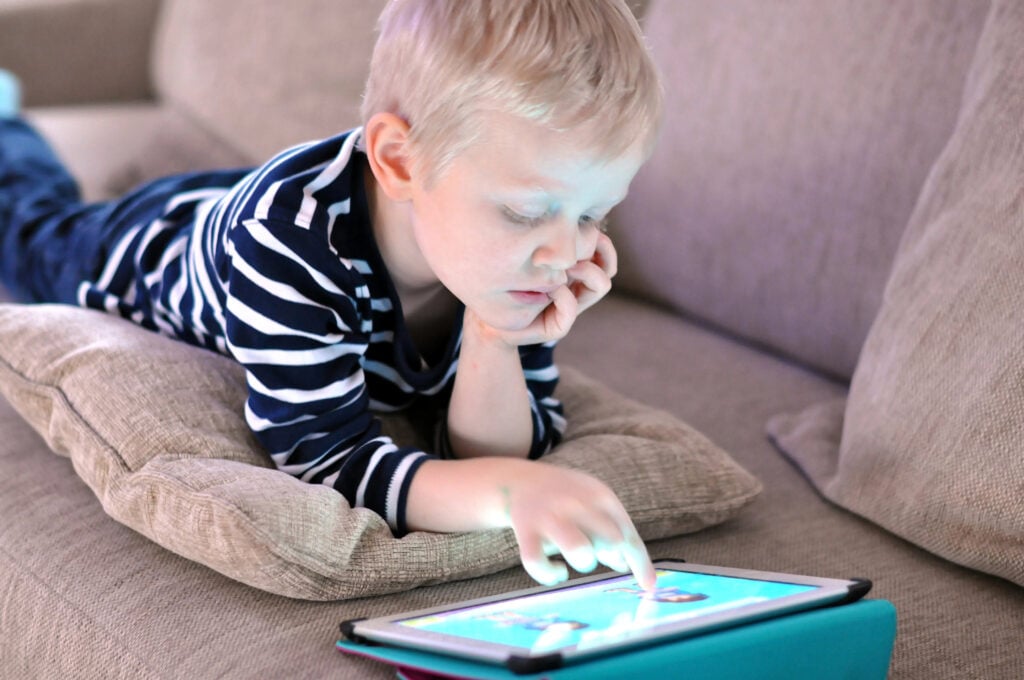
Parenting in the digital age means making a never-ending string of decisions about what screens and content to allow your child to access, and how much of it. We all know that too much screen time is harmful, that access to the wrong types of content can have lasting effects, and that missing some of the digital experiences their peers are having can leave kids out of the social loop.
Now, a new study adds an additional factor to bear in mind: your child’s language development.
Specifically, kids who are already struggling with language delays or deficits may need more consideration of how screen time is handled, and solitary screen time can complicate their progress.
Screen Time Can Vary Widely

As an experience, there are some differences between the many ways that one (adult or child) can engage with screens. There are educational materials, funny videos, propaganda for various viewpoints, video games, family movies, and so on.
As for adults, different types of media can have different effects on kids, and, it turns out, the way that they consume the media matters too. Specifically, for kids with language delays, solitary screen time can hinder their progress and lead to greater social, emotional, and behavioral difficulties.
Researchers believe that it may be as simple as screens robbing kids of the finite time available to make the connections that improve their language skills.
How Much Solitary Screen Time Does It Take To Show An Effect?
In the study, reported in News-Medical, as little as ten minutes of solitary screen time per day was enough to show harmful effects.
“Pathways from poor communication skills and low productive vocabulary to later adjustment problems were particularly strong among preschool- and kindergarten-aged children who averaged at least 10 to 30 minutes of solitary screen time per day across the course of a week.”
Struggles with language can lead to behavior problems, but this study is unique in showing that screens can exacerbate them, particularly by undermining the processes that help your child develop his speech and communication skills.
It’s important to note that this is specifically about solitary screen time, because that is time that your child misses out on social interactions.
How Do We Remove The Solitary Element?
If your child is watching Blue’s Clues, a parent present in the room adding in things like, “Oh! I see Blue! She was hiding behind the chair! Do you see?” can turn a passive experience into an active, social engagement.
Even simply being present and responding when your child wants to show you that her favorite Sesame Street character is having a jump-rope competition with a rock, or that the Paw Patrol characters are in another sticky situation, encourages communication and social interaction.
If your child is playing a game, having a sibling or friend play cooperatively and discuss the processes might fill this role as well, as could regular questions from a parent. (“Oh! I saw your character jump! Where are you supposed to go next?”)
Bear in mind that this study, at least, points to the loss of social interaction rather than the screen time itself as driving the negative effects.
Why Are Speech Delays & Behavioral Problems Linked, Anyway?

There are likely a few reasons that speech difficulties can lead to behavioral expression.
The first is the simplest. Being unable to express oneself is very frustrating! Imagine if, as an adult, every time you tried to say, “Can I have a coffee?” someone handed you a juice instead, and when you tried to express, “My sock is turned weird and the seam is hurting my toe,” people responded by putting you to bed, offering you some milk, or trying to get you to play patty-cake!
It wouldn’t take long to become frustrated, and especially in a situation where you couldn’t fix the problem yourself, you might snap.
The other, child behaviorists believe, is related to an internal monologue. That’s the conversation you have in your head, when you think, “I’m so aggravated with this cell phone not charging, I’d like to throw it against the wall,” and then reply to yourself, “…but I can’t afford to replace it, and don’t want to show my kids that kind of behavior, so I’m going to put it down and walk away for a moment instead.”
For a child without adequate language skills, behaviorists believe this inner monologue may be missing, Expressable explains.
“For example, if a child with a language delay is told not to touch the TV, they have to process that information and inhibit their natural response–which is likely to go ahead and touch the TV! A child should be able to use their internal monologue to inhibit this response and make the right choice. A child with a language delay may be more impulsive and lack the comprehension needed to follow the direction.”
How Can We Help Our Kids Develop Language Skills?
Limiting screen time, especially solitary screen time, is one step parents can take to help kids develop language skills. When your kids do engage with screens, mindful choices around their time limits, content types, and engagement patterns can also help.
Exposing your kids to lots of talking is great for language development.
Narrate the world around them. Point out the birds and talk about the color of their feathers, the sounds they make, and what it might be like to fly.
Talk about processes and plans. Say, “We’ve got to go to the store, so we’ll get your shoes on. You like the red shoes? Let’s put on your red shoes. One, two. Now we can get in the car. See our blue car? I’ll open your door. Up, up, up! Let’s get fastened!” and so on.
Listen to your child’s talk, even if it’s unclear or hard to understand, and respond.
Give opportunities for expression. Maybe your child can’t say “juice” or “milk” clearly yet, but if you show him both containers, he can express himself by pointing.
If you think your child is struggling with communication or is experiencing delays, never hesitate to discuss it with your pediatrician and move forward with speech therapy if necessary!
