

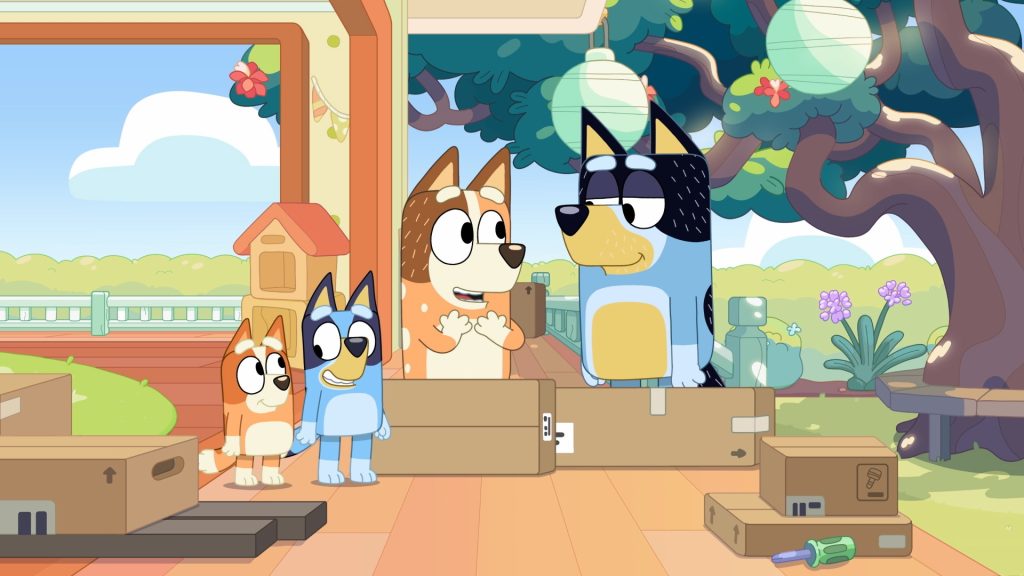
The beloved Australian animated series Bluey remains the gold standard in children’s television, appealing to young viewers and parents alike.
Despite having no new episodes, the seemingly unstoppable kids animated series ‘Bluey’ continues to dominate the streaming charts. According to ScreenRant, “Bluey has still beaten the series to the top spot in the streaming charts,” outperforming major new releases like Disney+’s X-Men ’97. Its universal appeal has made it a global phenomenon, routinely logging hundreds of millions of streaming minutes.
Bluey Doesn’t Talk Down To Kids or Parents
As anyone who’s spent time with the Heeler family knows, ‘Bluey’ stands out because it treats complex childhood issues with actual emotional maturity rather than trivializing them. An academic study published in the Educational and Developmental Psychologist analyzed the show’s seasons and found that nearly half of the episodes (48.7%) featured resilience as a primary or secondary theme. The show beautifully iteaches children internal confidence and problem-solving skills through creative play.
Rather than spelling out moral lessons, the show uses subtle storytelling that respects its audience’s intelligence. As Associate Professor Meryl Alper notes on Northeastern University’s College of Social Sciences and Humanities blog, “it operates on two levels where there’s jokes that are definitely for parents and there’s jokes that are very easy for kids to get.”
Parents Can Benefit From Bandit and Chilli’s Approach
The show is just as much of a resource for parents as it is entertainment for children. Research indicates that parents serve as the primary facilitators of resilience in 64.4% of the show’s resilience-building storylines, with Bluey’s mother, Chilli, leading the way. By modeling adaptive coping behaviors and active play, the parent characters, Chilli and Bandit, show real-world caregivers how to navigate daily stressors. This dynamic supports co-viewing, allowing parents to watch alongside their children and adopt the same gentle, play-based parenting strategies at home.
One of the best ways to understand kids is to engage with them regarding the media the consume. A 2013 study from the Journal of Education and Practice highlights what an excellent resource cartoons in general can be for parents.
“Parents should try to engage children in more interactive and family activities.” The study continues, “They should watch the animated cartoons their children watch or preview them, use it as an opportunity to discuss inappropriate material or unacceptable behaviour or lifestyle.”
‘Bluey’s’ dominance over the Kids TV landscape doesn’t look like it’s letting up any time soon, so spending some time with the Heeler’s seems like a great way for parents and kids alike to bond and share a laugh.

