

Viral Toddler’s Love of a Baby Doll Highlights Changing Attitudes Toward Play
When Pennsylvania mom Mary bought her three-year-old son Sylas a baby doll, she never expected the videos of him caring for it to attract millions of views online. Yet the heartwarming clips of Sylas feeding, bathing, and nurturing his doll resonated with parents around the world and sparked conversations about why toys should not be limited by gender stereotypes.
In a Sunday, July 19 interview about her son’s play, Mary told Good Morning America, “He’s learning so much more than just like playing with a baby [doll]. He’s learning a lot of self-help skills. He’s working on his own emotions and trying to communicate more.”
As anyone who’s visited a toy store knows, dolls have often been marketed primarily to girls, while boys were encouraged toward vehicles, action figures, or construction toys. Child-development experts, however, say those traditional assumptions are increasingly outdated and unsupported by research.
According to the National Association for the Education of Young Children (NAEYC), gender-typed toys can unnecessarily limit children’s opportunities to develop a wide range of skills. The organization encourages parents and educators to offer children diverse play experiences rather than steering them toward toys based solely on gender expectations.
What Children Learn From Playing With Dolls
A study conducted by researchers at Cardiff University found that playing with dolls increased children’s use of language associated with thinking about others’ emotions and perspectives. Researchers concluded that doll play helps children practice social processing skills that are important for empathy and understanding relationships. The study’s lead researchers noted that doll play encourages children to think about other people’s feelings even when they are playing alone.
Scientific research published in Frontiers in Human Neuroscience reached similar conclusions. The study found that doll play activated brain regions associated with social information processing, suggesting that children use dolls to rehearse social interactions and develop interpersonal understanding.
These findings help explain why children naturally use dolls to act out caregiving, friendship, conflict resolution, and everyday family situations.
Why Parents Shouldn’t Feel Embarrassed
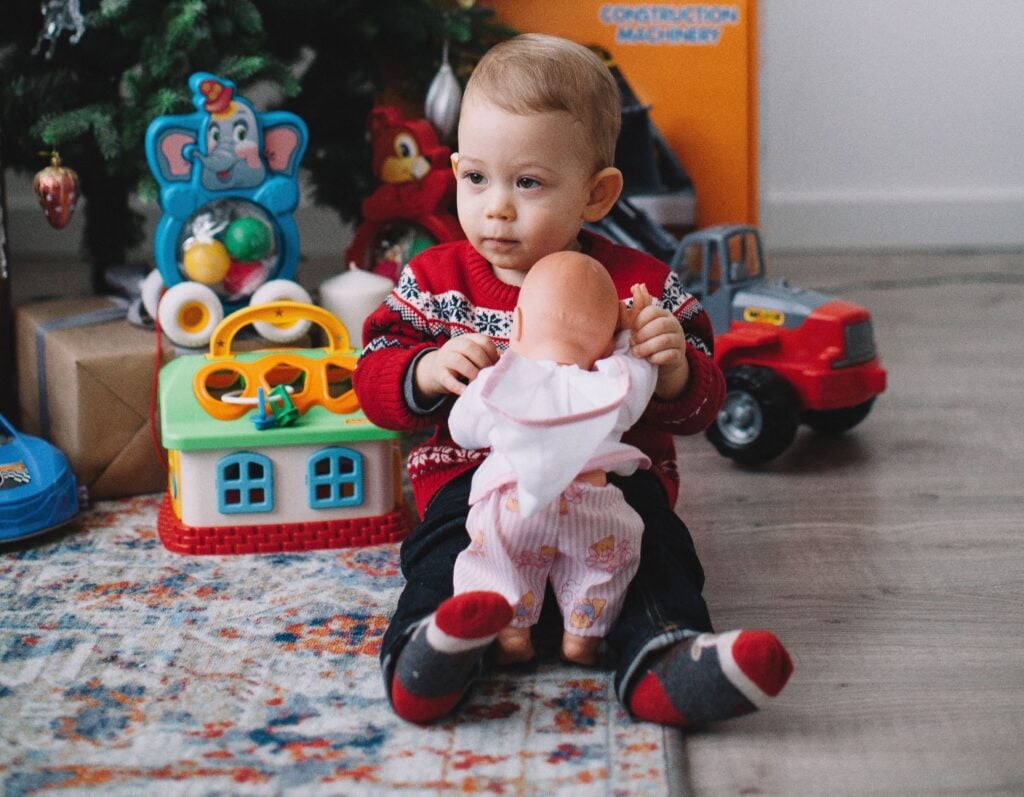
Mary hopes her son’s viral moment helps challenge those attitudes, saying “Boys deserve to learn how to nurture and love at a young age, just like girls.” However, even in searching for images to use in this article, it was difficult to find a boy playing with a doll. This shows that even in 2026 we are still hung up on these toy/gender sterotypes.
It would be difficult to find a parent that doesn’t agree that nurturing skills are valuable for all kids, regardless of gender. Empathy, communication, emotional regulation, cooperation, and caregiving are qualities that benefit children throughout their lives, whether they become parents, teachers, healthcare workers, friends, or partners.
Ultimately, dolls (any any toy for that matter) don’t have to be “girls’ toys” or “boys’ toys”—they are tools for imaginative play and it’s adults who put these labels on the toys. As research continues to show, children gain the most when they are free to explore a variety of toys and interests without being constrained by outdated ideas about what boys and girls are supposed to play with. By focusing on the skills children develop rather than the labels attached to toys, parents can support healthier, more confident, and more empathetic kids.

