

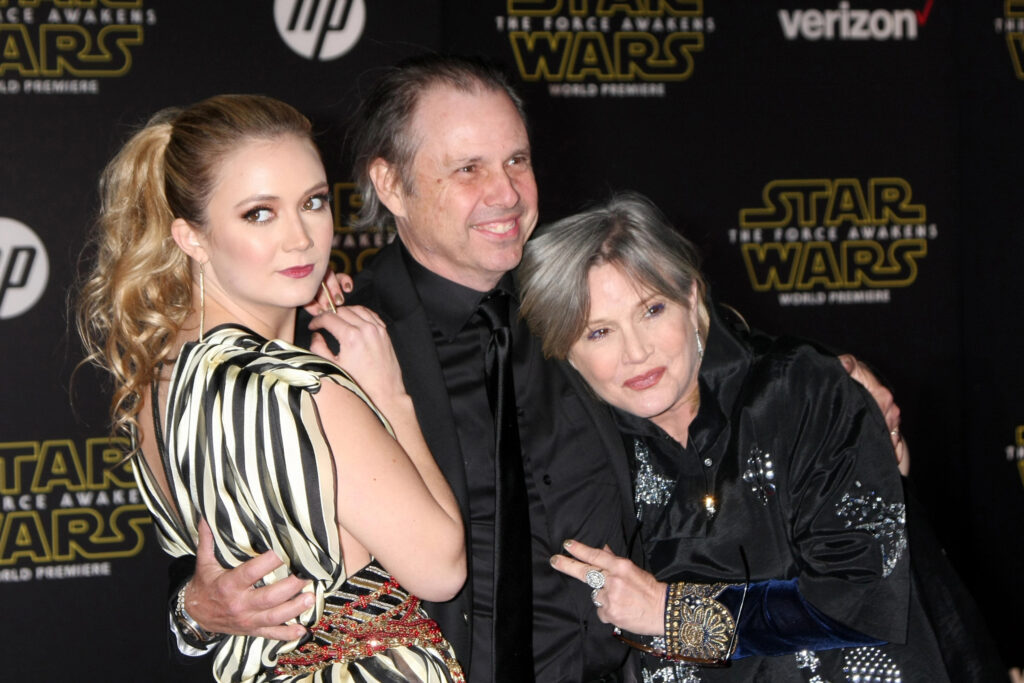
On May 4, 2026, Billie Lourd turned Star Wars Day into something far more personal than a pop culture holiday, posting an Instagram photo of her two young children sitting together to watch their late grandmother Carrie Fisher make her legendary entrance as Princess Leia in the 1977 original film.
The image, quiet and intimate, carries enormous weight. Fisher died in December 2016 at age 60, and Lourd has spent nearly a decade finding ways to make sure her children grow up knowing who their grandmother was — not just as a cultural icon, but as a person.
A Family Ritual Built Around Remembrance
Lourd’s son Kingston, 5, and daughter Jackson, 3, were the subjects of the photo she shared with followers, captured during one of Fisher’s earliest scenes in ‘Star Wars: A New Hope’ as the film played on their television. Lourd, 33, wrote her caption entirely in emojis, spelling out “May the 4th,” a playful nod to the franchise’s beloved catchphrase. She shares both children with her husband, actor Austen Rydell.
This is not a one-time gesture. Last year, Lourd posted a nearly identical photo of Kingston and Jackson watching Fisher in 1983’s ‘Return of the Jedi,’ with the same emoji-capped caption. The pattern reveals something deliberate: Lourd is methodically walking her children through their grandmother’s filmography, one Star Wars Day at a time.
Entertainment Weekly reported that Lourd described watching the films with her children as bringing her profound personal joy, a sentiment she expressed directly in her Instagram caption accompanying the post.
Keeping Fisher’s Memory Alive Year-Round
Star Wars Day is just one of several moments throughout the year when Lourd publicly honors her mother. She marks Fisher’s birthday each October and the anniversary of her death each December with social media posts that blend grief, humor, and gratitude — qualities Fisher herself embodied throughout her life.
In December 2025, nine years after Fisher’s passing, Lourd shared a childhood photo of herself with her mother and her father, Hollywood talent agent Bryan Lourd. In the caption, she wrote to People, “It has been 9 years since my mom died. My daughter woke up earlier than usual this morning, so we went outside together, and she knowingly lay her little head on my chest.” She continued, “She looked up at me with her big soulful eyes and said ‘I love you mama’ and grabbed my face with her little chubby hands and kissed me. She does this pretty much every morning, and dare I say, there is no better way to wake up and no ritual I love more. I told her how much her grandmomby would have loved her and she looked up at me and kissed me again.”
The previous October, marking what would have been Fisher’s 69th birthday, Lourd wrote on Instagram, “She was a brilliant magical human and I want them to know that. So despite the many emotions I have on these days I try to celebrate the good parts. I’ll tell my kids funny stories about her, watch one of her movies, eat one of her favorite foods, have a Coke with a shit ton of ice. Grief is a weird soup of feelings, and there are a lot of ingredients in it that are hard to swallow, but ultimately I think the soup has made me healthier — more cognizant of how short life is and more appreciative of all the happiness in my life.”
Who Carrie Fisher Was Beyond The Galaxy
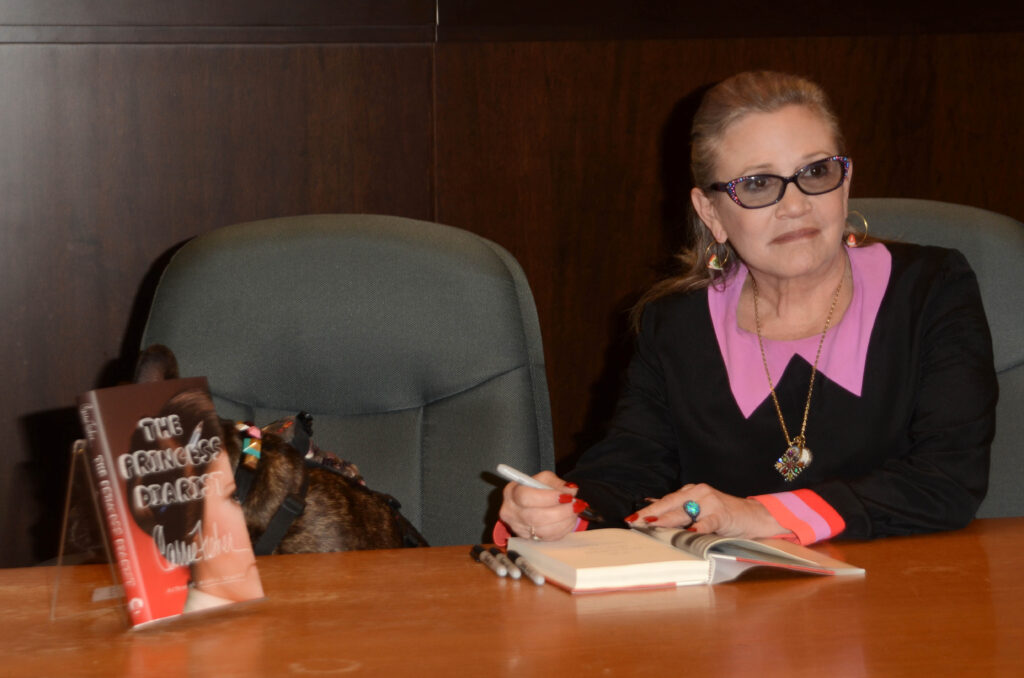
For Kingston and Jackson, their grandmother is the woman on the screen in a white robe with her hair in buns. But Fisher’s life and career extended far beyond the Star Wars universe in ways that make her legacy genuinely remarkable. Born in Los Angeles on October 21, 1956, to singer Eddie Fisher and actress Debbie Reynolds, she was raised within the orbit of Hollywood stardom, first stepping onto a Broadway stage in 1973 when she joined her mother in a revival production, then transitioning to film with ‘Shampoo’ in 1975.
As People notes, the role of Princess Leia Organa, the character who made Fisher a household name in the original trilogy, was just the beginning. She reprised the role in ‘The Empire Strikes Back’ in 1980, ‘Return of the Jedi’ in 1983, and ‘The Force Awakens’ in 2015. After her death, she appeared posthumously in ‘The Last Jedi’ in 2017, and archival footage was used in ‘The Rise of Skywalker’ in 2019. Beyond the franchise, Fisher built a substantial body of work across comedy and drama, appearing in films including ‘The Blues Brothers,’ ‘Hannah and Her Sisters,’ and ‘When Harry Met Sally…’
Fisher was also a celebrated author whose 1987 novel ‘Postcards from the Edge,’ drawn from her own experiences with addiction and life as the daughter of a famous actress, earned wide critical praise. She wrote the screenplay for the 1990 film adaptation starring Meryl Streep. Her one-woman show ‘Wishful Drinking’ moved from Los Angeles to Broadway in 2009, and the companion autobiography became a bestseller.
She was also a sought-after script doctor throughout the 1990s and beyond, quietly shaping films audiences never knew she touched. Her candor about living with bipolar disorder made her a meaningful voice in conversations about mental health long before such openness was common in Hollywood.
Fisher died on December 27, 2016, after suffering a medical emergency aboard a transatlantic flight. Her mother, Debbie Reynolds, passed away from a stroke at 84 just one day afterward. The two losses, arriving within 24 hours of each other, stunned the entertainment world.
A Mother And Daughter On Screen Together
There is an added layer to Lourd’s annual Star Wars viewings that makes them especially poignant: she and her mother actually shared the screen in the sequel trilogy. Lourd played Lieutenant Connix in all three new films alongside Daisy Ridley and Adam Driver, meaning Kingston and Jackson can one day watch their mother and grandmother act together in the same franchise.
What Lourd is doing, intentionally, annually, joyfully, is something many parents navigating loss quietly wrestle with: how do you make a person real to children who never got to meet them? Lourd’s approach is straightforward and deeply human. She uses the films, the stories, the food, the rituals. She talks about Fisher with humor and honesty. She lets grief and celebration exist in the same space.
For any parent or caregiver helping a child understand loss, there is something instructive in watching a 33-year-old woman sit her toddlers down in front of a 1977 science fiction film and say, in effect: this is where she lives now, and she is worth knowing.
As Kingston and Jackson grow older, those annual May 4th viewings will add up to something larger than movie nights. They will become the foundation of a relationship with a grandmother they never met, one who, as Lourd has said, was a brilliant, magical human worth celebrating.

