

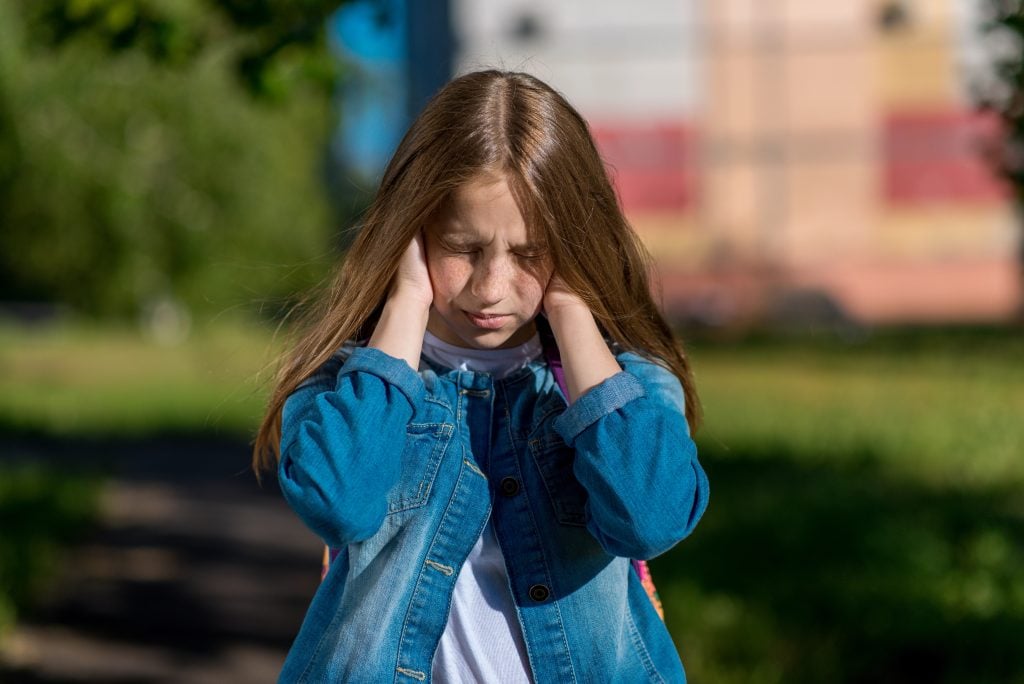
Has your child ever had a meltdown because public restrooms, with their hand dryers and auto-flush toilets, are just too loud? Or maybe you have a kid who covers his ears in the grocery store, or cries at the annual Christmas parade, because it’s just too loud for him.
It’s easy to write it off as an overreaction or as something your child will grow out of. In fact, it may be something that disturbs him less as he grows, but the reasons are more complex than simple maturation.
In fact, if your kid is routinely becoming more upset than seems reasonable at environmental noise, there may be a good reason.
First Of All, The World Is Dangerously Loud, Especially At Kid Height
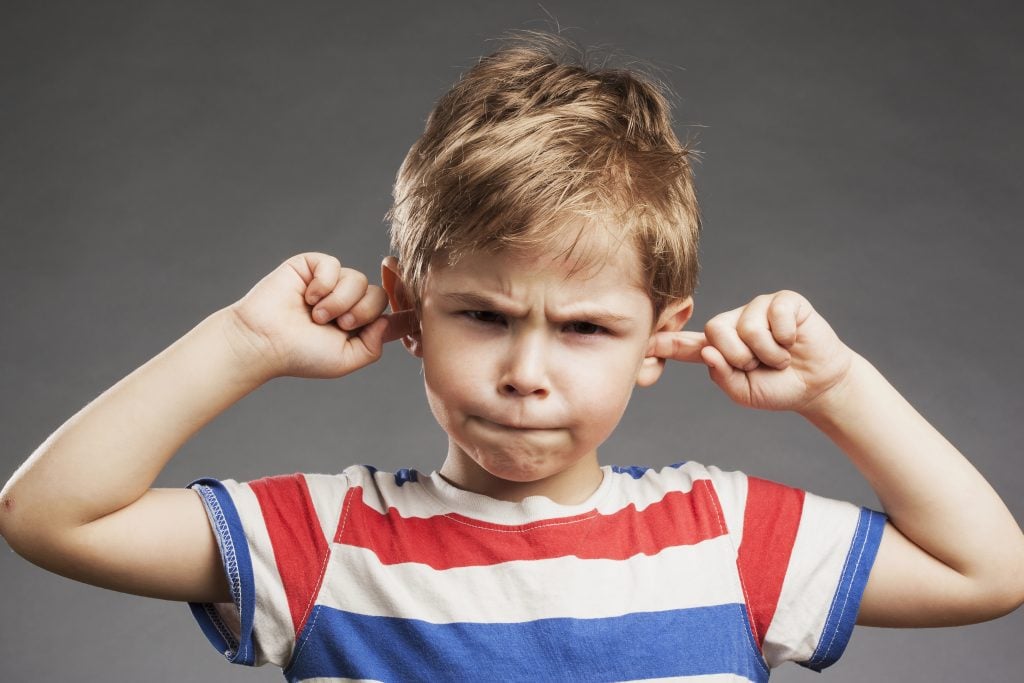
Back in 2019, 13-year-old Nora Keegan decided to investigate why her classmates so often seemed to flee the bathroom and cover their ears when the hand dryers were on.
Although the CALM Act sets decibel limits for toys, consumer electronics, broadcast television, and many other products, Keegan discovered that many of these hand dryers exceeded safe levels, NPR reported.
“She discovered that Xlerator hand dryers and two types of Dyson Airblade hand dryers posed the greatest threats to children’s hearing. These types all exceed 100 decibels — a volume that can lead to “learning disabilities, attention difficulties, and ruptured ear drums,” according to the study.”
One important factor: Keegan measured sound levels at a child’s ear height, much closer to the dryer than an adult’s ears.
Oh, and yes, the Hearing Health Foundation warns that sounds over 70 decibels can be harmful to the ears over time. The organization warns that 85 decibels is the maximum “safe level” over the course of an 8-hour workday, and that for kids, whose auditory systems are still developing, that’s also too much.
It’s Not Just Dryers
In public restrooms, kids can be made extremely uncomfortable by the sudden, unexpected loud sounds of automatic-flush toilets (which are also much closer to a kid’s ear level than an adult’s). With those, it’s not just the volume; it’s also the fact that they can go off unexpectedly, especially when a small child’s body doesn’t fully block the electronic eye that operates the mechanism.
A lot of other everyday noises are also closer to a child’s ear than to an adult’s: the vacuum cleaner, the dishwasher, a car or motorcycle idling or passing, a dog barking, and, often, the speakers associated with televisions and stereo systems.
Add it all up, and kids can end up exposed to much louder versions of the daily noise pollution than adults are, even though it’s the ones whose safety could depend on even lower exposure.
Noisy Spaces Add To Kids’ Stress
Most of us struggle to concentrate in a room with a complex assortment of sounds.
When the television is on, the air conditioning is running loudly, one kid is running laps around the living room, and another is reciting the plot lines of his top five favorite video games, it can be difficult to concentrate on the email from your child’s teacher you’re trying to read. If imagining that scenario was enough to raise your blood pressure, you may be horrified to learn that it’s even more intense for kids, according to a 2024 study published in Scientific Reports.
The study compared age groups and found that completing a simple task in a noisy environment was hard for all age groups, but especially for younger children compared to older kids and young adults.
In short, performing simple daily tasks can be harder in the presence of excess noise, especially for children.
Sound Sensitivity & Anxiety
In addition to the detrimental effects of sudden, excessive, or complex noises for all kids, some kids are simply more sensitive to sounds than the average.
This can be for a wide range of reasons, including anxiety disorders, autism, and other neurodivergencies(has your kid mentioned that he can hear the kitchen light? He’s not making it up), or physical problems that may need to be addressed.
If you notice that your child is more sensitive to sound than his peers, or that he seems more sensitive than you feel is typical, it’s worth checking with your pediatrician.
That said, the world is increasingly taking steps to make life more tolerable with sound sensitivity. Check whether your local Christmas parade has sensory-friendly options (ours turns off sirens, flashing lights, and other noises for a certain stretch of the festivities). Some stores are also offering sensory-friendly shopping periods, with less noise and dimmer lights. There is also a range of noise-reduction and ear protection products being expanded for kids.
Don’t Overlook Self-Imposed Noise Levels
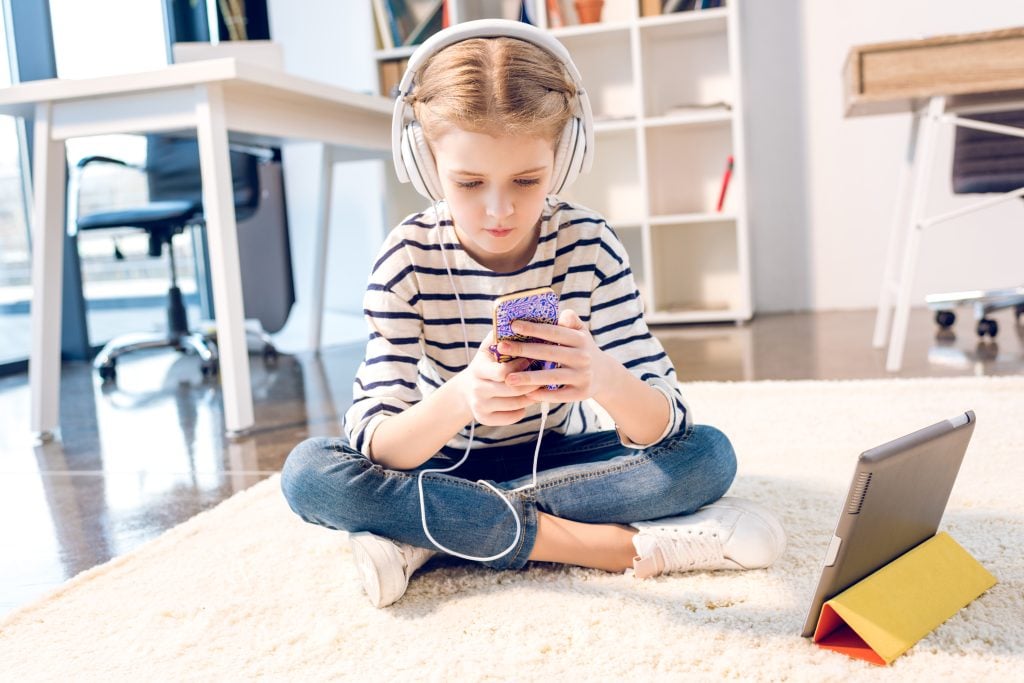
Your child may not be annoyed by sounds that he exposes himself to, even when they’re loud enough to be dangerous.
Wearing headphones and turning the volume up enough to shut out everything else can be soothing for some children (and, yes, adults). However, the Hearing Health Foundation also notes that if you can hear sounds from someone else’s headphones, they’re at least 85 decibels, and, as previously mentioned, that’s not safe for children.
Your child may not notice that these chosen sounds are also causing harm, so as a parent, you may want to adjust the maximum volume on their devices and/or have a conversation about safe sound levels.
How Much Harm Are We Talking About?
Okay, the one time you made your child stay in the bathroom while the toilet flushed and you dried your hands probably isn’t doing any measurable harm, or at least, not that has been explicitly proven at this point.
However, the CDC reports that about 1 in 8 kids (12.5%) has permanent hearing damage from noise exposure.
The federal public health agency recommends limiting your child’s exposure to loud noises and, when unavoidable, keeping them as far from the source as possible.
They also advise parents to provide their children with ear protection when they will be exposed to extremely loud sounds or to relatively loud sounds for prolonged periods.
Finally, because this one bears repeating, the CDC reminds us to turn down the stereo volume and limit headphone volume.
If you think your child may have hearing loss due to noise exposure, check in with your pediatrician.
