

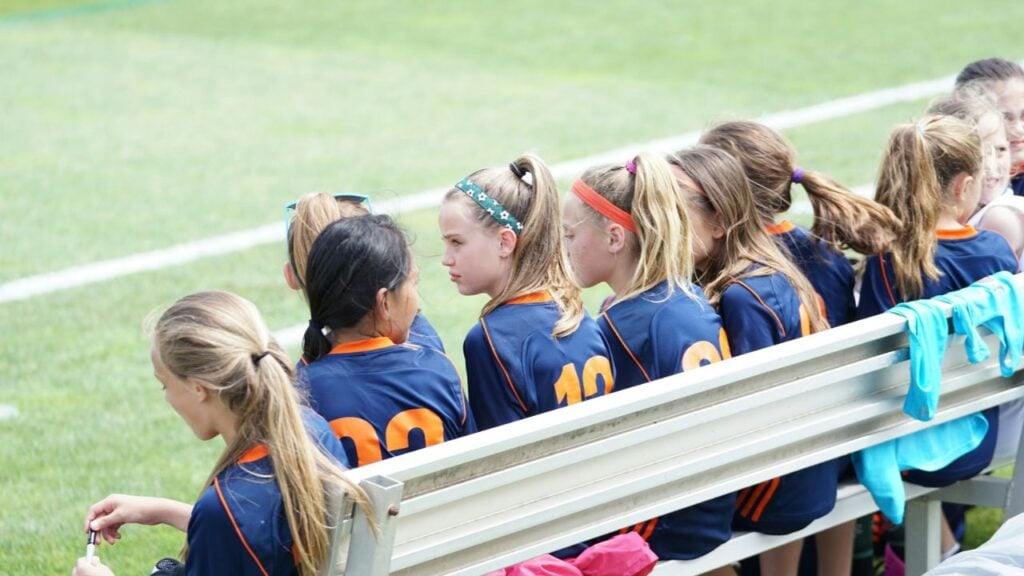
A new study has revealed that a direct blow to the middle of the head may be a better warning sign for concussion.
The research appeared Monday in the Annals of Biomedical Engineering. Its authors, based in the U.S. and Australia, followed 203 male and female athletes through about 3,800 impacts.
How They Tracked the Hits

Every athlete wore a mouthguard that contained a motion sensor. The sensors recorded the impact’s force and direction. The impacts were captured on camera and the researchers later watched the footage.
There were 47 concussions found. Instead of the off-center, twisting type that has garnered the most attention, several followed blows to the center of the skull.
Imagine a strike to the top of the head, a backward tumble that results in the head hitting the ground or two players colliding forehead to forehead.

The authors emphasized that concussions can still result from rotating strikes. The study reportedly made no other claims.
The study found that many American football helmets have a slick inner liner designed to reduce spin. The idea that twisting forces cause the most harm gave rise to such a design.
Additionally, the group evaluated helmets with fluid-filled cushions. Those helmets were associated with fewer concussions than regular ones when an impact struck the middle of the head.
What a Doctor Makes of It

Dr. Christine Greiss, who had no part in the research, said the results add useful but preliminary evidence. Rotation alone, she said, shouldn’t be treated as the main driver of risk. She is medical director at the Center for Brain Injuries at Hackensack Meridian JFK Johnson Rehabilitation Institute in New Jersey.
Greiss said many doctors used to see center-of-the-head hits as the least harmful kind. She no longer thinks that’s safe to assume. She revealed that more work is needed before the findings shape treatment, but patients need careful screening now.
“Prompt recognition and assessment are essential,” Greiss said.
This study came after a different examination of chronic traumatic encephalopathy, or CTE, a brain condition linked to repeated head trauma, earlier this year. 2,362 deceased former NFL players were reportedly included in that analysis. 93.5 percent of the 396 people whose brains were donated had CTE.
Researchers modified the numbers and estimated 74.5 percent for the entire group because brain donors might not all have been gamers. Per the analysis, about one in four former players acquired dementia at some time in their lives.

