

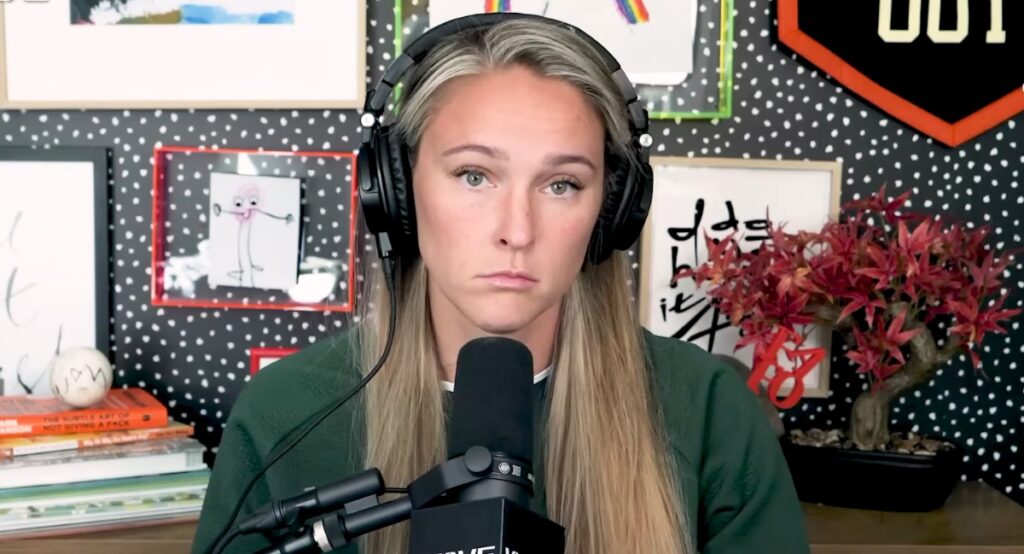
The NFL wife’s candid response to unwanted commentary on her family size is a masterclass in tuning out the noise.
Kylie Kelce, wife of NFL star Jason Kelce, has four daughters and apparently just as many opinions from strangers and loved ones about her reproductive choices.
In a candid moment that quickly resonated with parents everywhere, she revealed the negative commentary she received each time she and Jason announced a new pregnancy, and her response was as direct as it was refreshing: she told the critics, including, as she joked, her own uterus, to mind their own business.
The Rude Reactions Kylie Kelce Faced
Pregnancy announcements are supposed to be joyful. For Kylie, they came with a side of unsolicited opinions about her family size, her choices, and whether another child was a good idea.
She spoke candidly about the criticism she faced with each new pregnancy, making clear that the commentary was neither welcome nor warranted. Her willingness to name the experience publicly gave language to something millions of parents quietly endure.
What makes Kylie’s story so relatable is not just the rudeness itself, but the fact that it came repeatedly, announcement after announcement. For parents who have navigated similar moments, whether around family size, feeding choices, discipline styles, or any number of deeply personal decisions, her experience hits close to home.
You Are Not Alone: How Common Is Parenting Judgment?

If you have ever felt like your parenting decisions were under a microscope, the data backs you up. According to research cited by Connected Families, a survey of parents of toddlers found that nearly 9 in 10 parents feel judged for their choices, with 90 percent of moms and 85 percent of dads reporting that experience.
Nearly half of those parents said they feel judged all the time or nearly all the time. A separate New York Times-cited study of 475 mothers of children up to age five found that 61 percent felt they had been judged, with most of that criticism coming from within their own families.
That last detail matters. The harshest commentary often does not come from strangers on the internet. It comes from the people sitting across the Thanksgiving table, the relatives who love you and your children but cannot seem to resist weighing in on how you are raising them.
Why Unsolicited Advice Stings So Much
There is a psychological reason unwanted opinions feel so grating, even when they come from a place of genuine concern. Writing in Psychology Today, researcher Peter Gray explains that unsolicited advice triggers our instinct to protect our autonomy.
When someone tells you what to do, even politely, it can register as criticism, a power play, or a signal that the advice-giver does not trust your judgment. The sting is often sharpest when it comes from loved ones, because the desire to please them conflicts directly with the desire to assert your independence as a capable adult and parent.
Gray notes that an internet poll found 56 percent of respondents said they generally dislike unsolicited advice, with another 38 percent saying they only welcome it from the right person, at the right time, delivered in the right way.
That leaves a very narrow window for advice to actually land well, and most well-meaning relatives are not threading that needle.
The frustration compounds when the advice concerns something as personal as how many children you choose to have, or how you choose to parent the ones you already have. These are not neutral topics. They touch on identity, values, and deeply held beliefs about family, which is exactly why commentary in these areas can feel so invasive.
Practical Ways To Handle The Criticism
So what do you actually do when a relative cannot stop offering their take on your parenting? Experts at Connected Families suggest a few approaches that balance firmness with grace. One strategy is to respond with a question rather than a defense.
A coaching client named Denise described using this tactic after hearing particularly harsh criticism about her child: she would ask, “Tell me how? How exactly would you have handled that?”
She found it gave critics pause, created space for her to breathe, and shifted the dynamic without escalating into conflict.
Another approach is to lead with empathy before setting a boundary. Acknowledging that a relative means well, and even affirming something they do right, can lower the temperature enough to have a real conversation.
Something like, “I know you care about our kids and want the best for them,” followed by a clear statement of your own approach, tends to land better than a direct pushback.
Preparing your children for the reality that not everyone will agree with your parenting style is also worth considering.
Connected Families recommends framing it as a learning opportunity rather than a threat, helping kids understand that people who love them can still sometimes speak to them in ways that feel harsh, and that their worth is not determined by those moments.
And sometimes, the most powerful move is the simplest one: decide in advance how you will respond, practice it with your partner, and then hold your ground with confidence. Kylie Kelce essentially modeled this. She did not spiral. She did not second-guess herself. She drew a line and kept moving.
It’s Ok To Be Frustrated
Kylie Kelce is not the first public figure to push back on commentary about her family size, and she will not be the last.
But her willingness to name the experience plainly, and with humor, does something useful for parents who have absorbed similar criticism in silence. It normalizes the frustration and gives permission to stop performing gratitude for advice that was never asked for.
Whether you have two kids or four, whether you are announcing your first pregnancy or your fifth, your reproductive and parenting choices belong to you. The noise from the outside is just that: noise.

