



My grandmother had a plaque in her house that read, “A woman’s place is in the home, and she should go there directly after work.”
I’m not sure that sentiment was the most popular view in the 1920s and 1930s when she was growing up, but in her young adulthood, as the men of this country went off to war, millions of women who had previously stayed home joined the workforce. Today, a vast majority of moms with children under age 18 are employed, and there’s increasing demand for labor policies that reflect and support this.
In fact, despite a dip during COVID, more moms are working now than ever, and the search for work/family/life balance is ongoing.
More Moms Than Dads Left The Workforce In 2020

In 2020, as schools and daycares shut down, the workforce shifted as well. In families with younger children, one parent was often obligated to leave their job entirely, reduce their hours, or take on more remote work so someone could be home with the kids.
In most cases, the parent to do so was the mother. There are multiple reasons for this, including societal adherence to gender roles, women’s prominent place in industries that shut down during the pandemic, and the fact that women are still (on average) paid less than men. The U.S. Census showed that at least 1.4 million more women were out of work in January of 2021 than a year prior.
In fact, the data showed that about a third of moms with school-aged children were out of work.
Moms With Younger Children Are Also Back To Work
Statistics from the Department of Labor showed that by 2024, moms were back at work, even with very young children. The stats show not just an increase from the pandemic dip, but from pre-pandemic workforces.
Compared to February 2020, in February 2024, 3.1% more moms with a youngest child under age 6 were employed, and 2.4% more moms with a youngest child under 13 were working full-time.
The Department of Labor theorizes that the rise of remote work is a significant factor in this, but acknowledges that it’s not a good answer for every working mother, since it’s not an option in many fields, and doesn’t solve the childcare shortage crisis.
Married Moms Of Younger Children
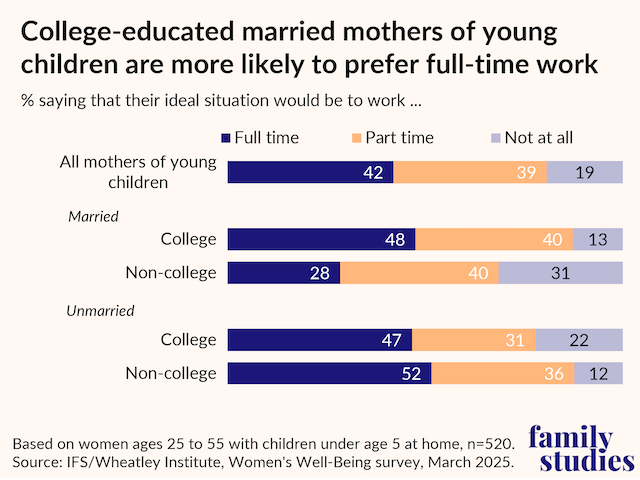
According to a recent report from the Institute for Family Studies (IFS), full-time employment for married moms with young children has surged, briefly surpassing the rate for single mothers for the first time in 2024, before settling slightly, leaving both groups equally likely to work full-time now.
That report cites financial concerns as a major factor but notes that preferences are also changing, especially among moms with a college degree.
“While part-time work used to be the top choice of American mothers, full-time employment is gaining ground. For example, among college-educated married mothers of young children under age 5, nearly half say full-time work is ideal, compared with just 28% of those without a college degree. In fact, college-educated married mothers are about as likely as their unmarried peers to say full-time work is their preferred arrangement.”
Moms Are Asking For More Family-Friendly Policies
When there’s a sick child, a sporting event, an appointment, or a school holiday, moms are more likely than dads to miss work. Moms also tend to be the parent who needs to take leave from work when there’s a new baby in the home (although, according to the 2024 Census, more dads took paid leave).
Policies, both from the employer and the government, that help support women in balancing parenting with employment would benefit families, and women are pressing for these changes.
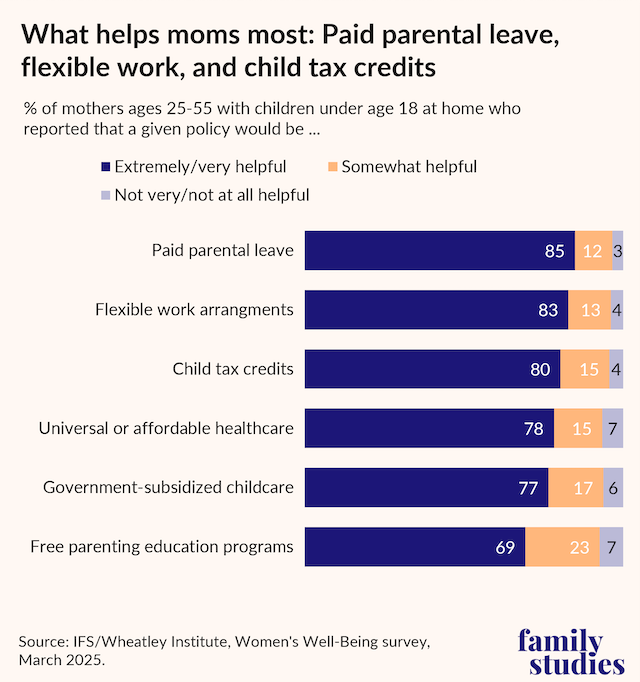
Most (85%) moms told IFS that paid parental leave would be extremely helpful. A majority also advocated for flexible work arrangements (83%), child tax credits (80%), and universal or affordable healthcare (78%).
A Better Balance Benefits Everyone
Life is only getting more expensive. Raising kids — well, that’s never been cheap, has it? More adults are choosing not to have kids because of the cost, and there’s plenty of speculation about the potential damage to society if we allow significant population drops.
Most families need two full-time incomes. Children need a parent who is available when they are sick or require care. Employers need workers whose situations allow them to balance work and home life. Society needs children whose parents can play an active role in their lives.
Improving employment policies so that this is all accessible to families would be a net positive for pretty much everyone.