

If you watch a few kids of similar age grow up in close proximity, you’ll notice something interesting about child development.
Specifically, it’s not really very linear. Two kids with similar parenting and experiences will say their first words at different points. One kid will master walking first, while another speaks sooner. Sure, there are milestones and points at which to be concerned about your baby’s development, but it should not be merely because another toddler did something first!
Still, these early years can be fraught, and parents worry a lot about their babies’ skill sets, which explains why a simple video posted by early childhood entertainer and educator Rachel Accurso, better known as Ms. Rachel, left many parents worried.
Here’s What Ms. Rachel Showed
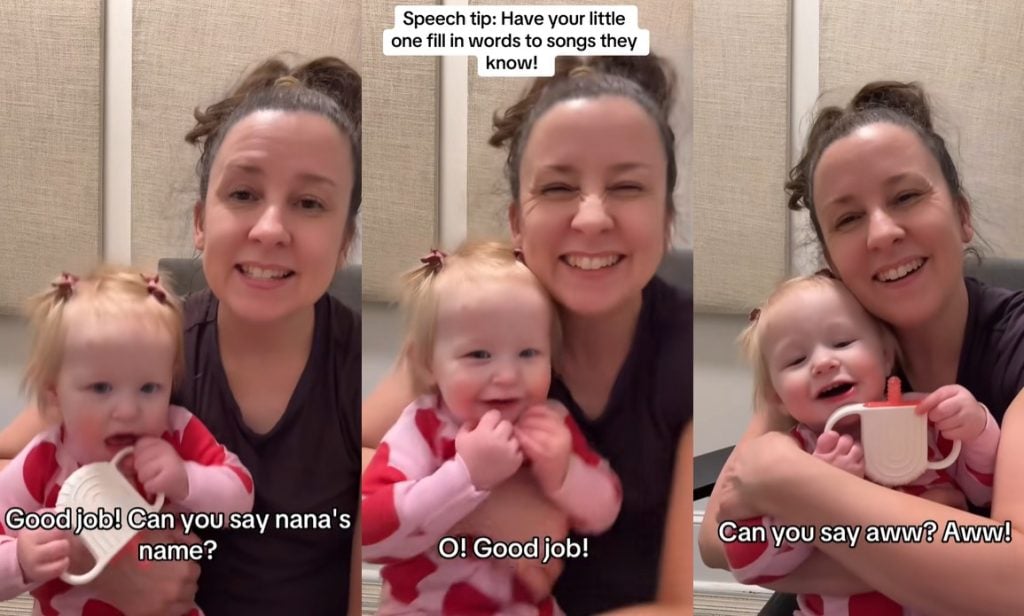
In a pair of videos with her tiny daughter Susannah, whose first birthday is in a few weeks, Ms. Rachel showed some of the ways that she plays with her own children while helping them learn. Of course, for small kids, play is learning, and learning is play, so this mostly involves such activities as singing a favorite song, then pausing for the baby to fill in the blank.
It’s the kind of lesson we don’t often get as parents. Our pediatricians speak up if there’s a noticeable delay, and we can buy stacks of books that tell us how many words to expect at what time, but if the ‘parenting instruction manual’ that we wish we were handed upon delivery existed, it might include these videos.
Ms. Rachel is showing an example of the games that help children build their vocabularies and speech skills, not setting a bar for a competition between toddlers (or their moms).
Why Did Some Parents Feel Bad After Watching The Videos?
Ms. Rachel’s little girl has an excellent vocabulary. She fills in the words to their song, and repeats words like “hi,” “bye,” “aww,” “uh-oh,” and names for family members, like “mama,” “dada,” “nana,” “papa,” and “baba” (brother).
Not every kid can rattle off a string of words like that at Susie’s age, no matter how intensively their parents work at it. Also, let’s be realistic: most of our kids don’t have parents whose literal job is early childhood education and who have done as much research on language development as Ms. Rachel has. (She’s built a career in child entertainment, but let’s not forget she has masters’ degrees in both early childhood education and music education. This is her area of expertise.)
That doesn’t mean other parents have failed their children if their vocabulary at 12 months doesn’t match Susie’s; that’s how some parents felt, judging by the comments.
“Well this made me feel like a shit mum to a 4 year old non verbal”
“My 21-month-old only say 5 words and I feel like a complete failure.”
“My 15mo old still says “dada” when I sing “Can you say MAMA?””
Ms. Rachel Steps In To Explain
In the original caption for the “Teaching First Words” video, Ms. Rachel mentions her older child, Thomas, who turns 8 this year.
Unlike Susie, she says, he didn’t really start talking until he was around three years old. She started all of these same practices with him, and in fact, says she spent more time on it, since she didn’t have two kids then. Still, all kids are different, and despite being just as smart and wonderful as his sister, he had a language delay and needed speech therapy.
That doesn’t make one child better, brighter, more successful, or more important, and it doesn’t mean that a parent has been more successful with a child who speaks early or on time than one whose speech is a bit later.
In a comment, Ms. Rachel added:
“Hey all – my son had a severe speech delay and he’s extremely bright and wonderful – he didn’t really talk until 3 years old. I did the same stuff with him (actually more because I didn’t have two kids.) we got him speech therapy / early intervention starting at 15 months (get help – sooner the better) this shows that kids are different and you shouldn’t feel bad! I thought everyone knew about my sweet boy struggling with speech. Love!”
In fact, it was her son’s speech delay that got Ms. Rachel started on YouTube, where she made videos as she worked to help him build his speech skills!
What Should Parents Take From This?
Every child is different. Some will speak earlier, some will crawl, walk, and climb earlier, some will read earlier, and some will develop number sense earlier, but if your child does any of these things later than one or a few peers, that doesn’t necessarily mean a delay.
According to Better Speech, your child should be babbling by 12 months (usually starting by 6-8 months); saying single words by 16 months (like “mama” and “dada”); and producing two-word phrases by 24 months. By 4, you should be able to understand at least about half of their speech.
Clearly, Susie is ahead of the curve on this, but if your child isn’t meeting these milestones, it may be time to speak to your pediatrician about a speech referral. As Ms. Rachel says, early intervention is considered the gold standard.
Even outside of this timeline, if something feels off, it’s good to check with your doctor.
Babies learn a lot from being exposed to plenty of talking and singing, and parents who aren’t composers and educators can do this too! Notice that Ms.Rachel has even turned family names into a song, and that Susie isn’t just speaking, she’s filling in the words to a tune she’s clearly heard many, many times.
Most of all, know that parenting shouldn’t be a competition. Love your babies, and don’t worry too much about how anyone else is doing it differently.
