


Early elementary-aged kids have a strong sense of justice and a very black-and-white sense of right and wrong.
That means one thing you can count on little kids to do is tons of tattling. If a kindergarten teacher stopped to listen to every grievance, her class wouldn’t ever make it through the ABC song.
The good news is that some really brilliant teachers have developed amazing tools and tricks for handling tattling in the classroom, and parents can take some tips from them for handling tattling at home.
First, They Teach The Difference Between Tattling & Telling
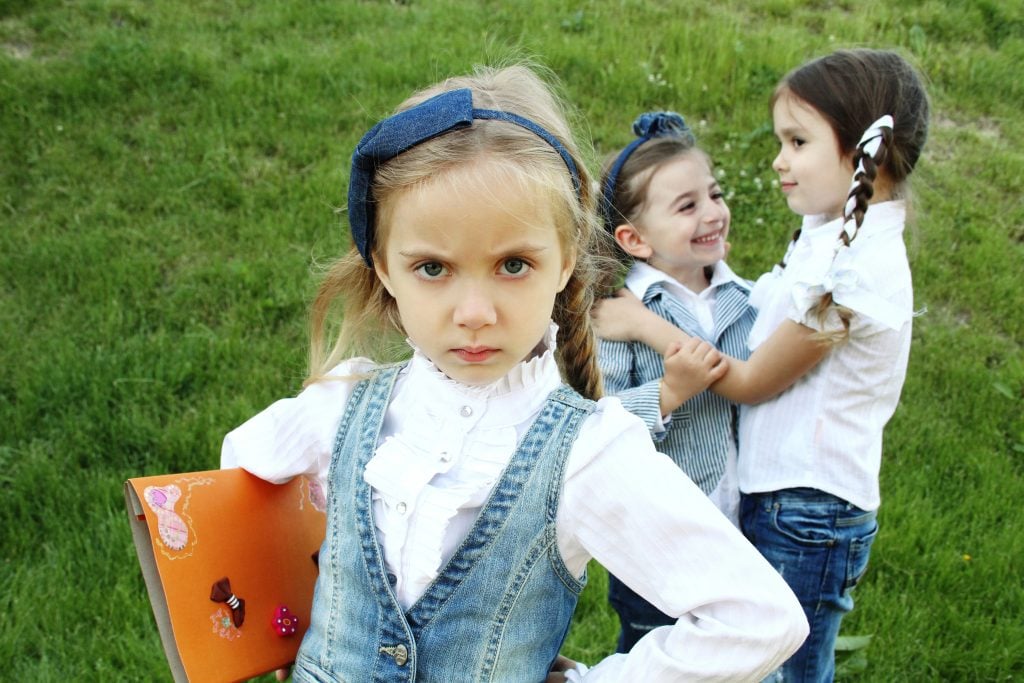
There’s a difference between running to an adult to handle a situation that truly needs intervention, and kids won’t intuit that difference. They have to be actively taught.
Teachers typically lay out a few simple guidelines.
If someone is hurt, in an unsafe situation, or needs an adult’s help, then it’s appropriate to tell a grown-up. Telling should always help someone, not hurt someone.
If someone is just being annoying, silly, or frustrating, and the goal is to get them in trouble or make them do something differently, then it’s tattling. Kids can learn that if they only want an adult to scold or punish a classmate, then it’s tattling, not helping.
Once the difference is established, the practice of eliminating tattling can begin.
Tattling Is Developmentally Normal (Which Doesn’t Mean It Should Be Encouraged)
Your newborn and toddler look at the world as a place with unknown rules and norms. Anything is possible. A cup dropped from the highchair tray could fall, or it could float to the ceiling (that’s why they test it so many times). Maybe the trash can is a place to put toys or to find snacks. Until they’ve conducted sufficient experiments, who knows?
By late toddlerhood, though, your child knows some things for fact. If you pretend to pour their juice into a bowl instead of a cup, they’ll laugh or shout, and correct you.
By kindergarten, most kids have developed some very rigid notions around what’s right and wrong, allowed and forbidden, done and simply not done. (These may or may not match their new classmates’ equally rigid notions.)
They can respond to another child behaving in a proscribed way with as much shock as they might, now, if that dropped sippy cup did float to the ceiling.
They’ve learned how the world works, and they need it to work that way. When it doesn’t, they’d like an adult to intervene, or at least assure them that things are still functioning properly. It’s part of their developing sense of order.
That’s Why Great Teachers Offer A Tattle Alternative
Okay, Jenny colored a dog pink, and Katy knows dogs are not pink, and this has disturbed her sense of equilibrium in the world. She desperately needs to report this failing in the structure of her corner of the universe, but her teacher is somehow focused on getting kids settled for story time and does not consider pink dogs a top priority at the moment.
When my oldest entered kindergarten, I was introduced to the concept of a Tattle Teddy.
There was a special bear in the back of the classroom, and kids who knew they might actually explode if they held their tattle in could rush back to the teddy, and tell it exactly what was on their minds.
Of course, if they needed to share a real concern or help, the teacher was ready to listen, but if a kid started spilling petty grievances, she’d say, “Tell it to the teddy.”
Over the course of that year, her students began to learn how to tell which reports were tattling and which would support their classmates.
The Tea In Elementary Classrooms Can Be Extremely Hot
The options for a tattle outlet are varied. Teachers use a plush bear or monster, a poster of an ear to whisper into, or even a box with a slot for little notes.
One teacher, Laurel Bates, chose to place a ‘tattle phone’ in her classroom, and she’s been keeping track of the complaints her kids have been dialing in. Then she takes the transcripts to TikTok and shares them with the rest of us.
The phone she uses records students’ messages, so she can listen to them at the end of the day. Aside from offering premium entertainment, this means that she is aware of any ongoing conflicts or issues, and that if kids take something to the tattle phone that really needed to be brought to an adult, she doesn’t miss it.
Check out one installment of her Tattle Tea below.
Borrowing These Tricks For Home Use
Let’s be super clear: listening to our kids’ grievances, even the pettiest ones, can be a way to connect and understand their feelings.
Just the same, listening to a few hundred iterations of “my brother is building with blocks and doing it a different way than I would” and “my sister glanced vaguely in my direction” and “he got five marshmallows and I only got four” could actually have a parent googling whether it’s still possible to run away with a circus, so setting some limits is entirely reasonable.
I’ll admit I’ve used the Tattle Teddy on at least three of my kids. I’ve also, more than once, encouraged a kid to write down their list of grievances (this is also handy for endless questions during a movie) and submit it when complete. I honestly love the writing one, because most kids can use the writing practice anyway, and there’s just something about writing that seems to really help vent that frustration.
In the long run, teaching your kids the difference between tattling and telling (which will later evolve into the difference between venting and seeking solutions) is the goal. Along the way, they develop a better sense of when a behavior they don’t like is really a problem, and when it’s just someone being different from them, and develop the problem-solving skills to address more conflicts on their own.
