


Space: the final frontier. These are the voyages of the starship “Parenthood.” Its continuing mission: to explore strange new streaming services; to seek out cartoons about space; to boldly go where no one has gone before!
Or something like that.
Like dinosaurs and princesses, just about every kid, no matter their gender or location, will probably go through a phase where space is their main focus. For parents, the challenge is (as with most topics) finding ways to encourage this curiosity while helping kids learn the real-life science and ideas behind going to the stars.
Below is a collection of space-themed cartoons that teach kids real-life space science in varying degrees. It’s a delicate balance to create entertaining shows that are rooted in reality, and these shows take the biggest swings at it. To be especially helpful, I’ve included a rating of the scientific accuracy of the ideas and concepts presented in each show.
I’ve included recommended age ranges for each show along with the streaming services where they’re currently available in the United States. Streaming availability and age recommendations in this guide reflect platforms commonly used by families in the United States. International availability may differ based on regional licensing.
So, gather your small space cadets, fire up the warp drive, secure the pod bay doors, and punch it, Chewie!
Miles From Tomorrowland

Miles From Tomorrowland is a show about Miles Callisto, his older sister Loretta, and their parents as they journey through the galaxy on missions for the Tomorrowland Transit Authority. Set in a futuristic universe where space travel is part of everyday family life, the show blends space adventure with family dynamics, showing how learning and growth happen together. Visually vibrant and fast-paced, Miles from Tomorrowland features imaginative future technology and relatable emotional moments, helping kids feel excited about exploration while reinforcing social-emotional lessons through science-inspired storytelling.
What Miles From Tomorrowland Teaches Kids About Space: While Miles from Tomorrowland takes place in a highly fictional future, it draws on contemporary, realistic space-exploration ideas. Navigation, space missions, environmental challenges, and the importance of preparation when exploring unknown places are key parts of the stories. The show emphasizes scientific thinking—identifying problems, brainstorming solutions, testing ideas, and adapting when obstacles arise. By presenting space as a learning environment, young viewers see space exploration as a thoughtful, problem-solving process driven by teamwork and perseverance.
Age: 3–7
Scientific Accuracy: ⭐⭐⭐⭐ (4/5)
Where To Stream: Disney+
Space Racers

In Space Racers, a group of anthropomorphic spaceships travel the Solar System, exploring space and learning about it through assigned missions. The main characters, Eagle, Hawk, Raven, Robyn, and Starling, are cadets at the Stardust Space Academy, and each episode features space-based scientific discoveries that align with real-world science.
How Space Racers Teaches Kids About Space: Along with fun lessons on teamwork and friendship, Space Racers teaches viewers about planetary science, physics, stars, black holes, and space motion, using accurate terminology and visuals. Space Racers has a curriculum-driven structure that prioritizes accuracy and real-life scientific principles about space travel.
Age: 4–8
Scientific Accuracy: ⭐⭐⭐⭐⭐ (5/5)
Where To Stream: Amazon Prime Video
Ready Jet Go!

Jet, an alien boy, and his human friends explore questions about space through experiments and adventure as they travel between Earth and outer space. Each episode begins with a real scientific question kids might ask, with the solutions being discovered through the story.
What Ready Jet Go! Teaches Kids About Space: Ready Jet Go! teaches astronomy fundamentals, including gravity, orbits, planets, moons, and space travel, using real scientists and accurate explanations, but wrapped in fun and exciting adventures. The Scientific concepts are clearly connected to real-world observations, even though the settings are imaginative and exp/ansive.
Age: 4–8
Scientific Accuracy: ⭐⭐⭐⭐⭐ (5/5)
Where To Stream: PBS Kids
Astroblast!
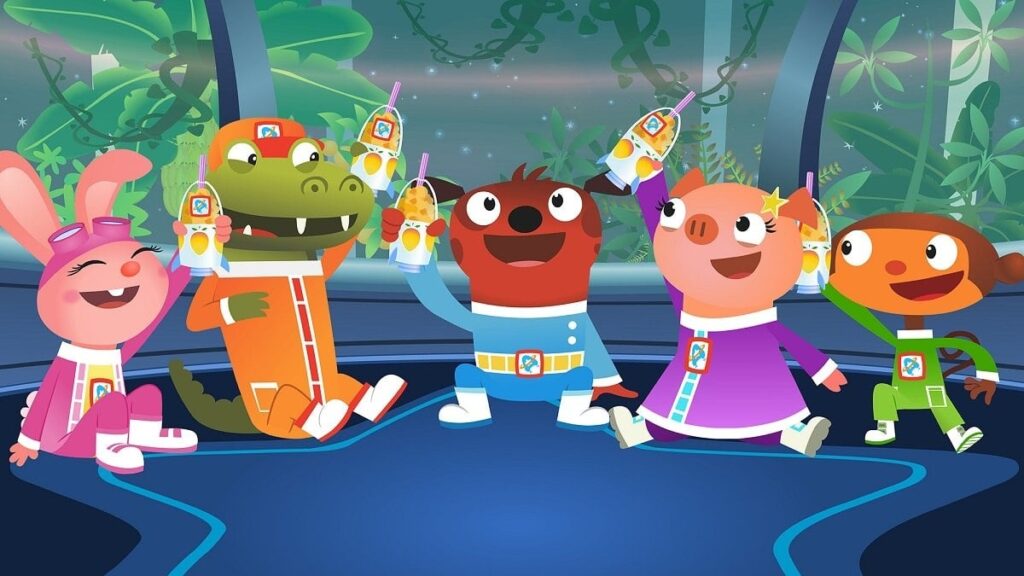
Similar to Ready Jet Go!, Astroblast! follows four young space cadets at the Astroblast Space Academy. Under the guidance of their mentor, the cadets travel throughout outer space on missions designed to help them learn responsibility, cooperation, and problem-solving. Rather than focusing on high-stakes danger, Astroblast! emphasizes growth, perseverance, and curiosity, creating a safe and engaging introduction to space-themed adventures for preschool viewers. Each episode presents a challenge that requires the cadets to think critically and try new strategies grounded in real space science principles.
What Astroblast! Teaches Kids About Space: Astroblast! introduces young children to foundational space concepts such as gravity, motion, and the solar system in a simplified yet accurate way. While the science is simplified, the show avoids misinformation and instead focuses on accurate principles presented at a preschool level. Importantly, it teaches how scientists and explorers think—observing problems, forming solutions, testing ideas, and adjusting when things don’t work. The academy setting reinforces that learning about space takes practice and teamwork. By framing space exploration as a learning journey rather than just a fantasy spectacle, Astroblast! helps children build early STEM confidence and curiosity.
Age: 3–6
Scientific Accuracy: ⭐⭐⭐⭐ (4/5)
Where To Stream: The Roku Channel
Star Trek: Prodigy
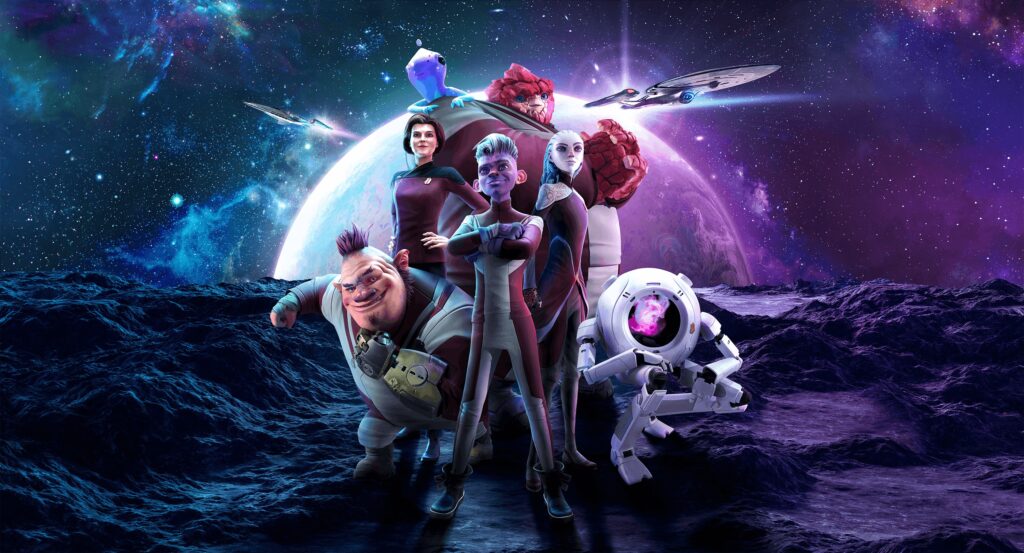
Star Trek is a space franchise that wasn’t super kid-friendly until the release of Prodigy. The show follows a group of alien teens who discover an abandoned Starfleet ship in a distant part of the galaxy. Guided by a holographic Starfleet officer, the characters learn to pilot the ship and become explorers and teammates. The series is a great introduction to the Star Trek universe, and its themes of belonging, identity, and responsibility are central as the crew learns what it means to explore with purpose.
What Star Trek: Prodigy Teaches Kids About Space: Although Star Trek: Prodigy is obviously science fiction, it is rooted in real scientific concepts and exploration ethics. Star systems, space navigation, cosmic phenomena, and the vast scale of the universe. More importantly, the show teaches how science and exploration are guided by ethics, cooperation, and respect for life. Concepts such as cause and effect, unintended consequences, and the responsible use of technology are consistently reinforced. Star Trek: Prodigy encourages curiosity while promoting thoughtful, science-minded decision-making.
Age: 8–12
Scientific Accuracy: ⭐⭐⭐⭐ (4/5)
Where To Stream: Amazon Prime Video
Rob the Robot

Based on the book series of the same name, Rob the Robot is about, well, Rob the Robot and his robot friends, who traverse the galaxy working through logic-based problems and challenges. Episodes encourage viewer participation.
What Rob The Robot Teaches Kids About Space: In Rob The Robot, basic space ideas and concepts are taught and explained with real-life scientific accuracy. The show pairs this with an emphasis on problem-solving skills, making it engaging and captivating for preschoolers. The focus is on reasoning rather than fantasy, but it’s a lot of fun too.
Age: 3–6
Scientific Accuracy: ⭐⭐⭐⭐½ (4.5/5)
Where To Stream: Amazon Prime Video
Space Dogs Family
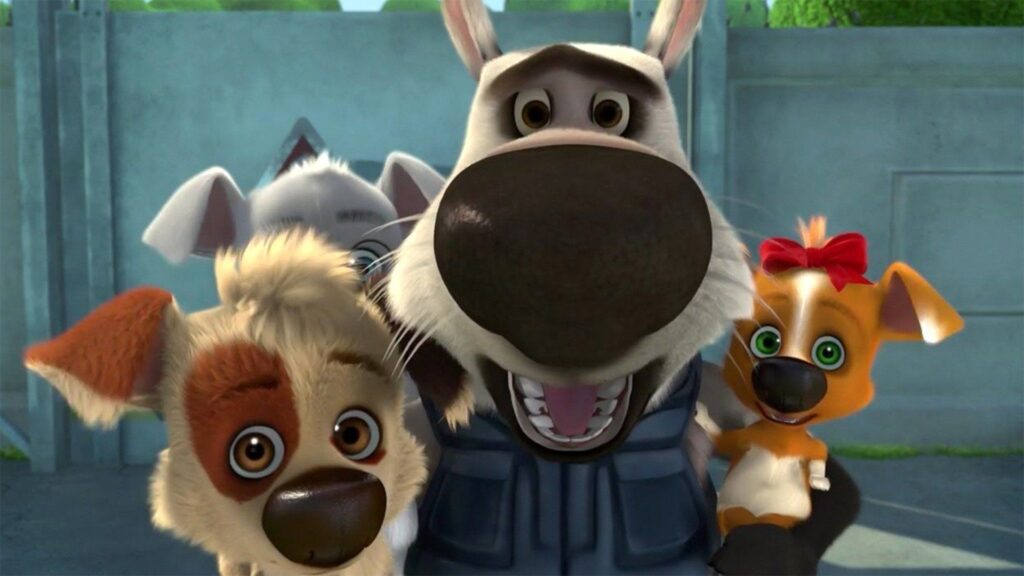
As the clever title suggests, Space Dogs Family is about a family of dogs living and working aboard a space station orbiting Earth. Balancing everyday family life with space missions, each episode blends family-dynamic humor with space-based tasks, creating an environment that feels both exciting and familiar. The show’s light tone and colorful animation keep stories accessible, while the space station setting provides a unique backdrop for everyday adventures.
What Space Dogs Family Teaches Kids About Space: Space Dogs Family introduces kids to realistic aspects of space living in a simplified way. Viewers learn about Earth, living in confined environments, and how daily routines change in space. While the science isn’t deeply technical, it avoids fantasy explanations and instead focuses on believable space scenarios. In Space Dogs Family, space is a workplace and home, helping kids understand that exploration involves responsibility, cooperation, and planning.
Age: 5–8
Scientific Accuracy: ⭐⭐⭐½ (3.5/5)
Where To Stream: Plex
Floogals
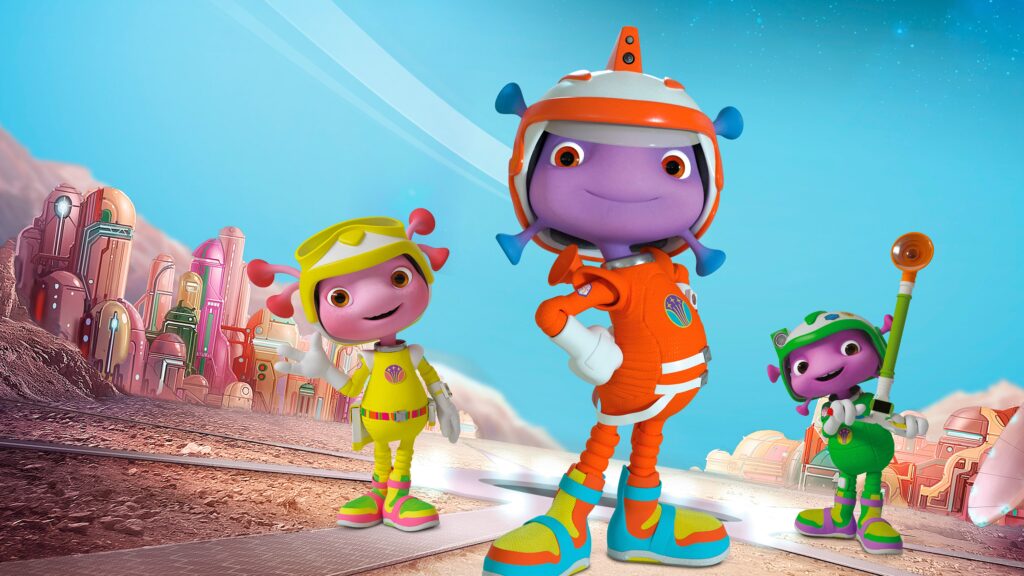
Floogals follows three small alien explorers named Fleer, Flo, and Junior who are sent to study Earth as part of a scientific mission. Hiding among everyday objects, they observe human behavior and household items with curiosity and confusion. The show uses minimal dialogue, relying heavily on visual storytelling and expressive animation. This approach makes Floogals accessible to very young viewers while encouraging observation and interpretation.
What Floogals Teaches Kids About Space: While Floogals is set mostly on Earth, it teaches kids how space explorers think and behave. The aliens’ childlike curiosity drives the narrative, reinforcing themes of discovery and learning. The show models curiosity, patience, and respect for unfamiliar environments. Rather than teaching astronomy facts, it focuses on the mindset required for space exploration: asking questions, testing ideas, and learning from mistakes. This foundation prepares kids to understand scientific exploration later, in areas beyond space science.
Age: 2–5
Scientific Accuracy: ⭐⭐⭐ (3/5)
Where To Stream: Amazon Prime Video
Little Einsteins

Little Einsteins is a hybrid live-action/animated series that follows four young friends who travel the world and space in their musical Rocket ship, appropriately named Rocket. Adventures often take the group into space, visiting planets, stars, and imaginative cosmic environments. The show blends appreciation for music and art with simple problem-solving. Its slow pacing and repetition are designed for preschool audiences, making big concepts feel approachable and fun.
What Little Einsteins Teaches Kids About Space: The series introduces basic space vocabulary and concepts, such as planets, stars, and the idea of traveling beyond Earth. While the science is highly simplified and symbolic, it helps young children become familiar with space-related ideas without overwhelming them. The show encourages curiosity and exploration rather than factual mastery. Combining space themes with music and participation helps kids associate learning about the universe with creativity and fun.
Age: 2–5
Scientific Accuracy: ⭐⭐½ (2.5/5)
Where To Stream: Disney+
Ask the StoryBots

A group of curious StoryBots travel through imaginative worlds to answer kids’ biggest questions about how things work. While the show doesn’t solely focus on space, many episodes do, and the StoryBots’ attention to detail and simple explanation of real-life science make it worth checking out with your space-savvy child.
What Ask The Story Bots Teaches Kids About Space: As mentioned, Ask The Story Bots isn’t all about space, but when it does explore it, the show explains stars, gravity, planets, and the universe using simplified yet accurate metaphors and songs. Scientific facts are vetted and clearly explained. The spin-off StoryBots Super Songs also features several episodes that are about space.
Age: 4–8
Scientific Accuracy: ⭐⭐⭐⭐⭐ (5/5)
Where To Stream: Netflix
LEGO Star Wars: The Freemaker Adventures
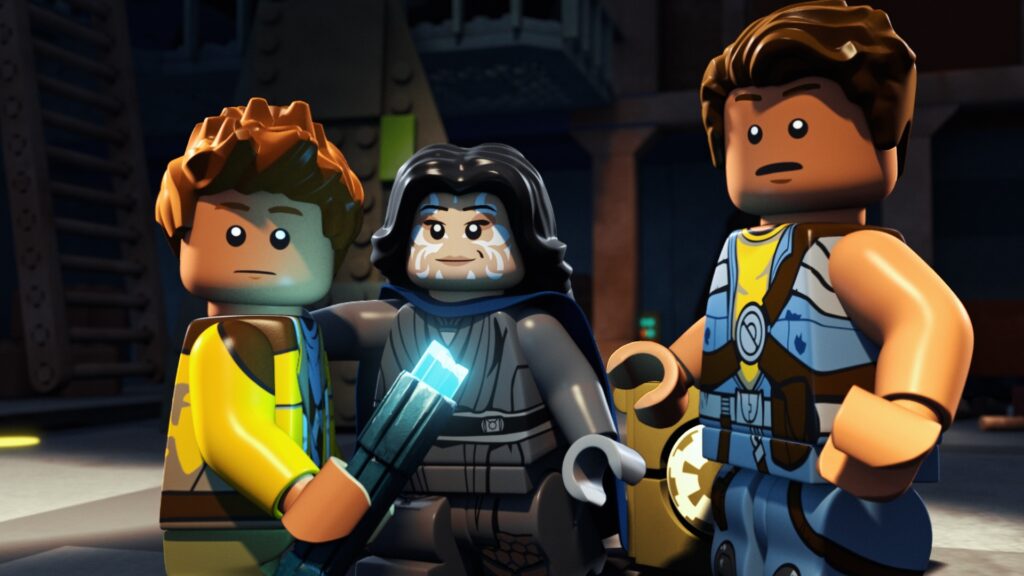
No set of space shows would be complete without a visit to a galaxy, far, far away. Combine that with Lego, and you’ve got a sure-fire hit on your hands. LEGO Star Wars: The Freemaker Adventures is about the Freemaker family, scavengers who build and sell ships during the events of the original Star Wars trilogy. When the youngest Freemaker discovers a mysterious connection to the Force, the family becomes entangled in a galactic conflict. The series blends humor, action, and character growth while staying accessible to younger viewers.
What LEGO Star Wars: The Freemaker Adventures Teaches Kids About Space: While firmly rooted in fantasy, The Freemaker Adventures introduces kids to the scale and diversity of space, even if not very scientifically accurate. Though it does not teach real astronomy, it helps kids think big about space and exploration, making it a doorway to deeper scientific interest later on. It also reinforces problem-solving, engineering creativity, and teamwork.
Age: 6–10
Scientific Accuracy: ⭐⭐ (2/5)
Where To Stream: Disney+

