


I love water. Whether it’s a quiet day of fishing, coral scuba diving, or a swift sailboat race, water has always been a place my family and I love to spend time. The kids took to it like fish to water, and wherever we go, we have to include a way for them to swim and/or frolic.
Also, you can drink it. Well, much of it.
The good news is that this delightful rock we call Earth is 71% covered in water. Fresh water, ocean water, glacier run-off water, it’s all in there. Some water is so deep that we have no idea what might be living down there! Others, shallow enough that we can see tiny life forms living their lives, oblivious of us.
Kids love exploring, and safely exploring the oceans and waterways is a great way to have a lot of fun and come across the strangest life our planet has to offer. If you can’t make it to the Sea, though, don’t fret! Cartoons about marine life have your back, and this list of episodes will give you and your kids a gateway into the briny deep!
I’ve included recommended age ranges for each show and notes on where to watch them with a streaming subscription or via free services.
Where To Watch Note: Some streaming services may list episodes in a different order or split episodes into multiple parts. I suggest searching by episode name if the episode isn’t located in the same position I have noted. Streaming availability and age recommendations in this guide reflect platforms commonly used by families in the United States. International availability may vary by region due to licensing.
Octonauts — “The Great Algae Escape” (Season 8, Episode 8)
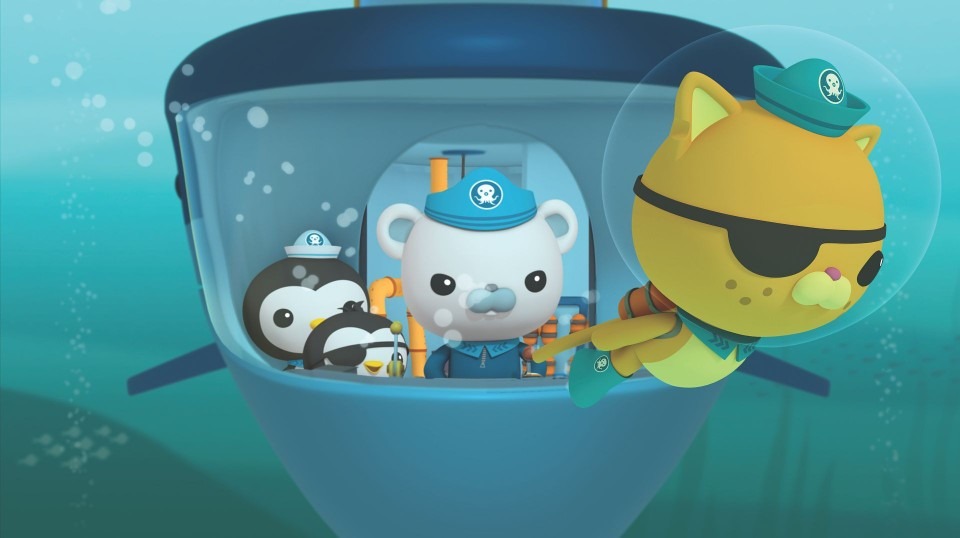
The Octonauts are a team of adorable explorers who traverse the sea, helping and learning about underwater creatures. When the Octonauts discover that large amounts of ocean algae are mysteriously disappearing, Captain Barnacles and his crew spring into action. As fish begin losing their food source, the team investigates multiple underwater environments to uncover the cause. Peso, Kwazii, and Shellington learn how interconnected marine ecosystems are as they race against time to restore balance.
What “The Great Algae Escape” Teaches Kids About Marine Life: This episode introduces algae as a foundational ocean organism that supports marine food webs. Children learn that many fish and other sea creatures depend on algae, directly or indirectly, for survival. The story demonstrates ecosystem interdependence, showing how changes to one species affect many others. By framing algae as important rather than insignificant, the episode encourages respect for microscopic life and introduces early concepts of marine ecology and conservation. The Octonauts’ mission shows how even the smallest organisms can create big problems when removed from the food chain.
Age Range: 3–7 years
Where To Stream: Netflix
Splash and Bubbles — “Dunk’s Cleaning” (Season 1, Episode 11)

Splash and Bubbles follows a young fish, Splash, who settles in Reeftown and befriends Bubbles, a mandarin dragonet. The duo, along with friends Dunk and Ripple, explore the reef to learn and make new friends. In “Dunk’s Cleaning,” Dunk faces a dilemma when he discovers a parasite in his mouth. His initial fear of visiting the cleaner shrimp to get help causes him to hesitate. Throughout the episode, Dunk learns the importance of asking for help when facing challenges, even when it feels intimidating. With the support of his friends, Dunk realizes that seeking assistance is a brave and necessary step.
What “Dunk’s Cleaning” Teaches Kids About Marine Life: “Dunk’s Cleaning” teaches kids about symbiotic relationships in the ocean, showing how some sea animals help others stay healthy. The episode introduces the concept of cleaning stations, where smaller fish remove parasites and debris from larger animals like Dunk. Children learn that cooperation is an important survival strategy in marine ecosystems and that even small creatures play valuable roles. By presenting this process in a friendly, relatable way, the episode builds understanding of balance, teamwork, and interdependence in ocean life.
Age Range: 3–7 years
Where To Stream: PBS Kids
The Deep — “Little Wolf” (Season 1, Episode 4)

The Deep stars the Nekton family, who are adventurous underwater explorers living aboard a state-of-the-art submarine. They explore unknown areas of the Earth’s oceans, learning about ecosystems. In “Little Wolf,” the family is called to investigate reports of a mysterious sea creature nicknamed “Little Wolf,” believed to be threatening other marine life. As they track the creature through the ocean, they discover that appearances can be misleading. Rather than a monster, Little Wolf is a misunderstood predator trying to survive. The family learns that fear often comes from lack of understanding, and they work to protect both the creature and the ecosystem it belongs to.
What “Little Wolf” Teaches Kids About Marine Life: “Little Wolf” teaches kids about predators and their vital role in ocean ecosystems. It explains how predators help maintain balance by controlling population levels and supporting biodiversity. By showing a feared creature as necessary rather than evil, the episode challenges misconceptions about sharks and other predators. Children learn that healthy oceans require all species, including those that seem scary, to function properly.
Age Range: 6–12 years
Where To Stream: Netflix
The Deep — “Lost World” (Season 1, Episode 13)
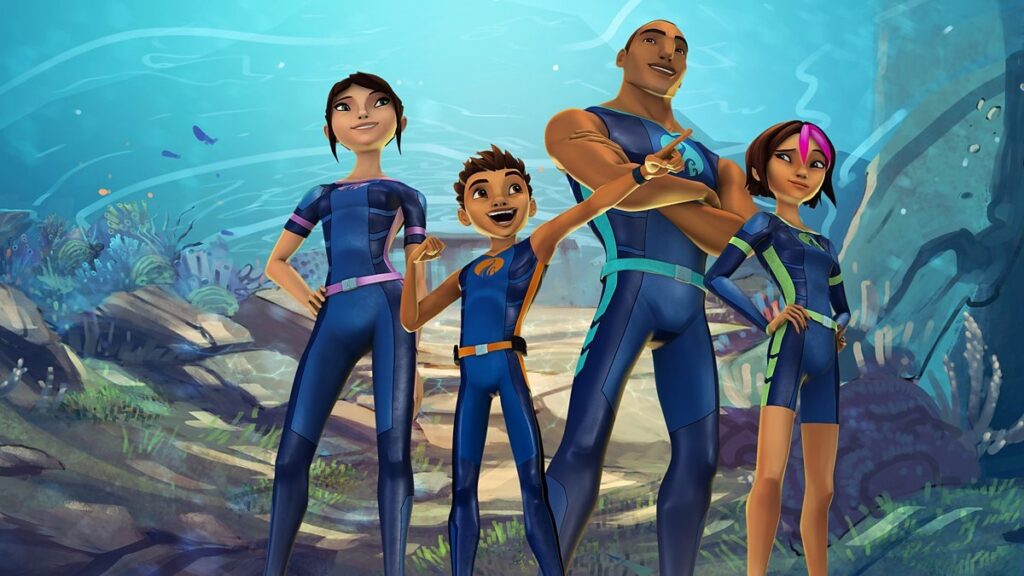
In “Lost World”, the Nekton family uncovers a hidden underwater world untouched by time. This lost ecosystem is home to rare and ancient marine creatures adapted to extreme depth and pressure. As the family explores, they realize how fragile the environment is and how easily it could be damaged by interference. The episode blends discovery and danger, emphasizing the importance of caution and respect when exploring unknown parts of the ocean.
What “Lost World” Teaches Kids About Marine Life: The best part of “Lost World” is that the episode introduces the idea that much of the ocean remains unexplored and scientifically unknown. Viewers learn that deep-sea ecosystems are fragile and unique, requiring protection from human impacts. The story highlights adaptation, biodiversity, and environmental responsibility, encouraging respect for untouched marine habitats. It reinforces that exploration should be paired with conservation to preserve ocean life for future generations.
Age Range: 6–12 years
Where To Stream: Netflix
SpongeBob SquarePants — “Krusty Krab Training Video” (Season 3, Episode 10)
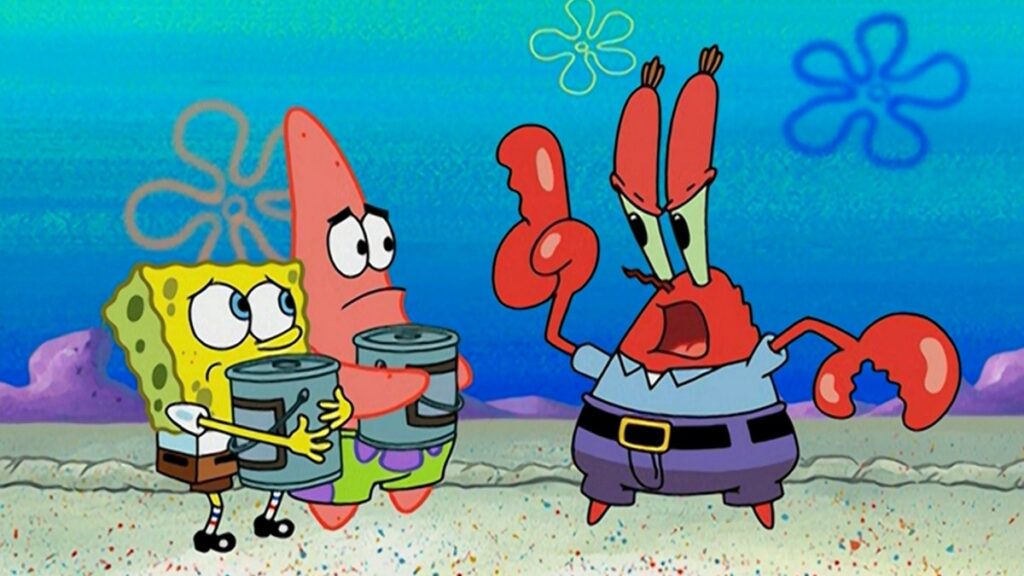
SpongeBob SquarePants follows the titular sea sponge as he and his friends navigate life undersea in the delightfully absurd Bikini Bottom. Presented as a parody training video, this episode explains how the Krusty Krab (a restaurant where SpongeBob works) operates while showcasing SpongeBob’s enthusiasm for his job. Although framed as workplace comedy, the episode remains firmly set in Bikini Bottom, using underwater visuals, sea creatures, and ocean-based humor to build its world.
What “Krusty Krab Training Video” Teaches Kids About Marine Life: While comedic and absurd, “Krusty Krab Training Video” reinforces the idea that marine animals live in complex underwater communities. The ocean setting introduces kids to anthropomorphic sea creatures and marine environments in an approachable way. Though not scientific, it builds familiarity with ocean life and helps normalize marine settings, which can spark curiosity and interest in real-world sea creatures and habitats.
Ages: 6-11
Where To Stream: Paramount+
The Lion Guard — “The Rise of Makuu” (Season 1, Episode 2)

The Lion Guard is a spin-off of The Lion King Franchise, starring Simba and Nala’s son, Kion, and featuring many of the characters from the film series. In “The Rise of Makuu”, a fierce crocodile leader challenges Simba’s rule, creating conflict along the Pride Lands’ waterways. Kion and the Lion Guard must decide how to maintain balance while dealing with Makuu’s aggressive behavior.
What “The Rise of Makuu” Teaches Kids About Marine Life: This episode introduces freshwater ecosystems and aquatic reptiles, such as crocodiles. Children learn that rivers and wetlands are shared habitats that require balance and cooperation among species. “The Rise of Makuu” highlights how water ecosystems support many animals and how conflict can arise when resources are misused. It encourages respect for aquatic environments and understanding different animal roles within ecosystems.
Age Range: 2-7
Where To Stream: Disney+
Wild Kratts — “Creatures of The Deep Sea” (Season 4, Episodes 15 & 16)

Wild Kratts stars real-life brothers and zoologists, Martin and Chris Kratt, as they travel the world learning about and helping animals. In this hour-long special, the Wild Kratts descend into the mysterious “Midnight Zone” using their deep-sea Amphi-Sub. They encounter bizarre bioluminescent animals and observe the extreme adaptations required to survive immense pressure and total darkness. From the giant squid to the sperm whale, the brothers explore how life thrives thousands of feet below the surface.
What “Creatures of The Deep Sea” Teaches Kids About Marine Life: This extra-sized episode of Wild Kratts introduces children to the concept of vertical zones in the ocean. It teaches kids about bioluminescence and how deep-sea creatures use it for hunting and communication. By showcasing extreme water pressure and freezing temperatures, the show explains how specialized body structures enable animals to inhabit environments that are otherwise inhospitable to humans.
Age Range: 4-8
Where To Stream: PBS KIDS, Hulu
Wild Kratts — “Our Blue And Green World” (Season 7, Episodes 5 & 6)
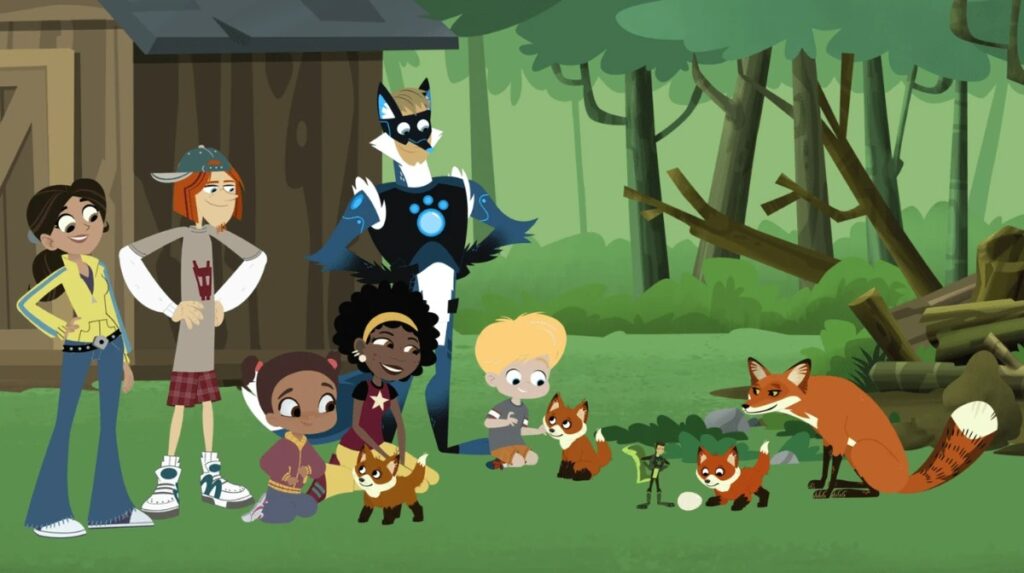
In another double episode, the Kratt brothers engage in a friendly debate over whether the “Blue World” (aka the oceans) or the “Green World” (aka the forests) is more vital to the planet. To make a decision, they travel across diverse ecosystems, comparing the specialized roles of marine and terrestrial species. Ultimately, they discover that these environments are deeply interconnected, showing how the health of our oceans directly impacts life thriving on land and vice versa.
What “Our Blue And Green World” Teaches Kids About Marine Life: While it covers a lot of the “Green World, ” This episode spends half its time in the “Blue World,” teaching children about the global importance of the ocean as a life-support system. It highlights how marine plants produce a significant portion of the Earth’s oxygen, mirroring the role of trees on land. By exploring the water cycle and nutrient exchange, kids learn that sea life isn’t isolated; the ocean regulates the planet’s climate and provides essential resources that sustain all living creatures, regardless of their habitat.
Age Range: 4-8
Where To Stream: PBS KIDS, Hulu
Nature Cat — “Ocean Commotion” (Special Episode)
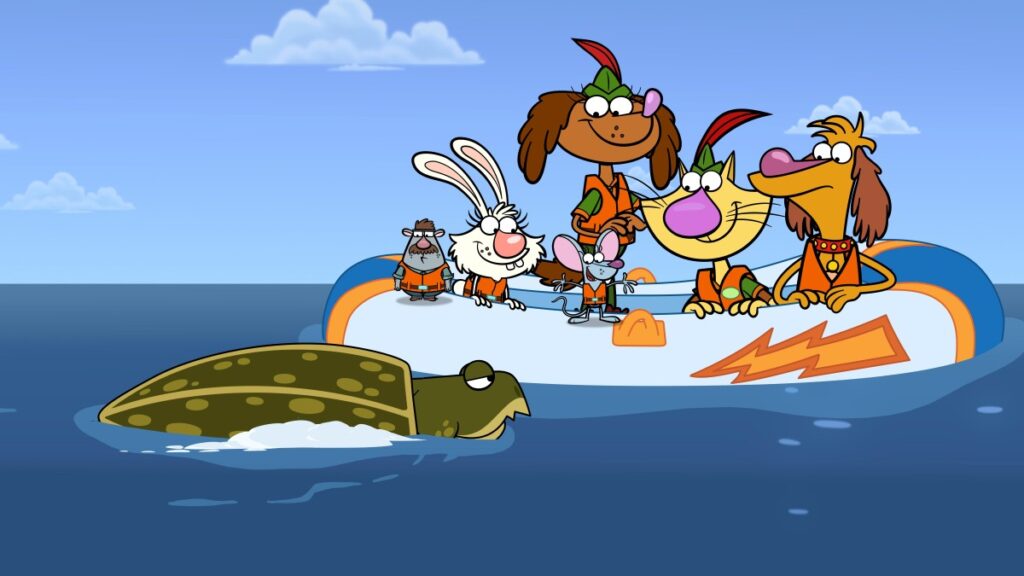
Nature Cat stars a formerly lazy house cat named Fred, who transforms into the superheroic Nature Cat when his family is away. In the special “Ocean Commotion,” Nature Cat and his friends embark on a massive journey through the Great Lakes and down rivers to find Hal’s lost toy in the Atlantic Ocean. Along the way, they explore the beach, observe how currents move, and discover the diverse animals that live in coastal and deep-sea ecosystems. Through this epic quest, the group learns how all waterways are connected and why it is vital to keep our oceans clean. Nature Cat’s enthusiasm turns a rescue mission into an exciting lesson about the vast blue world.
What “Ocean Commotion” Teaches Kids About Marine Life: This special episode of Nature Cat introduces kids to fundamental marine science, including ocean currents, water connectivity, and aquatic habitats. Children learn that the ocean is a massive, interconnected system home to countless species, and that trash from inland can eventually travel to the sea and harm wildlife. The episode promotes environmental stewardship, specifically, reducing plastic pollution, and encourages children to use observation and teamwork to protect the natural world.
Age Range: 3-8
Where To Stream: PBS Kids
Curious George — Sea Monkey (Season 2, Episode 19)
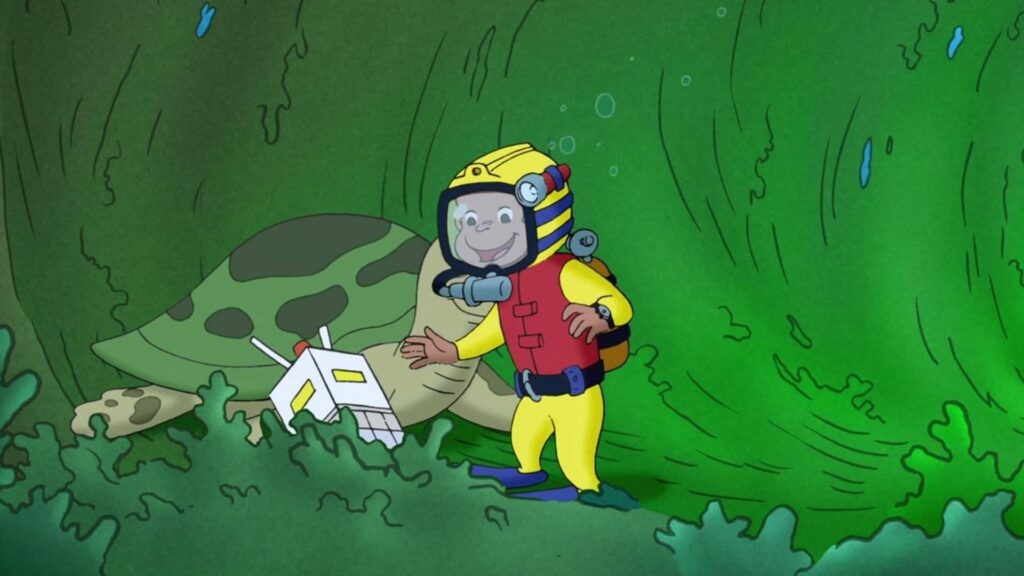
Curious George is a modern reboot of the classic tales about the curious little monkey and his friend, The Man With The Yellow Hat. After George sees some “sea monkeys,” he is fascinated by the tiny creatures and wants some of his own. Using his imagination and a magnifying glass, he attempts to find them in the wild. His curiosity leads him to the local pond, where he learns about the microscopic world living in the water. George discovers that while “sea monkeys” are actually brine shrimp, the pond is teeming with other small organisms, such as tadpoles and minnows, each with its own unique way of moving and growing.
What “Sea Monkey” Teaches Kids About Marine Life: “Sea Monkey” introduces children to underwater creatures, including brine shrimp, and highlights the hidden biodiversity found in small bodies of water. It teaches kids about the life cycles of freshwater aquatic creatures, specifically how tadpoles eventually transform into frogs. By using a magnifying glass as a scientific tool, the show encourages young viewers to observe the “unseen” parts of sea and pond life, emphasizing that even the smallest organisms play a big role in their environment.
Age Range: 3-7
Where To Stream: Hulu
Dinosaur Train — “Maisie Mosasaurus” (Season 2 Episode 25)

Dinosaur Train follows Buddy, a T. rex adopted by Pteranodons, as they ride the Dinosaur Train to learn all about Dinosaurs. In “Maisie Mosasaurus,” The Pteranodon family boards the Dinosaur Train Submarine to explore the Western Interior Seaway. There, they meet Maisie Mosasaurus and her father, Marvin. Maisie is a large, fast-swimming marine reptile with powerful flippers and sharp teeth. The kids are surprised to find that, despite being a formidable sea creature, Maisie is actually afraid of diving into deep, dark water. She and Shiny Pteranodon bond over their shared preference for the sunlit surface, where they spend the day racing and demonstrating how their respective families hunt for fish.
What “Maisie Mosasaurus” Teaches Kids About Marine Life: This episode introduces children to prehistoric marine reptiles, specifically the Mosasaurus, and explains how they differ from dinosaurs. It explains that Mosasaurs were air-breathing lizards with flippers, meaning they had to surface to breathe. Kids learn about “surface-dwelling” marine life and the various food sources found in the sunlit zone, such as fish, squid, and ammonites. It also highlights physical adaptations, showing how large flippers and streamlined bodies enable high-speed swimming in the ocean.
Age Range: 3-6
Where To Stream: PBS Kids, Prime Video
H2O: Mermaid Adventures – “It’s in the Bag!” (Season 1, Episode 7)

In this spinoff of the live-action series, three teenage girls—Emma, Rikki, and Cleo—transform into mermaids with magical powers whenever they touch water. They protect the ocean and its creatures while keeping their identities a secret. In this episode, the mermaids face a frantic situation when Emma accidentally loses her favorite bag, which contains a special item. Their search leads them deep into the underwater world, where they must navigate various reef obstacles and interact with sea creatures to track it down. The mission becomes a race against time to retrieve the bag before it drifts away or is discovered by someone who might reveal their secret identities.
What “It’s In The Bag” Teaches Kids About Marine Life: This episode teaches children about how currents and tides affect the movement of objects in the ocean. It highlights the problem of marine debris and how human-made items can disrupt natural aquatic habitats. By following the girls’ journey, viewers learn about the seafloor topography, including caves and coral crevices, and see how different fish use these structures for shelter as they navigate the complex, ever-changing underwater environment.
Age Range: 7-12
Where To Stream: Netflix
Paw Patrol – “Pups Save Puplantis” (Season 4, Episode 26)
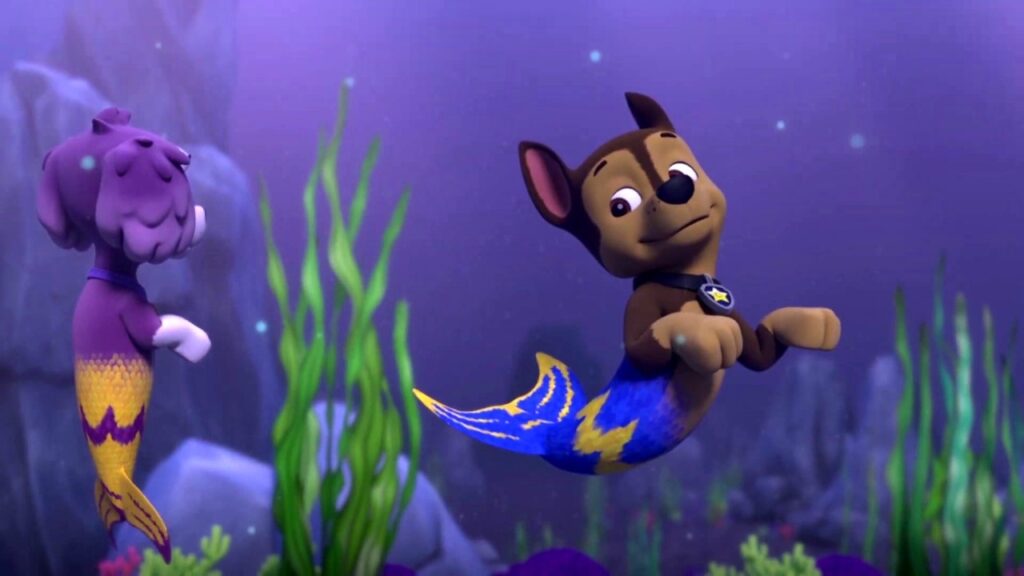
The PAW Patrol is a team of adorable puppies who make rescues and save the day around Adventure Bay in their custom vehicles. In this aquatic adventure, the PAW Patrol is magically transformed into Mer-pups to visit the hidden underwater city of Puplantis. Trouble arises when Sid the Pirate and his first mate, Arrby, plot to steal the legendary Pearly Shell, which gives Puplantis its magic. The Pups must use their new underwater abilities and specialized Sea Patrol gear to outsmart the pirates. Through teamwork and bravery, they protect the city and ensure the magical shell remains safe in its rightful home.
What “Pups Save Puplantis” Teaches Kids About Marine Life: In Puplantis, there’s a lot of glowing going on! This episode teaches children about bioluminescence through the glowing flora and fauna of the magical city. It teaches kids about the importance of protecting underwater landmarks and the delicate balance of aquatic ecosystems. By featuring characters that mimic the movements of seals and fish, the show encourages viewers to consider how different body shapes and “fins” are necessary for propulsion and agility in an environment where gravity behaves differently from land.
Age Range: 3-8
Where To Stream: Paramount+
Gabby’s Dollhouse – “CatRat’s KittyFish” (Season 8, Episode 6)

In Gabby’s Dollhouse, cat enthusiast Gabby transforms into a tiny version of herself to go on adventures with her favourite cats in her dollhouse. In this episode, CatRat discovers he has a special “KittyFish” tail, sparking a bubbly underwater adventure. Gabby and Pandy join him as they dive into the fantastical undersea world in the SS MerCat. They explore the wonders of the ocean floor and help CatRat embrace his new aquatic side while playing games and solving sea-themed puzzles.
What “CatRat’s KittyFish” Teaches Kids About Marine Life: This episode introduces young viewers to aquatic adaptation by showing CatRat learn to use his tail to navigate the water. “CatRat’s Kittyfish” also highlights the beauty of coral-like structures and underwater “neighborhoods,” fostering a sense of wonder about the seafloor. Kids learn to associate the ocean with cleanliness and health, while the episode encourages imaginative play involving the diverse shapes and colors found in marine ecosystems.
Age Range: 5-11
Where To Stream: Netflix
The Creature Cases – “The Mystery of The Missing Milk” (Season 5, Episode 1)

In The Creature Cases, animal Agents Sam Snow and Kit Casey traverse the globe, helping out and learning about the fascinating creatures of the earth. In “The Mystery of the Missing Milk,” they travel to a North American beach to investigate a thief who has stolen the milk meant for a group of baby elephant seals. The agents explore the coastal habitat, interviewing suspects like a fast-flying seabird while managing the urgency of feeding the pups. The mystery deepens when a baby seal nearly tumbles into a sea of sharks, requiring a daring rescue before the duo finally uncovers the culprit.
What “The Mystery of the Missing Milk” Teaches Kids About Marine Life: This episode educates children about elephant seals, focusing on their dietary needs and territorial behavior. It teaches kids that baby seals rely on nutrient-rich milk for survival and highlights the coastal environment where they breed. By depicting interactions with other beach-dwelling species and the dangers posed by marine predators such as sharks, the show illustrates the “food web” and the natural challenges marine mammals face in their early stages of life.
Age Range: 4-8
Where To Stream: Netflix

