

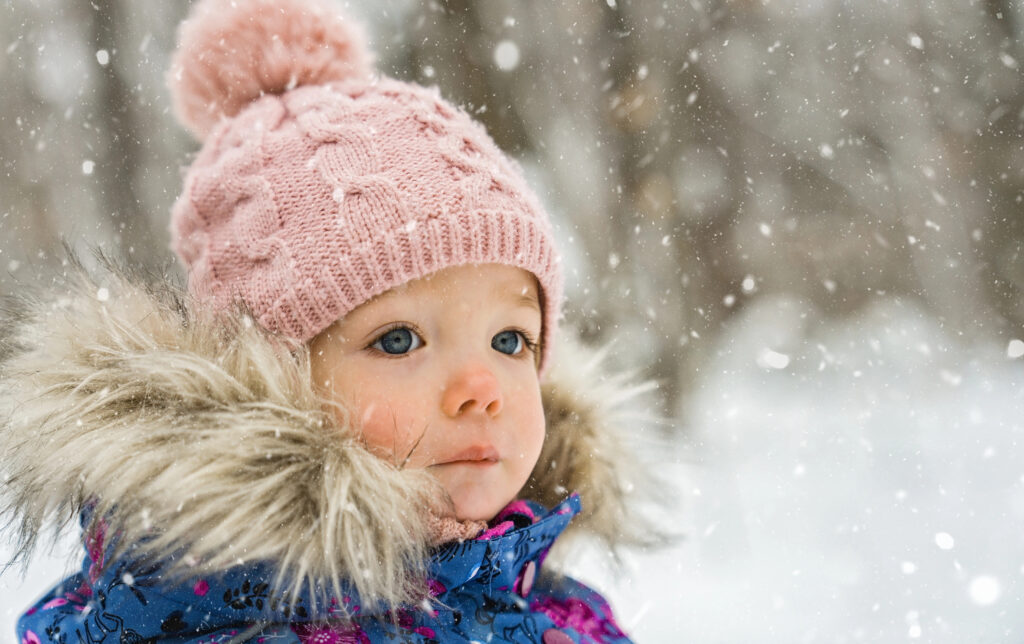
My first baby was born in the winter, and the first time we left the house (to buy groceries) I had my first experience with a well-meaning stranger trying to help by telling me how cold my baby must be (dressed in warm clothes, in a carrier I was wearing, and with a light blanket over that, in a grocery store).
Parents and strangers alike expend a lot of concern about babies being too cold, but often overlook how easy it can be to overbundle a baby, causing the baby to overheat and suffer, even in winter.
Pediatricians warn that too much bundling, while an understandable instinctive effort to protect our little ones, can actually do harm.
Overbundling Can Lead To Overheating
The general rule of thumb is to wrap your little one in one more layer than the adults are wearing.
Babies do not regulate body temperature as efficiently as adults and can get too hot or too cold more easily. They also can’t tell us how they’re feeling, so parents have to observe for signs. Cold hands or feet can be a sign your baby is too cold, while sweating or changes in breathing can be a sign your baby is overheated.
Overbundling can even raise your baby’s body temperature. Dr. Christina Johns, MD, MEd, FAAP, says that she’s seen babies brought in by parents worried about a fever, only to unbundle them and find that there is no true fever, caused by illness. Instead, the babies may just be overheated.
Writing for PM Pediatric Care, she also warns that overbundling can increase the risk of SIDS.
When To Put On Socks, Booties, & Hats
Layering is always key, but should your baby be wearing a hat? What about socks?
Since a lot of body heat can be lost through the hands, feet, and head, it’s important to keep these areas warm when heading out in the cold. However, the Children’s Hospital of Chicago warns against wearing the hat inside.
They warn that a hat in a warm house can make it much harder for babies’ bodies to regulate temperature and increase the risk of overheating.
Outside, pay close attention to these clothing items and watch for dampness! If your baby’s mittens, socks, or hat become wet, they should be replaced with dry ones immediately.
Keeping layers dry is an essential part of bundling appropriately, and it’s also another reason that too many layers (causing sweating) can be a problem.
Overbundling In The Car Adds Extra Concerns
In the car, you may not notice your overheating baby’s face turning red and sweaty, but there’s another serious risk of overbundling.
If you’ve got too many layers on your baby, or even one too-thick layer, the car seat straps will not do an efficient job of keeping him safe. Babies (and bigger children) should never wear heavy coats in carseats.
Instead, you can wrap a light blanket around your baby over the car seat straps, or use an approved car seat cover (but still watch out for overheating). Or, put the coat on once you reach your destination.
One ER doctor recommends warm leggings or a fitted fleece top and shares that she’s encountered scary incidents where babies in crashes have simply slid right out of their car seats because of the extra bulk of a heavy coat!
Always Keep Safe Sleep Practices In Mind When Dressing Baby For Bed!
It’s nice to bring a baby home to a lovely, warm house, but the reality is, many homes can still be chilly. Older homes can be drafty or have inefficient heating systems; apartment buildings can be questionable for heating; and with heating prices, many families are just turning the thermostat down a notch anyway.
Bundling up for bed with layers of blankets may be cozy for adults, but it can be risky for little ones.
Remember that babies should not have loose blankets in their cribs; a swaddle should be enough for warmth without being so heavy as to cause overheating.
The Sleep Foundation says that baby sleep sacks can be a good choice, but shouldn’t be used once the baby starts rolling over, and that the same applies to swaddling. A too-tight swaddle can also restrict breathing, so use caution in wrapping your baby!
Instead, they recommend light layers, with one more layer for the baby than an adult feels comfortable with in the same room.
