

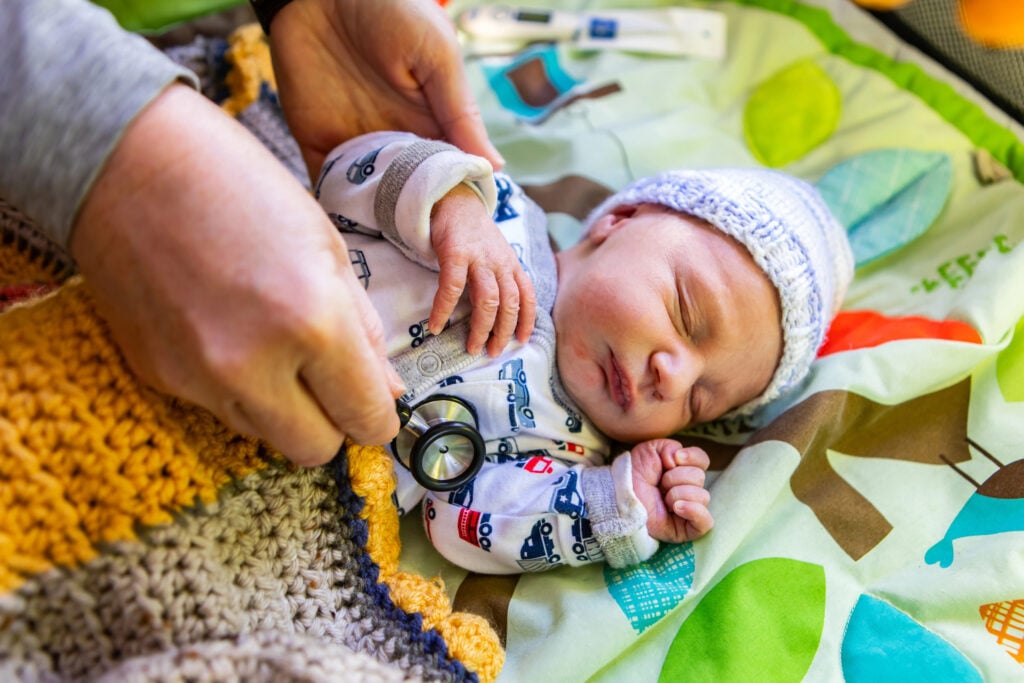
When your baby is born, he’ll immediately undergo an Apgar score and will soon after have a hearing and blood test. When genome screening becomes a standard option alongside these tests, should you opt in?
As genetic testing technology marches forward, there’s increasing discussion of a time when newborn genome screening could be standard, even universal. Now, some researchers are calling for more caution.
If you’re offered this type of newborn screening for a future pregnancy, will you opt in?
What’s The Risk Of A Genetic Variant?

If you think back to what you learned about genetics in high school biology class, you probably remember a simple version. Most of us were taught that we get two copies of each gene, one from each parent, and that the different combinations result in different outcomes (phenotypes). We know that dominant genes show up even if you only have one copy, and recessive genes take two copies.
In practice, genetics is more complex, and increasingly large-scale studies show that some genetic variants associated with health outcomes may not actually result in those outcomes.
A group of researchers at the University of Exeter is calling for caution in rolling out these programs, based on the evidence they’re gathering about specific genetic conditions. For example, in one preprint in MedRxIV, researchers address heritable retinoblastoma (eye cancer). Previous data had suggested that people with a certain genetic variant were extremely likely to develop the disease, but the newest large-scale study suggests that as few as 25% of individuals with this gene variant had been diagnosed with retinoblastoma by age 60.
The team is publishing other papers examining more than 50 genes associated with 15 different conditions and the likelihood that a person with the genetic variant will actually develop the condition.
What Does All Of That Mean For Parents & Newborns?
Researchers are concerned that if genome sequencing is rolled out too quickly, there’s a potential for overdiagnosis.
The risk is that parents and pediatricians could find themselves with an expectation that a given disease or disorder is inevitable (or nearly so) in a baby’s future, and make decisions accordingly, only for the reality to be that far fewer babies than expected will develop the condition.
This can fuel parental anxiety and cause limited healthcare resources to be directed towards problems that turn out to be much smaller than expected, potentially cutting funding for other areas.
News-Medical quotes Professor Caroline Wright, of the University of Exeter Medical School, explaining why it’s important for these programs to be rolled out with caution.
“We urgently need the best evidence to ensure we get this right. The benefits of a successful programme will be profound, but we need to be aware of the risk of overdiagnosis based on current evidence. Being told your baby is at high risk of developing disease has a massive impact on families – we need to ensure we use the most accurate risk estimates possible in order to provide the best care.”
What Should Parents Do?
If you’re offered genetic testing, discuss it with your doctor.
Ask about the potential benefits and risks for your child. The best choice may vary. For instance, a parent who knows that their family history includes heritable conditions that benefit from early diagnosis may find more benefits than risks in early genetic screenings, either in a limited capacity for that specific condition, or more broadly.
However, parents should not take the presence of a genetic variant as a definitive prediction of a health condition. Instead, any genome sequencing should be discussed with your pediatrician to understand the implications.
