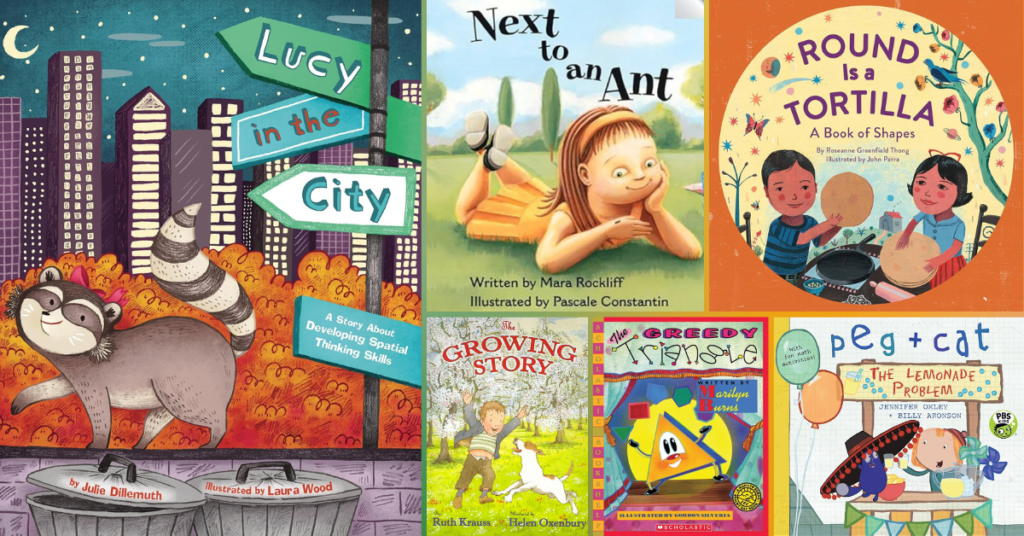
As a parent of four, I’ve learned that the right children’s books about math don’t just “teach” numbers, they reframe the whole subject as a story your child actually wants to revisit. When math shows up as a mystery to solve, a cookie-sharing dilemma, or a silly problem that needs a clever workaround, kids stop bracing for a worksheet and start leaning in to foundational concepts.
What I like most about math picture books is how naturally they scale across ages. One child can enjoy the rhythm, illustrations, and simple counting on the first read, while older siblings can pause to predict answers, explain strategies, or notice patterns. As a homeschool family, my wife and I have had the opportunity to closely watch our kids develop their math skills, and I’ve noticed that even our kids who have progressed beyond picture books academically still appreciate a smart premise, a quick visual puzzle, or a wait that is actually a clever moment when younger siblings are reading.
This list focuses on stories that make concepts tangible, measurements your child can picture, division your child can act out, and big numbers they can imagine. Each children’s book about math below includes specific math subjects and a clear age range, so you can match the right read to the child you’ve got in front of you. And while you’ll absolutely find addition, subtraction, and other basic math concepts here, the picks also cover the quieter math kids use to build early spatial awareness and positional language with shapes and geometry, mapping and navigation, scaling and comparison, and how children learn about math through physical growth, perspective, and real-world problem solving.
My wife has two master’s degrees in English and Library and Information Science, so to say we’ve checked out hundreds of math picture books from our local library (where she is the President) is probably an understatement. This list includes both books we own and titles we’ve checked out multiple times over the years, as our three, eight, 11, and 14-year-old children have all progressed through or started their math journeys.
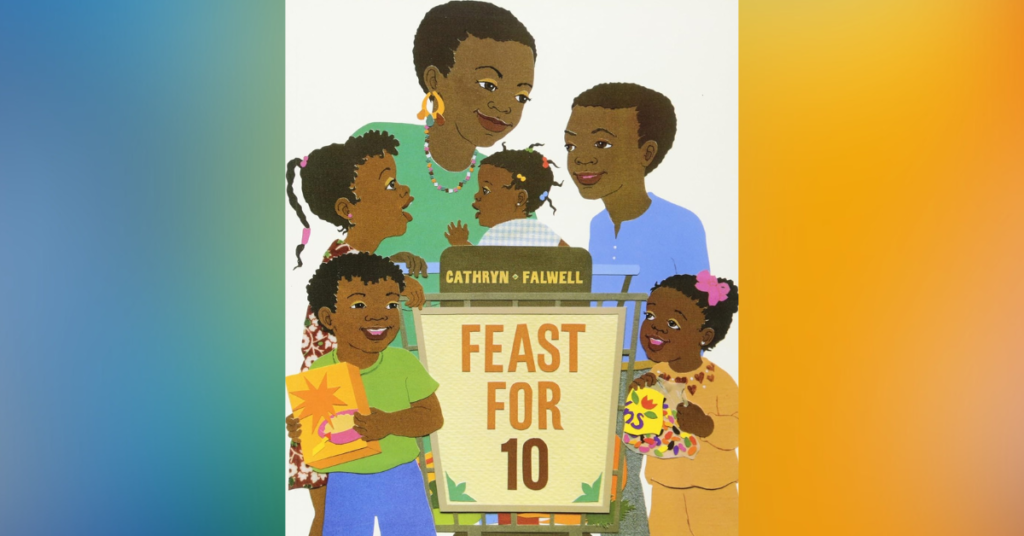
Feast For 10 By Cathryn Falwell
Math Subjects Explored: Counting 1–10, addition, sequencing, and one-to-one correspondence.
Recommended Ages: 2–5 years old
A family prepares a meal together, following a numerical journey from the grocery store to the dinner table. The story is split into two rhythmic counting sequences: first, the family gathers “one cart,” “two pumpkins,” and “three chickens” at the market; then, they return home to wash, cook, and set the table for ten hungry people. The vibrant collage illustrations and bouncy text make the math feel like a natural part of a warm family tradition.
While many counting books stop at identification, Feast for 10 reinforces one-to-one correspondence, the ability to match a specific number name to a specific object, by showing the items clearly arranged on the page. Because the book repeats the 1–10 sequence twice (once for shopping and once for preparation), it solidifies number order and sequencing. It also serves as a gentle introduction to addition as children see the total number of items on the table grow. By linking math to the familiar rhythms of shopping and cooking, the book shows young children that numbers are useful tools for organizing their daily lives.
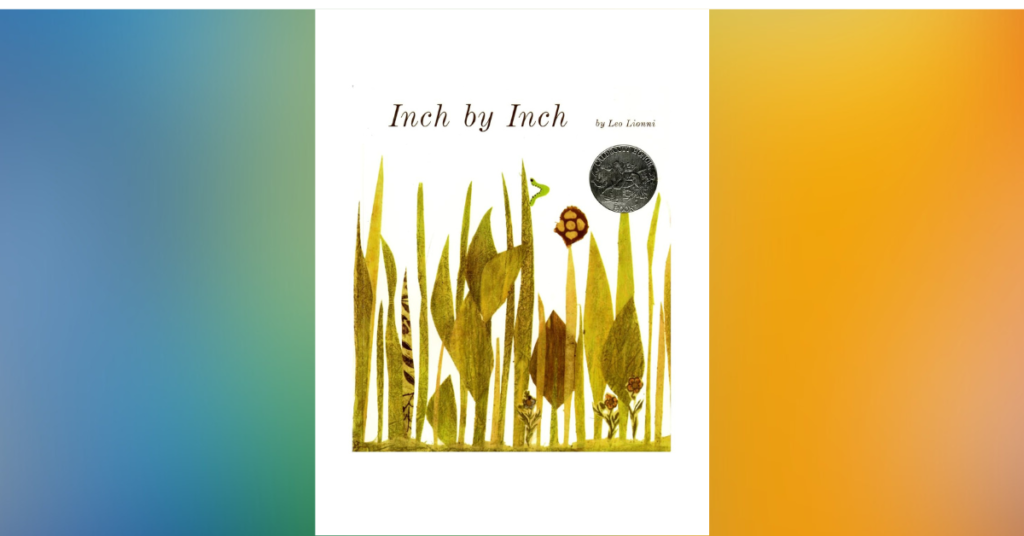
Inch by Inch By Leo Lionni
Math Subjects Explored: Measurement, length, comparison, estimation
Recommended Ages: 3–7 years old
A small inchworm travels through nature, measuring everything in his path—robin’s tail, flamingo’s neck, and more, turning the outdoors into a playful measurement lab. The premise is simple enough for preschoolers to enjoy, but the repeated-measuring structure creates a satisfying pattern: see something interesting, measure it, and move on. The tension spikes when a hungry bird gives the inchworm a dangerous request—measure her song, or become lunch, forcing the inchworm to think fast and use what he knows in a creative way.
This is a particularly effective early math book because it makes “an inch” feel real without requiring rulers or formal tools. Kids learn that measurement is about consistent units and comparison, and they naturally start noticing relative size: longer, shorter, bigger, smaller. It also opens the door to estimation—your kid can guess how many inches something might be and then “inch” along with a finger to test the idea. If you want an easy follow-up activity, measure a few household objects “inchworm-style” using a paper strip marked into equal segments to reinforce the concept of equal units.
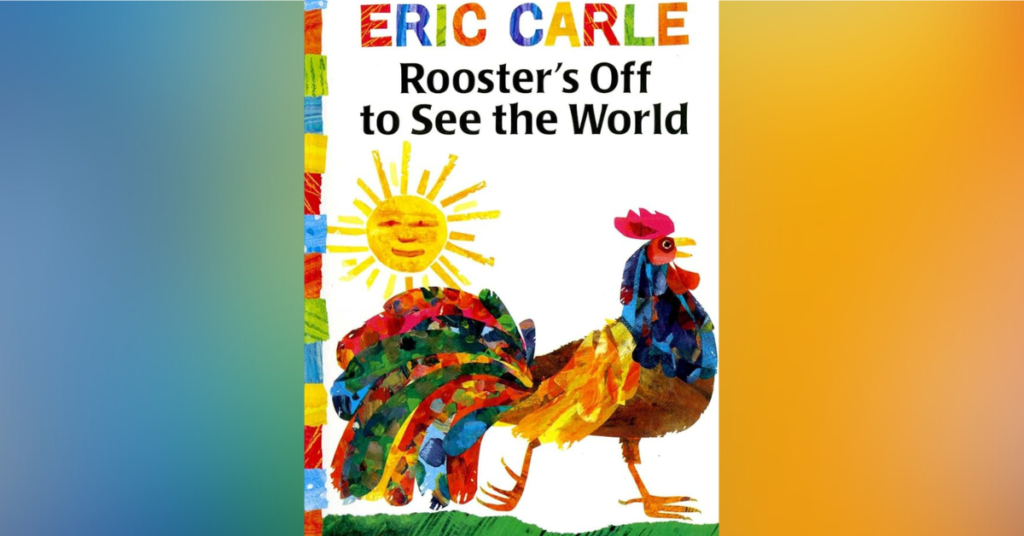
Rooster’s Off To See The World By Eric Carle
Math Subjects Explored: Addition, subtraction, sets, and sequencing
Recommended Ages: 3–6 years old
Rooster sets out on an ambitious journey to see the world, but he soon realizes that traveling is much better with company. As he marches along, he is joined by sets of animals in a distinct numerical progression: two cats, then three frogs, then four turtles, and finally five fish. However, as night falls and the group grows hungry and homesick, the process reverses. The animals leave in their respective groups until Rooster is once again alone, returning home to sleep.
From a math perspective, this book is a masterclass in introducing addition through sets. Unlike simple counting books that add one object at a time, Eric Carle introduces the concept of adding groups (1+2+3+4+5). This helps children move toward “subitizing,” or the ability to recognize a small group of objects without counting each one individually. When the animals depart, the story provides a clear visual model for subtraction, showing how the total decreases as specific sets are removed.
Anno’s Counting Book By Mitsumasa Anno

Math Subjects Explored: Counting, sequencing, patterns, increasing quantities
Recommended Ages: 3–7 years old
This wordless counting book takes readers through the seasons as numbers quietly increase from page to page. Each spread adds one more of something: people, animals, and objects, inviting kids to search, count, and notice changes. Because there is no text explaining what to do, children naturally take an active role in discovering the math on each page. The detailed illustrations reward careful observation, making repeated readings just as engaging as the first.
Mathematically, the book supports one-to-one correspondence, counting order, and pattern recognition. Kids aren’t just counting isolated objects; they’re tracking how quantities grow over time and how those changes fit into a larger scene. This makes it particularly effective for developing number sense rather than rote counting. Parents can easily adapt the experience to different ages by asking open-ended questions like “What changed?” or “What stayed the same?,” which helps kids connect counting to real-world observation and logical thinking.
Mouse Count By Ellen Stoll Walsh
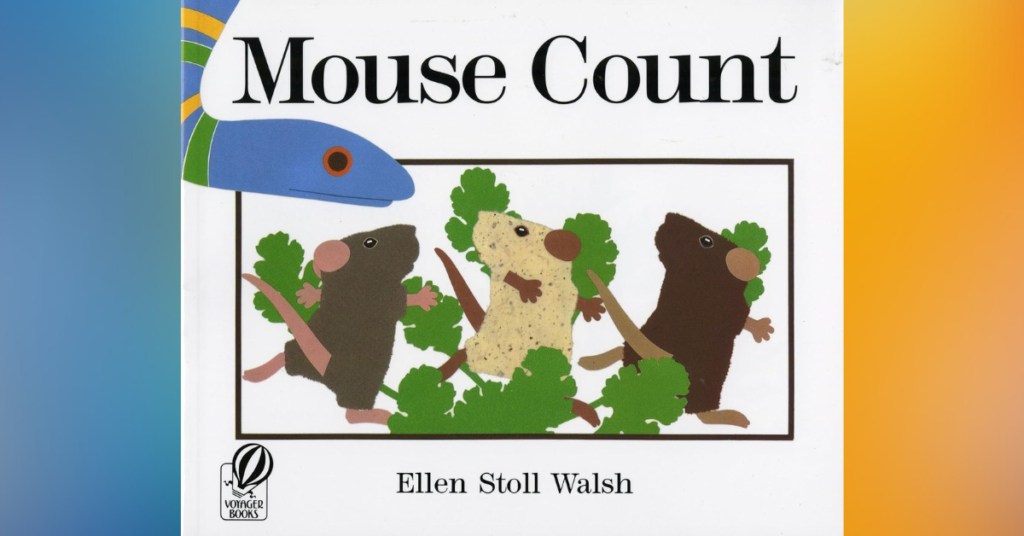
Math Subjects Explored: Counting 1–10, subtraction (counting down), set reversibility, and one-to-one correspondence.
Recommended Ages: 3–6 years old
In this clever suspense story, a hungry snake finds a group of nap-taking mice and decides to fill a jar with his dinner. As he captures them, the snake counts from one to ten, providing a clear visual representation of a set growing larger. However, the mice eventually outsmart the snake and make their escape, forcing the snake (and the reader) to count them all the way back down to zero.
The true mathematical power of Mouse Count lies in its demonstration of number reversibility. By showing the mice entering the jar and then exiting, children learn that subtraction is essentially counting in reverse. The “jar” serves as a clear visual container for a set, helping children understand that the number ten isn’t just a label but a collection of ten individual units. Because the mice are large and easy to point to, this book is ideal for practicing one-to-one correspondence. The gentle tension of the story keeps kids focused on the “how many” as they root for the mice to escape, making the concept of “counting down” feel purposeful rather than a rote exercise.
The Shape of Things By Dayle Ann Dodds
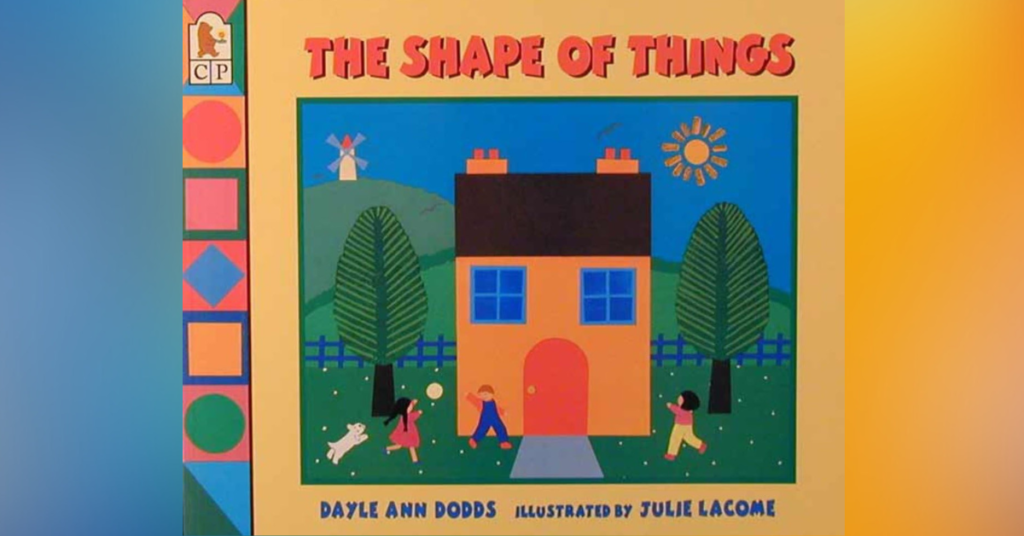
Math Subjects Explored: Geometry, shapes, spatial reasoning, composition
Recommended Ages: 3–7 years old
Simple shapes combine to create familiar objects such as a house, a boat, and a tree, showing kids how basic geometric forms make up the world around them. The clean illustrations and short text keep the focus on visual discovery, making it easy for young readers to spot shapes and see how they fit together.
This children’s book on math strengthens geometric vocabulary and spatial reasoning by encouraging kids to mentally decompose and recompose shapes. Rather than memorizing shape names in isolation, children learn how shapes work together to form more complex structures. It’s an excellent foundation for later geometry skills and a natural fit for hands-on extensions, like building pictures from paper shapes or blocks.
Circus Shapes By Stuart J. Murphy
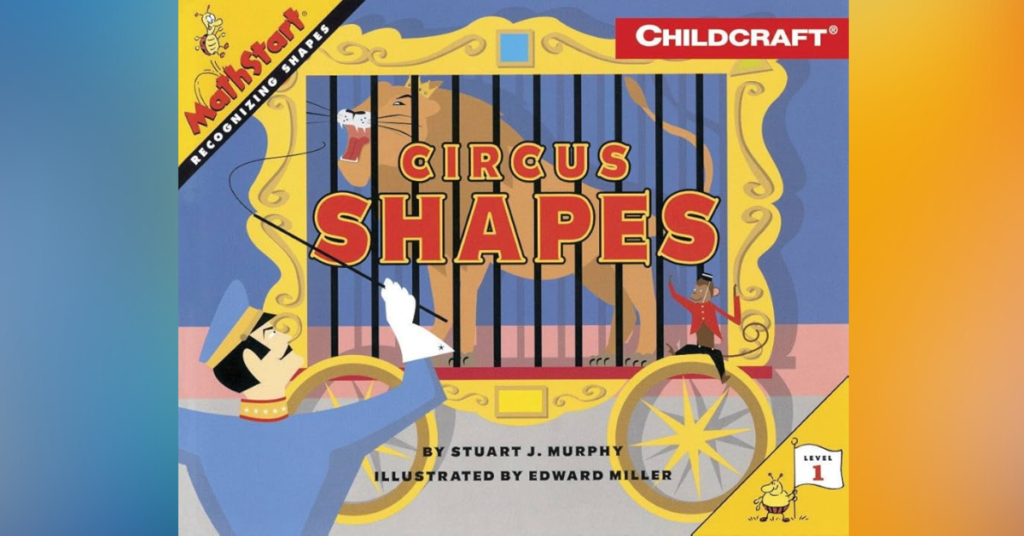
Math Subjects Explored: Geometry, shape recognition, spatial awareness
Recommended Ages: 3–6 years old
Set against the lively backdrop of a circus, this book introduces shapes through performers, props, and scenes that naturally incorporate circles, triangles, rectangles, and more. Each page highlights a specific shape while embedding it into an engaging illustration, helping kids see geometry as part of the real world rather than isolated symbols. The circus theme adds energy and humor, keeping young readers interested from start to finish.
From a math standpoint, the book supports early geometry by reinforcing shape identification and vocabulary. Kids learn to spot shapes in different orientations and sizes, which is an important step beyond simply recognizing a shape in its “perfect” form. This flexibility strengthens spatial reasoning and prepares children for more advanced geometric thinking later on. It’s especially effective for preschoolers who are just beginning to label and recognize shapes in everyday environments, such as playgrounds, signs, and buildings.
Mouse Shapes By Ellen Stoll Walsh
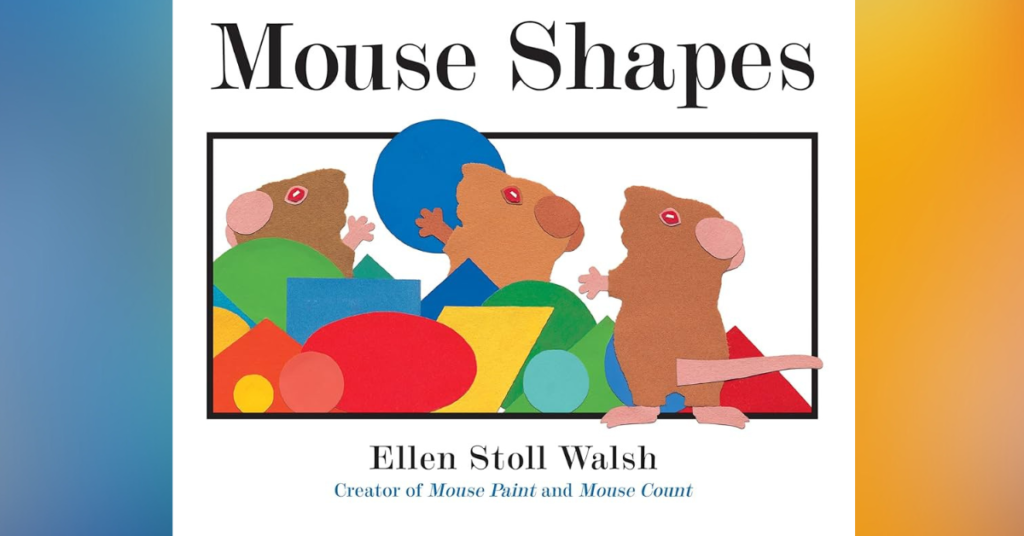
Math Subjects Explored: Geometry, composition, and decomposition of shapes, spatial reasoning
Recommended Ages: 3–7 years old
Three mice explore a box filled with colorful shapes and begin building pictures—houses, people, and other objects using only those basic forms. When a cat appears, the mice must quickly use their shapes to solve a problem, turning abstract geometry into a survival tool. The story balances playful creativity with gentle suspense, making it memorable and engaging.
This book excels at showing how shapes combine to form more complex figures. Kids see firsthand that geometry isn’t just about naming shapes; it’s about how shapes relate to one another in space. The mice’s construction model decomposition (breaking pictures into shapes) and composition (building pictures from shapes) are both foundational spatial skills. These concepts directly support later math learning, including geometry, fractions, and even early algebraic thinking. It’s also a strong hands-on companion that kids can use to recreate scenes using pattern blocks or cut paper shapes.
Rosie’s Walk By Pat Hutchins

Math Subjects Explored: Spatial relations, positional language, sequencing
Recommended Ages: 3–6 years old
Rosie the hen takes a simple walk around the farm, unaware that a fox is following her and repeatedly getting into trouble. The humor unfolds visually, but the text focuses on Rosie’s path—around, over, under, and through various farm obstacles. The contrast between the calm narration and chaotic visuals keeps kids entertained.
This book is excellent for teaching spatial vocabulary and directional concepts. Kids learn positional words in context, seeing exactly what “around the haystack” or “under the beehives” means. These spatial concepts are critical precursors to geometry and problem-solving. Sequencing also plays a role, as children track Rosie’s path from start to finish. Because the language is simple and repetitive, it’s especially effective for younger readers developing foundational math vocabulary.
Five Creatures By Emily Jenkins
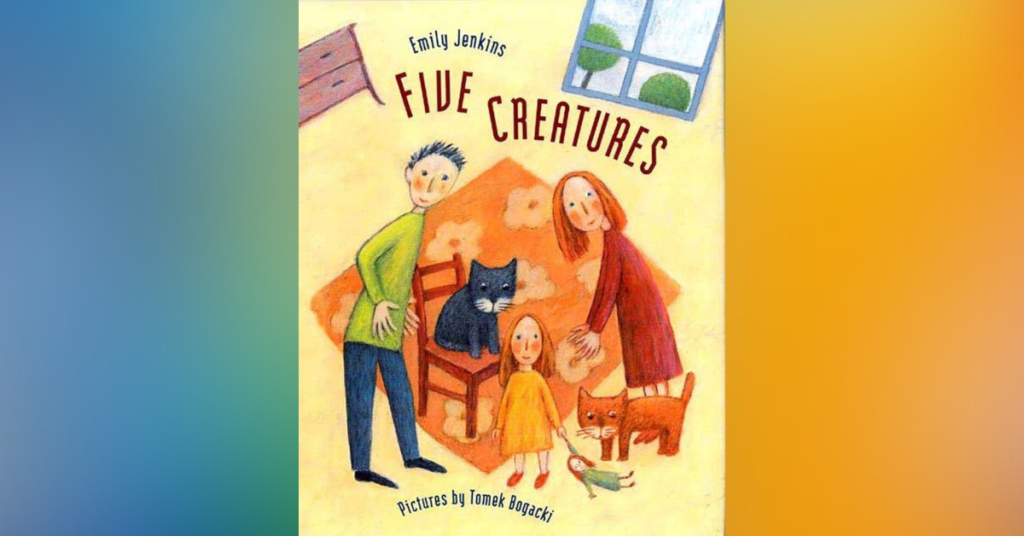
Math Subjects Explored: Counting, comparison, observation, number sense
Recommended Ages: 3–7 years old
In Five Creatures, a simple refrain guides readers through a counting story where the quantity and characteristics of creatures invite careful observation. Your child counts what they see, compares quantities, and looks for patterns in repeated elements. The text’s rhythm, paired with playful illustrations, encourages participation and prediction.
This book strengthens one-to-one correspondence (matching numbers to items) and builds confidence by embedding counting in a narrative rather than presenting it as a drill. Older siblings can extend the experience by asking questions such as “How many more?” or “Which group is bigger?” making it a flexible tool for mixed-age reading.
Over, Under, and Through By Tana Hoban

Math Subjects Explored: Spatial reasoning, positional concepts, visual literacy
Recommended Ages: 3–6 years old
This wordless picture book presents photographs of everyday objects arranged to show spatial relationships—over, under, through, and around. Without text, children are invited to interpret the images and describe what they see, making the reading experience interactive and flexible.
The absence of words shifts the focus entirely to spatial reasoning. Kids must analyze each image to understand the relationship between objects, strengthening their ability to describe position and movement. This kind of visual-spatial thinking is essential for later success in geometry, measurement, and even graph interpretation. The book works well across ages because the complexity comes from discussion; older kids can use more precise language, while younger ones can simply point and describe.
Piggies In The Pumpkin Patch By Mary Peterson

Math Subjects Explored: Counting, addition, subtraction, sequencing
Recommended Ages: 3–6 years old
A group of piggies plays in a pumpkin patch, with pigs appearing, disappearing, and reappearing in predictable patterns. The playful tone and seasonal setting make the story inviting, while the counting structure keeps the math front and center.
This book supports early number sense by encouraging kids to track changing quantities. As piggies enter and leave the scene, children practice counting forward and backward and begin to understand how totals change. The repeated structure reinforces confidence, helping kids anticipate outcomes and check their thinking. It’s an effective, low-pressure way to introduce basic operations in a context that feels fun and familiar.
Inside, Outside, Upside Down By Stan and Jan Berenstain
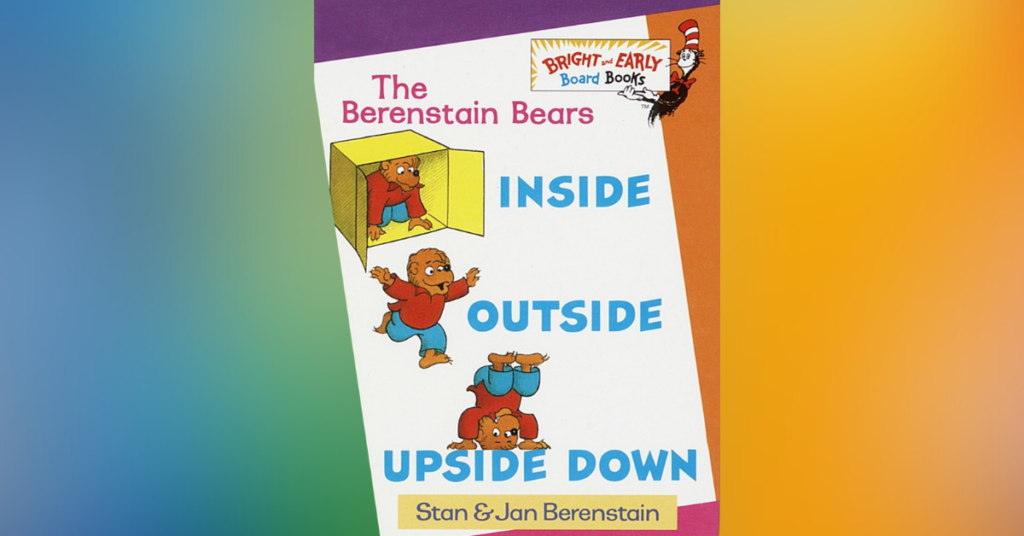
Math Subjects Explored: Spatial reasoning, positional language, orientation
Recommended Ages: 3–6 years old
This book explores everyday situations through the changing perspectives of inside versus outside and upright versus upside down, using familiar characters and settings. The simple text pairs with clear illustrations that emphasize position and orientation, helping kids understand how objects and people relate to their surroundings. The playful tone keeps the learning light while reinforcing important concepts.
Spatial vocabulary is a critical precursor to geometry, and this book delivers it in context. Children learn positional terms not as definitions, but as lived experiences within the story. Understanding orientation—especially concepts like upside down—also strengthens mental rotation skills, which are strongly linked to later success in math and science. The repetitive structure allows your child to anticipate changes and visually check their understanding, reinforcing confidence with spatial language they’ll encounter again in math classrooms.
Up, Down, and Around By Katherine Ayres
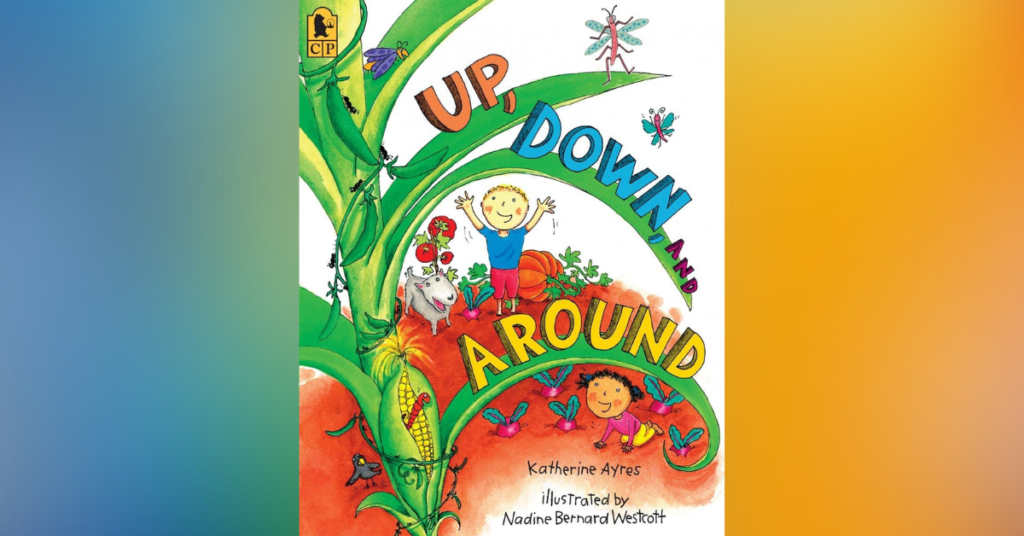
Math Subjects Explored: Spatial relationships, direction, sequencing
Recommended Ages: 3–6 years old
This story follows a garden’s growth cycle, describing how plants grow up, roots spread down, and vines wind around structures. The calm, rhythmic language mirrors the steady progression of nature, making it especially engaging for younger children. Each spread focuses on a different spatial relationship, reinforcing directional language through repetition.
Mathematically, the book strengthens understanding of direction and spatial positioning. These concepts are essential for interpreting graphs, diagrams, and geometric figures later on. Sequencing also plays a role as kids follow the progression from planting to harvest, building a sense of order and cause-and-effect. Because the spatial terms are grounded in real-world experiences, gardens, plants, and growth, children are more likely to internalize and reuse the language naturally during play and learning.
Where’s Spot? By Eric Hill
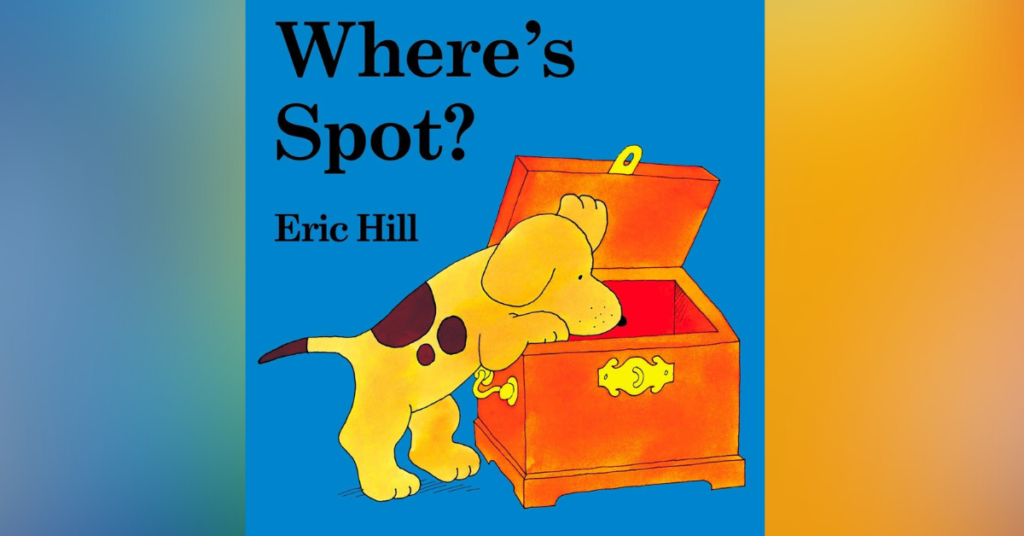
Math Subjects Explored: Spatial reasoning, positional concepts, problem-solving
Recommended Ages: 3–5 years old
This interactive lift-the-flap book follows a parent dog as she searches the house for her missing puppy, Spot. Each flap reveals a different location, prompting children to predict where Spot might be hiding next. The repetition and surprise keep young readers actively engaged throughout.
The math value lies in spatial awareness and logical elimination. Kids learn positional words like under, inside, and behind while practicing problem-solving skills. If Spot isn’t here, where could he be? This process mirrors early deductive reasoning used in math. The physical act of lifting flaps also reinforces engagement and memory, helping children connect spatial language with real locations. It’s an effective early introduction to spatial concepts wrapped in a playful, age-appropriate format. It’s a simple children’s book about math, even when your child doesn’t realize they are learning about the subject. It’s also been a favorite among all four of my children when they were young.
Hippos Go Berserk! By Sandra Boynton
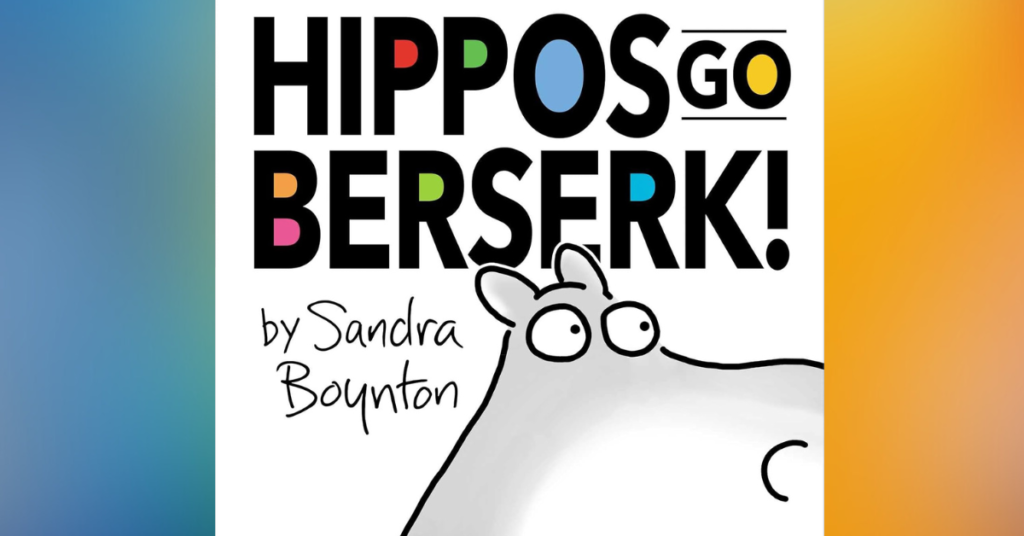
Math Subjects Explored: Counting, addition, subtraction, sequencing
Recommended Ages: 3–6 years old
Two hippos start a quiet evening that quickly turns into a wild party as more and more guests arrive. Eventually, the party winds down and guests leave, reversing the count. The exaggerated illustrations and escalating chaos make the story memorable and funny for young readers.
This book clearly demonstrates counting up and counting down, reinforcing the idea that numbers are dynamic. Kids practice tracking totals as characters enter and exit, strengthening number fluency. The predictable structure builds anticipation and confidence, while visual storytelling helps children self-correct their counting. It’s a lively, engaging way to reinforce basic operations without formal instruction. My kids have all loved the hippos’ silly antics, making it both a fun and educational win in our home.
The Growing Story By Ruth Krauss
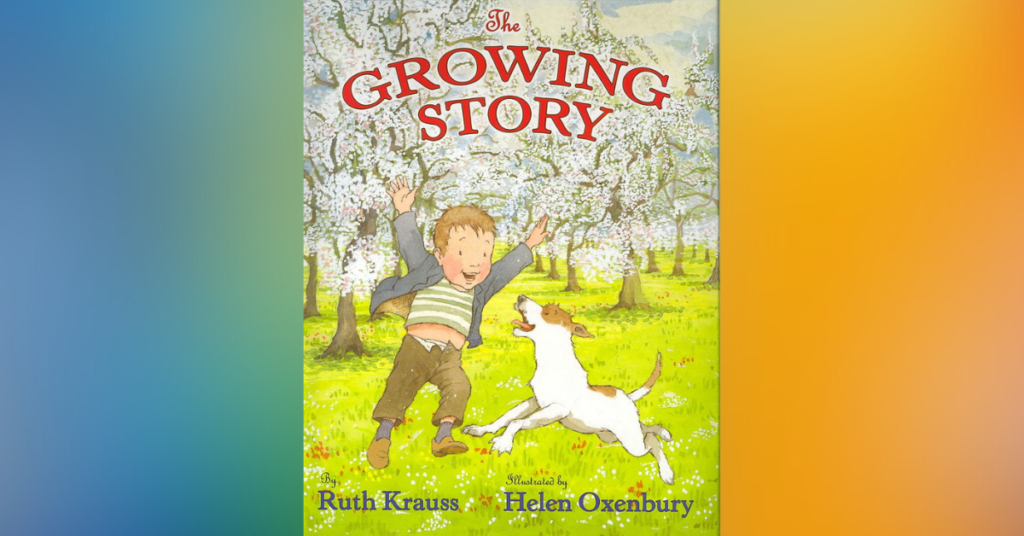
Math Subjects Explored: Measurement, comparison, sequencing, change over time
Recommended Ages: 3–6 years old
This gentle story follows the gradual growth of a child, a puppy, and a plant, all unfolding side by side. Each spread emphasizes how things change incrementally, encouraging children to notice differences in size, height, and development over time. The illustrations are soft and minimal, making the progression easy for young readers to track without distraction.
From a math perspective, the book introduces the idea of measurement without numbers, focusing instead on comparison and sequencing. Children learn that growth happens in stages and that “bigger” and “smaller” are relative concepts tied to time. This builds early measurement intuition and helps kids understand ordered sequences—skills that support later work with timelines, number lines, and data representation. It’s especially effective for preschoolers beginning to grasp that math can describe real-life changes, not just static quantities.
Fish Eyes: A Book You Can Count On By Lois Ehlert
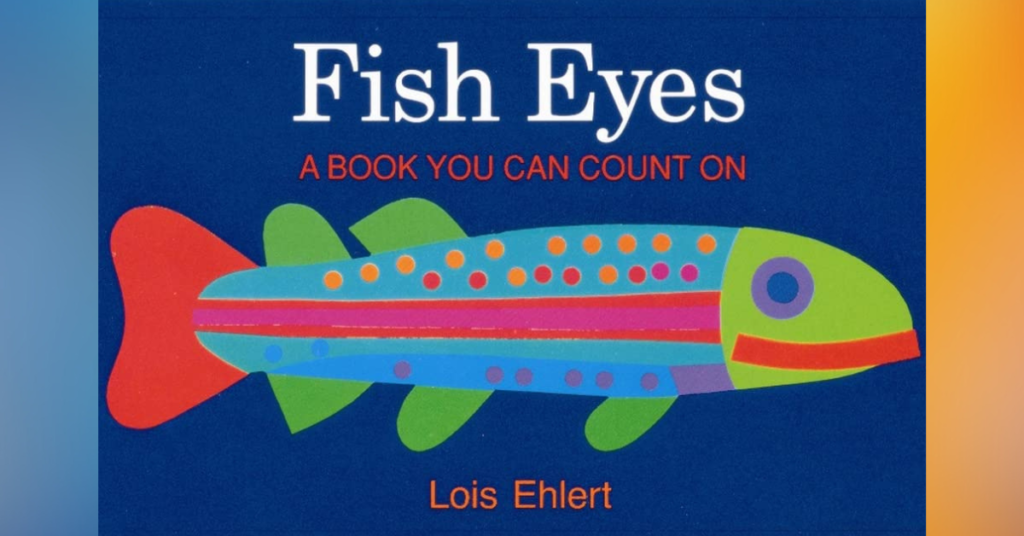
Math Subjects Explored: Counting, grouping, number patterns
Recommended Ages: 3–7 years old
This visually striking book invites children to count fish eyes, scales, and repeating patterns across bold, colorful illustrations. Each page encourages close inspection, rewarding attention to detail and active participation.
Mathematically, this book strengthens one-to-one correspondence and introduces grouping as a counting strategy. Children begin to recognize patterns and repeated units, which support early multiplication and skip-counting concepts later on. The artistic presentation makes counting feel exploratory rather than rote, appealing especially to visual learners. By blending art and math seamlessly, the book reinforces the idea that numbers can be playful, creative, and engaging.
Sort It Out! By Barbara Mariconda
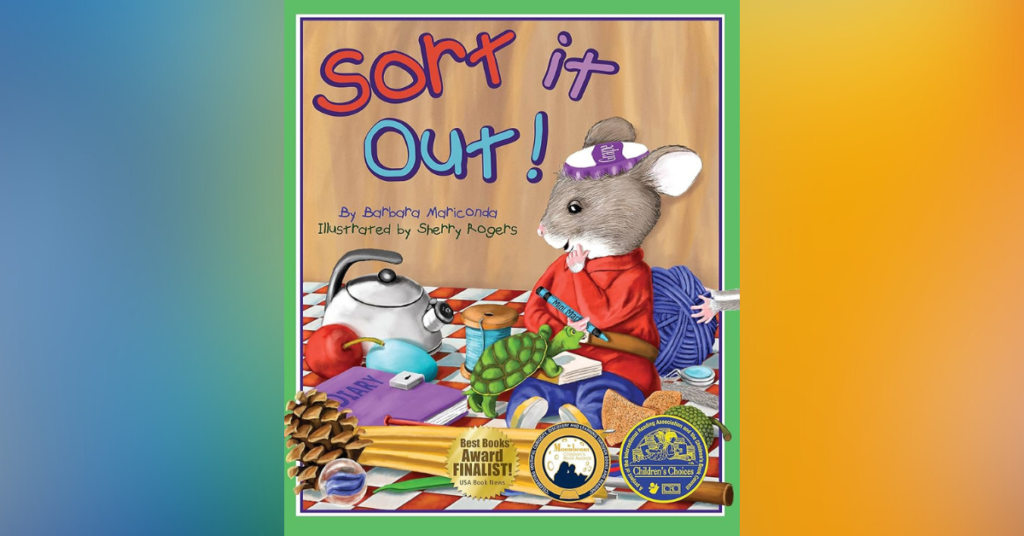
Math Subjects Explored: Sorting, classification, sets, categories
Recommended Ages: 4–7 years old
Sort It Out! follows characters as they organize objects into groups by color, size, shape, and function. Rather than showing “correct” categories, the story celebrates multiple ways to think about how things belong together. This reinforces that sorting is an act of reasoning, not memorization.
Your child naturally practices set formation, a core early math skill that underlies data organization and logical thinking. Because the narrative emphasizes decision-making (“Why did you group it this way?”), kids begin to articulate their mathematical reasoning. It’s a perfect extension to hands-on sorting games using everyday materials.
The Chicken Problem By Jennifer Oxley and Billy Aronson
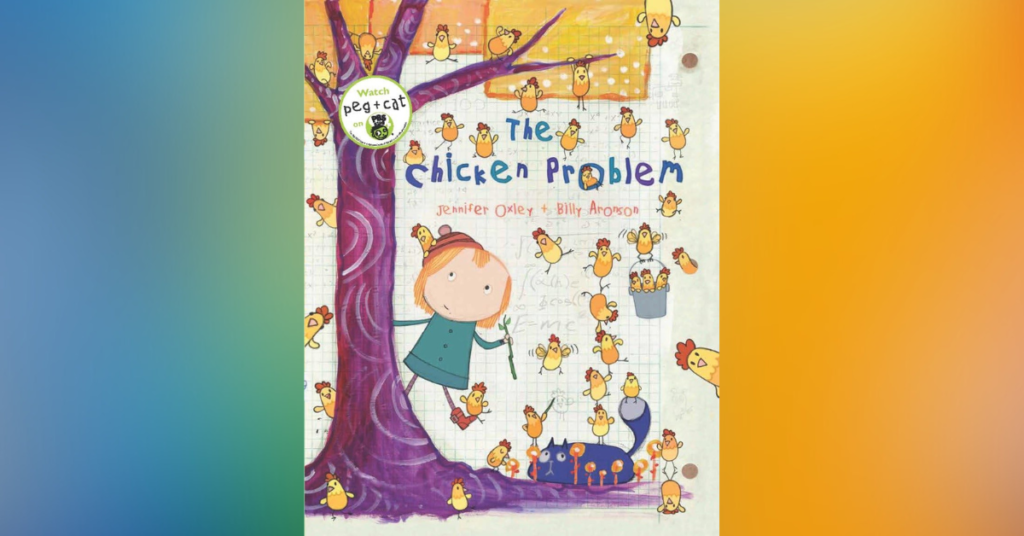
Math Subjects Explored: Counting, problem-solving, logical reasoning, basic operations
Recommended Ages: 4–8 years old
When someone leaves a chicken coop open, and the chicks scatter in every direction, Peg and Cat step in with a calm plan: use math to get everyone back where they belong. The story plays like a friendly “mission,” with Peg and Cat encountering small obstacles that require them to count carefully, keep track of what’s missing, and make sensible choices based on the information in front of them. Kids who already know Peg + Cat from the show tend to fall right into the rhythm—the characters model how to stay patient when things feel chaotic, and that alone is a great “math mindset” lesson for young readers.
From a skills standpoint, the book naturally reinforces counting, sequencing, and early problem-solving. The math isn’t presented as a lecture; it’s embedded in the plot as the tool that enables the solution. That means kids are practicing number sense without feeling like they’re being tested. It’s also a strong read-aloud choice because it invites participation—your kid can help count, predict what comes next, and “check the work” as Peg and Cat try to solve their poultry predicament. Peg + Cat is a huge hit in our family thanks to its adorable TV show, and multiple books from the series have made our list of children’s math books because they handle the subject in a clever, straightforward way that my kids love and understand.
Peg + Cat also made our list of the best cartoons for kids that teach math concepts.
The Doorbell Rang By Pat Hutchins
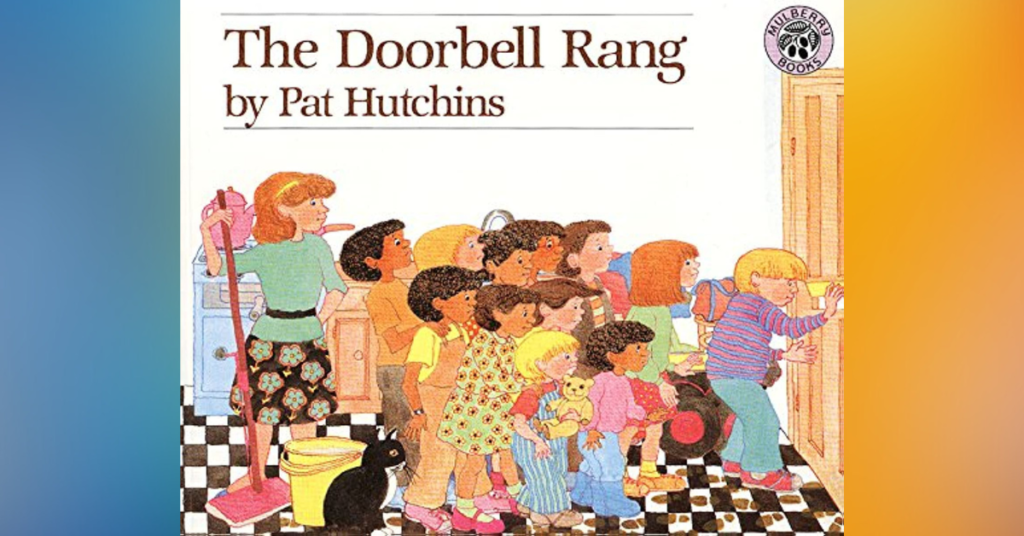
Math Subjects Explored: Division, sharing equally, remainders, and fair distribution
Recommended Ages: 4–9 years old
Sam and Victoria start with a simple situation: they have a dozen cookies to share. Then the doorbell rings, and rings again, and again, until a small group becomes a larger group, and the kids have to keep rethinking what “fair sharing” actually looks like as more friends arrive. The brilliance is how naturally the story forces repeated recalculation: the same set of cookies, a changing number of people, and the constant question of how to divide the total so everyone gets the same amount.
This is a classic children’s book about math because it makes division feel like a real-life problem kids instantly understand. Without using heavy terminology, the book introduces equal groups, the idea that “more people means fewer per person,” and the practical logic behind fair shares. It’s also a simple springboard for hands-on learning: grab 12 small snacks and act out doorbell arrivals to physically model division. For older kids in the 7–9 range, it can become a gentle introduction to remainders and “what do we do with extras?” even if the story itself keeps things kid-friendly and clean.
Each Orange Had 8 Slices: A Counting Book By Paul Giganti Jr.
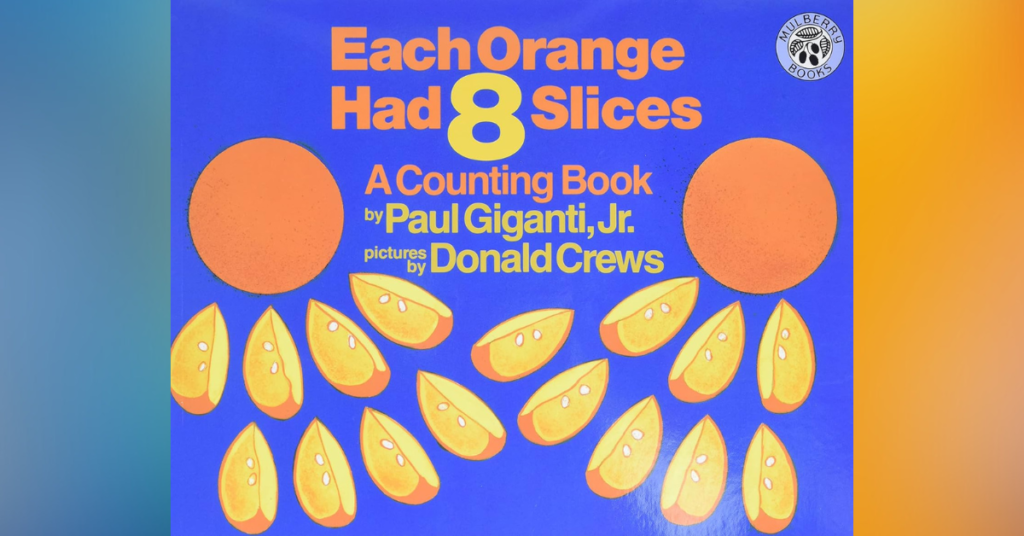
Math Subjects Explored: Counting, multiplication foundations, repeated addition, word problems
Recommended Ages: 4–8 years old
This book reads like a series of quick “math snapshots” from a child’s day: oranges with slices, animals with legs, and everyday scenes that naturally prompt counting. The illustrations do much of the teaching, allowing children to track the objects visually and then check their thinking against the words. What sets it apart is how it quietly moves beyond simple counting into early multiplication thinking. When the text sets up “each” scenarios (each cow has calves, each calf has legs), kids are essentially practicing repeated addition without having to learn formal multiplication notation.
As a children’s book about math, it’s especially effective for families with mixed ages because you can adjust the challenge on the fly. A 3–5-year-old can count objects directly on the page. A 6–8-year-old can start predicting totals, grouping items, and explaining how they know—“I did 4+4+4+4” or “I did 4 times 4.” It also strengthens math vocabulary, such as “each,” which matters because students who understand the language of word problems tend to perform better as math becomes more text-heavy later.
Measuring Penny By Loreen Leedy
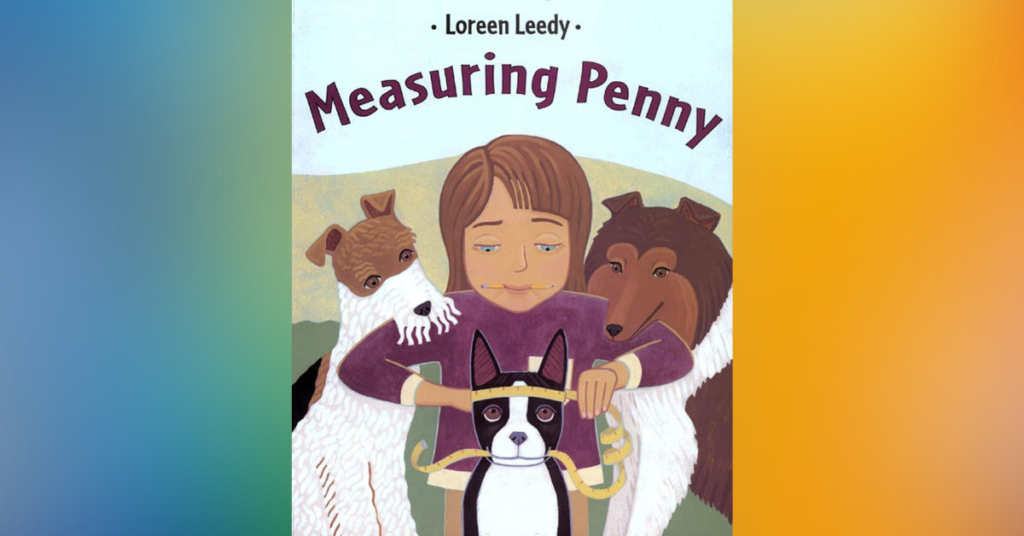
Math Subjects Explored: Measurement, standard vs. nonstandard units, comparing lengths and sizes, time and weight concepts
Recommended Ages: 4–9 years old
Lisa has a homework assignment: measure something in multiple ways. Instead of picking a boring object, she chooses her dog, Penny, immediately making the entire activity more fun and personal. As Lisa measures Penny, the book introduces the idea that measurement depends on units and that the same thing can be described using different units. The story is warm and kid-friendly, and it feels like the kind of school assignment many children actually get, which helps kids connect the book’s math to real life.
This is a particularly practical children’s book about math because it clearly distinguishes between standard units (like inches and feet) and nonstandard units (like paper clips or pencils), reinforcing why consistent units matter when you want accurate comparisons. It also supports broader measurement language—bigger/smaller, longer/shorter—without making the reading experience feel technical. If you want a home activity that mirrors the book, let your kid measure a stuffed animal or even a sibling using both “standard” (tape measure) and “nonstandard” (LEGO bricks) units, then compare results and talk about why the numbers change when the units change.
One Is a Snail, Ten Is a Crab By April Pulley Sayre and Jeff Sayre
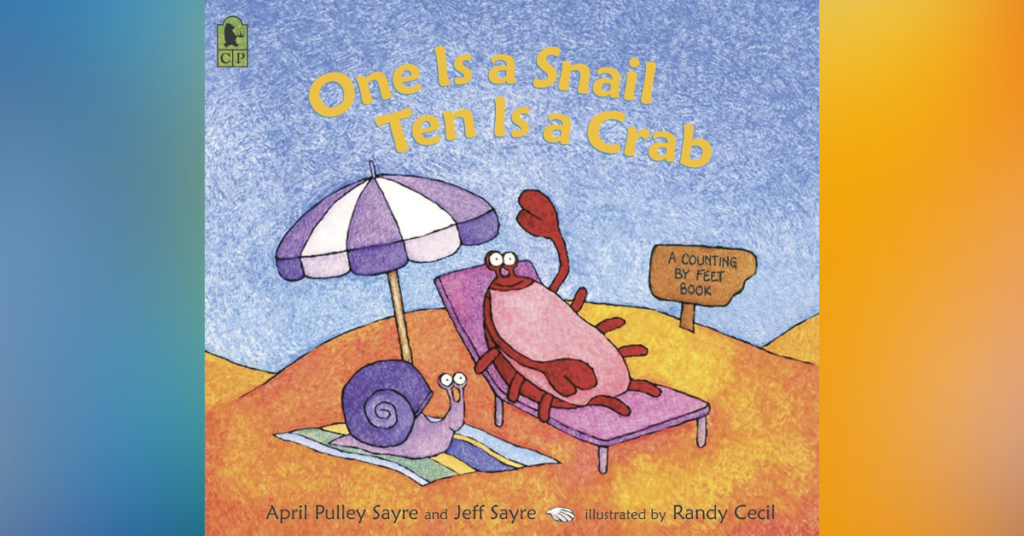
Math Subjects Explored: Counting, addition, grouping, base-10 foundations
Recommended Ages: 4–8 years old
This clever book redefines counting by focusing on feet rather than animals. A snail counts as one because it has one foot, a person counts as two, a dog as four, and a crab as ten. By building numbers through combinations of creatures, the book encourages kids to think flexibly about how totals can be composed in multiple ways. The illustrations clearly show how different groupings lead to the same number, making the math highly visual and accessible.
What makes this book stand out is its introduction to base-10 thinking well before formal place-value instruction begins. Kids see that ten can be built from smaller parts and that numbers can be decomposed and recombined. For younger readers, it’s about counting feet and enjoying the silliness. For older kids, it becomes an early lesson in addition strategies, “two dogs and a person makes ten,” and lays the groundwork for understanding how numbers are structured. It’s also an excellent conversation starter for asking kids to invent their own number combinations.
Just a Little Bit By Ann Tompert
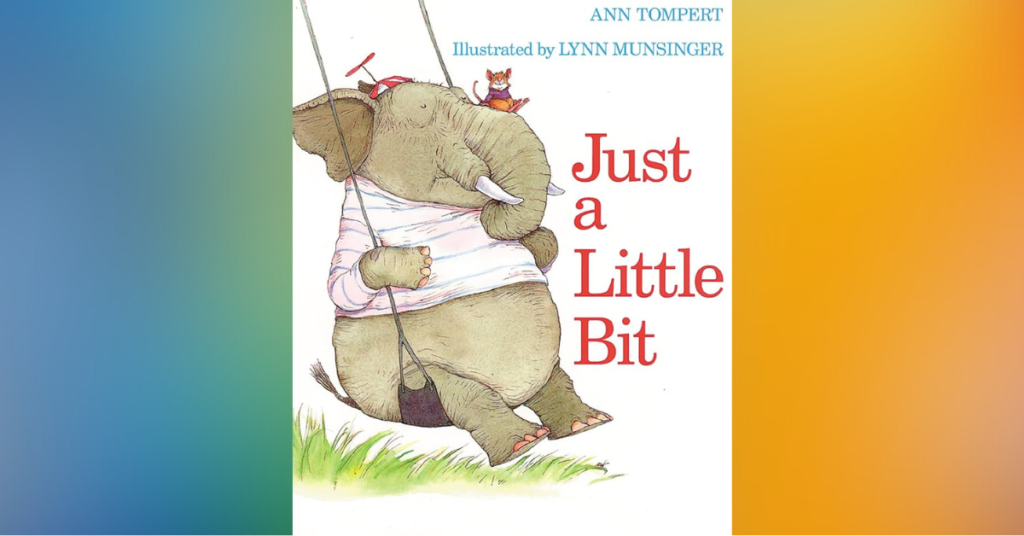
Math Subjects Explored: Weight, balance, mass, addition, and comparison
Recommended Ages: 4–8 years old
An elephant and a mouse decide to play on a seesaw, but they quickly hit a literal standstill: the elephant is much too heavy to go up. To get the game moving, a succession of animal friends—a giraffe, a zebra, a lion, and more—climb onto the mouse’s side one by one. The story builds tension with every new arrival as the scale refuses to budge, until a tiny beetle finally provides the “just a little bit” of extra weight needed to tip the balance.
Mathematically, this story is a perfect introduction to the concepts of weight and equilibrium. It moves beyond simple “big vs. small” comparisons to show how multiple smaller units (the various animals) can be combined to equal or exceed a larger mass. Kids begin to understand the additive nature of weight—that “heavy” isn’t just a fixed trait, but a total that can be reached through combined effort. The repetitive, cumulative structure allows children to predict how much more weight might be needed, turning a charming story about teamwork into a foundational lesson on mass and the mechanics of a balance scale.
Next to an Ant By Mara Rockliff
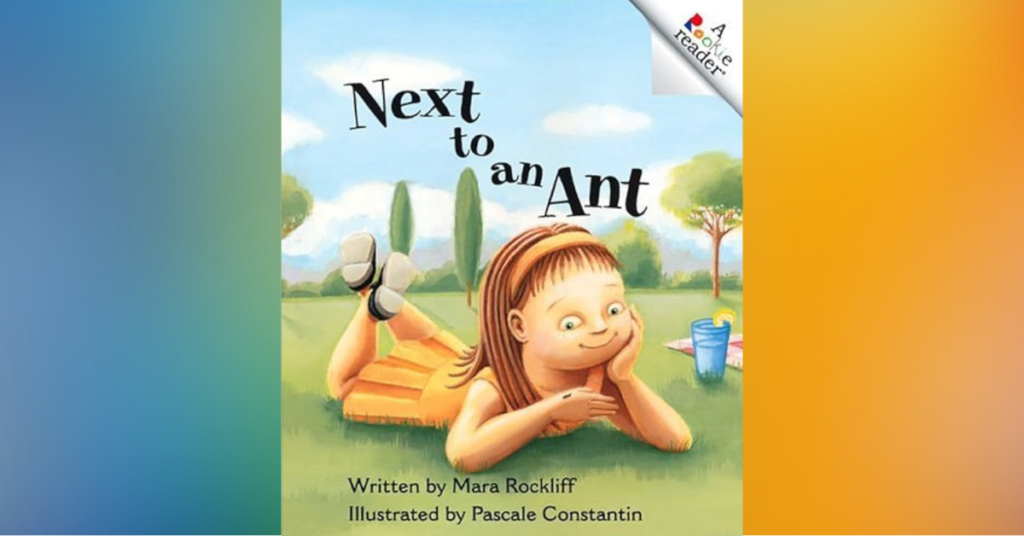
Math Subjects Explored: Measurement, scale, relative size, perspective
Recommended Ages: 4–9 years old
This book explores how size changes depending on what you’re comparing. An ant is tiny next to a shoe, but huge next to a grain of sand. Each page presents a new comparison, encouraging kids to rethink their assumptions about big and small. The illustrations make abstract ideas about scale concrete and easy to grasp.
Mathematically, the book builds an understanding of relative measurement and proportional thinking. Kids learn that size is not absolute—it depends on the reference point. This concept becomes increasingly important as children progress to more advanced math and science topics. For younger readers, it strengthens basic comparison skills; for older ones, it opens the door to discussions about scale, ratios, and perspective in a developmentally appropriate way.
Have You Seen My Monster? By Steve Light

Math Subjects Explored: Geometry, shape recognition, advanced polygons, and visual discrimination
Recommended Ages: 4–8 years old
At a bustling county fair, a young girl is on the hunt for her friendly monster. As she moves through the carnival—past the Ferris wheel, the food stands, and the various rides—the monster is always nearby, cleverly hiding in plain sight. The story serves as a sophisticated visual scavenger hunt, prompting readers to find the monster while identifying specific geometric shapes embedded in the detailed, pen-and-ink architecture of the fairgrounds.
Mathematically, this book goes far beyond basic circles and squares. It introduces children to many shapes, ranging from common favorites to complex forms such as nonagons, curvilinear triangles, trapezoids, and hexagons. By embedding these shapes in real-world objects—such as a ticket booth or a patterned fence—it teaches children to recognize geometry in their environment. This develops advanced visual discrimination and geometric vocabulary, encouraging children to look beyond the “whole” of an object to identify the specific mathematical components that make it up. It’s an engaging way to challenge kids who have already mastered basic shapes and are ready for more technical terminology.
Round Is a Tortilla By Roseanne Greenfield Thong
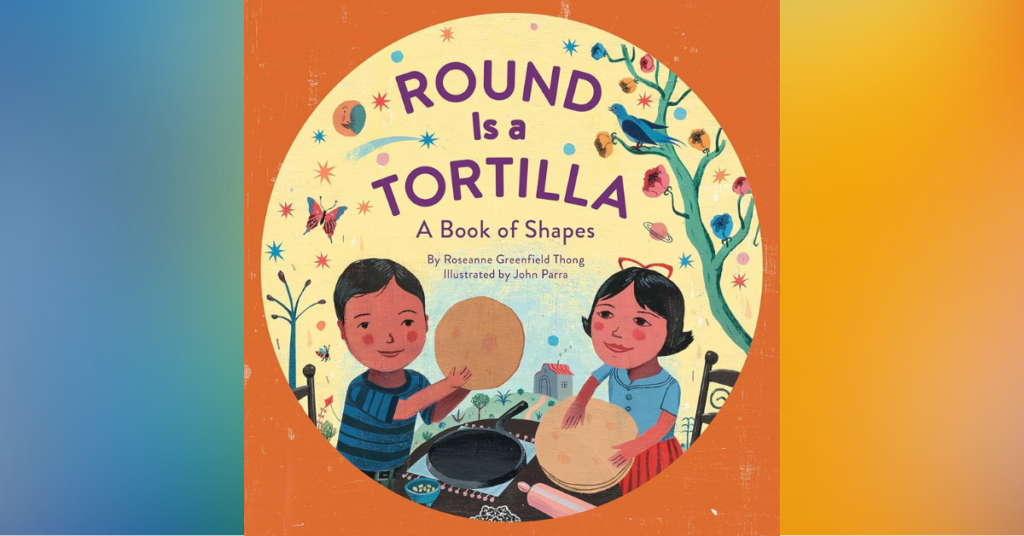
Math Subjects Explored: Geometry, shape classification, real-world connections
Recommended Ages: 4–8 years old
This book explores shapes through familiar objects found in a lively neighborhood, round tortillas, rectangular doors, triangular rooftops, and more. Each page pairs a geometric shape with a real-world example, helping students see math woven into daily life. The cultural richness of the setting adds warmth and authenticity, making the book feel grounded and relatable.
Mathematically, the story strengthens shape recognition and classification by showing shapes in varied contexts. Kids learn that shapes aren’t limited to textbooks; they appear everywhere once you know how to look. This reinforces spatial awareness and supports vocabulary development, especially for children who benefit from concrete examples. The structure also invites participation—kids can point out shapes they recognize or search for new ones beyond the page, turning geometry into an active exploration rather than a passive lesson.
When a Line Bends, a Shape Begins By Rhonda Gowler Greene
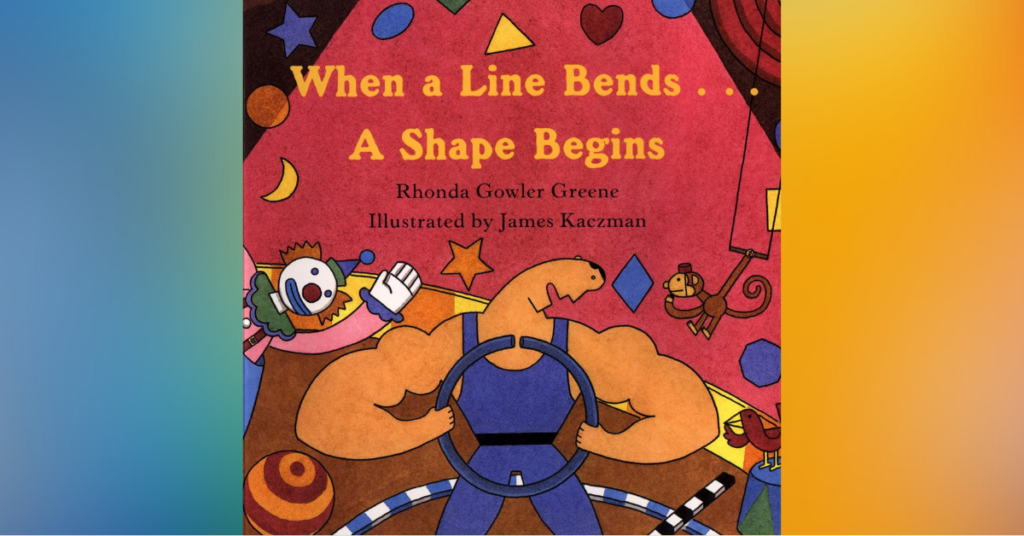
Math Subjects Explored: Geometry, shapes, angles, spatial reasoning
Recommended Ages: 4–8 years old
This book starts with a simple idea: a straight line. As the line bends, twists, and connects, shapes emerge: triangles, squares, and more. The minimalist illustrations and rhythmic text guide kids through the transformation process, emphasizing how shapes are created rather than simply naming them after the fact.
The value of math lies in helping students understand the building blocks of geometry. By focusing on how shapes form from lines and angles, the book encourages deeper conceptual thinking. Children begin to see shapes as dynamic constructions, which supports later learning about angles, vertices, and sides. This approach is especially helpful for kids who struggle with memorization but thrive when they understand how things work. It’s a strong foundation for both visual learners and hands-on thinkers.
Changes, Changes By Pat Hutchins
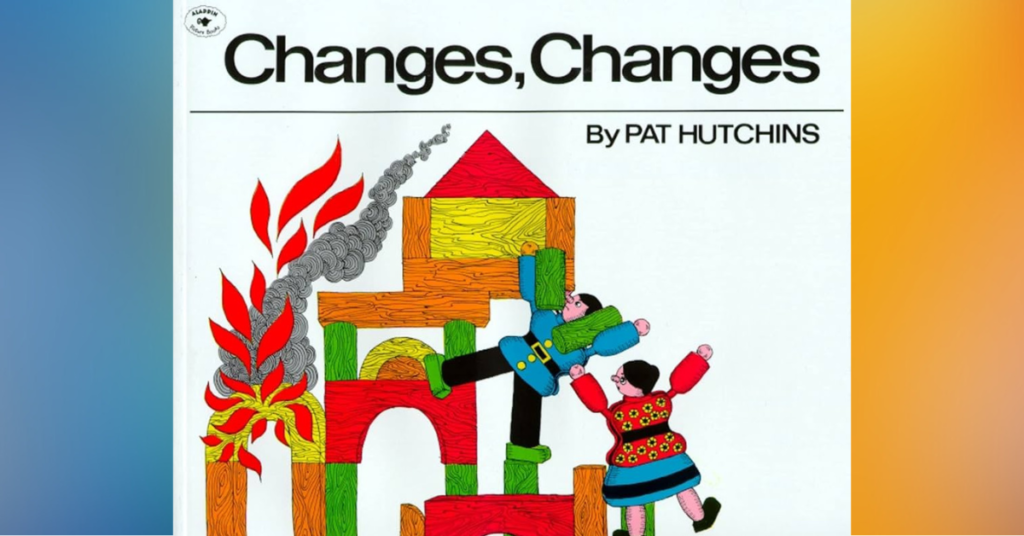
Math Subjects Explored: Spatial reasoning, geometry, problem-solving
Recommended Ages: 4–8 years old
Using only simple block shapes, this wordless story follows a couple as their house burns down and they repeatedly rebuild using the same pieces in new ways. Each reconstruction shows a different configuration, highlighting creativity and adaptability in the face of change.
The math focus is on transformation and recomposition. Kids see how the same set of shapes can be rearranged to solve different problems, reinforcing flexible thinking and spatial awareness. This directly supports later geometry concepts, including transformations and conservation of area. The lack of text encourages children to narrate the story themselves, strengthening reasoning and communication alongside math skills.
Albert Is Not Scared By Eleanor May
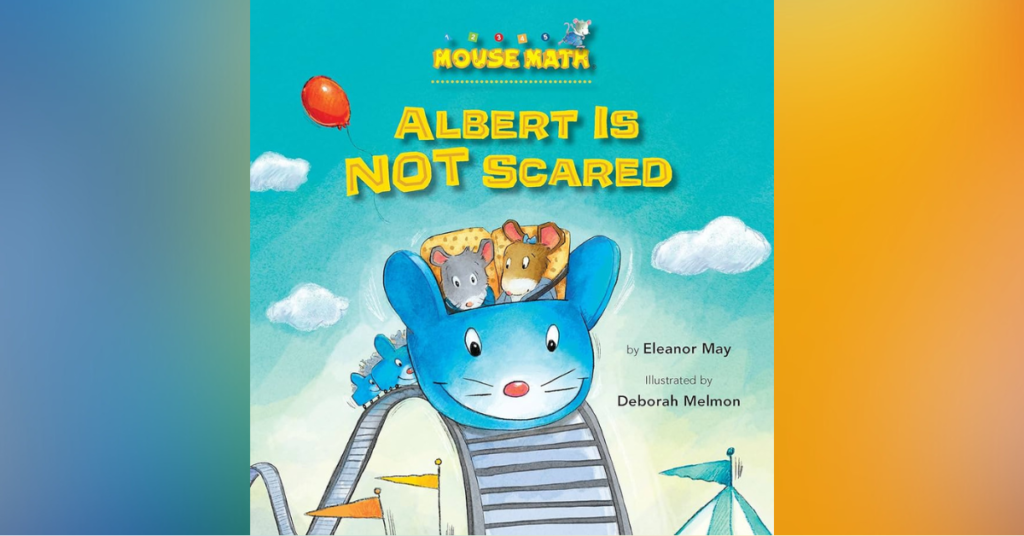
Math Subjects Explored: Counting, logical reasoning, pattern recognition
Recommended Ages: 3–6 years old
Albert insists he is not scared of anything, not ghosts, not noises, not shadows, yet the situations he encounters suggest otherwise. As Albert moves through the story, a pattern emerges: each supposedly “not scary” encounter accumulates, creating visual and numerical repetition that young readers quickly anticipate. The humor comes from the contrast between Albert’s confidence and what readers can clearly see unfolding on the page.
From a math perspective, the book subtly reinforces pattern recognition and logical reasoning. Kids notice repeated elements, predict outcomes, and track how many times certain situations occur. These early patterning skills are foundational to algebraic thinking. The book also supports logical reasoning as children reconcile Albert’s statements with the illustrations. While the math is not overt, the cognitive work required, spotting repetition, identifying sequence, and predicting what comes next, directly supports mathematical thinking in a developmentally appropriate way.
Who Eats First? By Ae-Hae Yoon
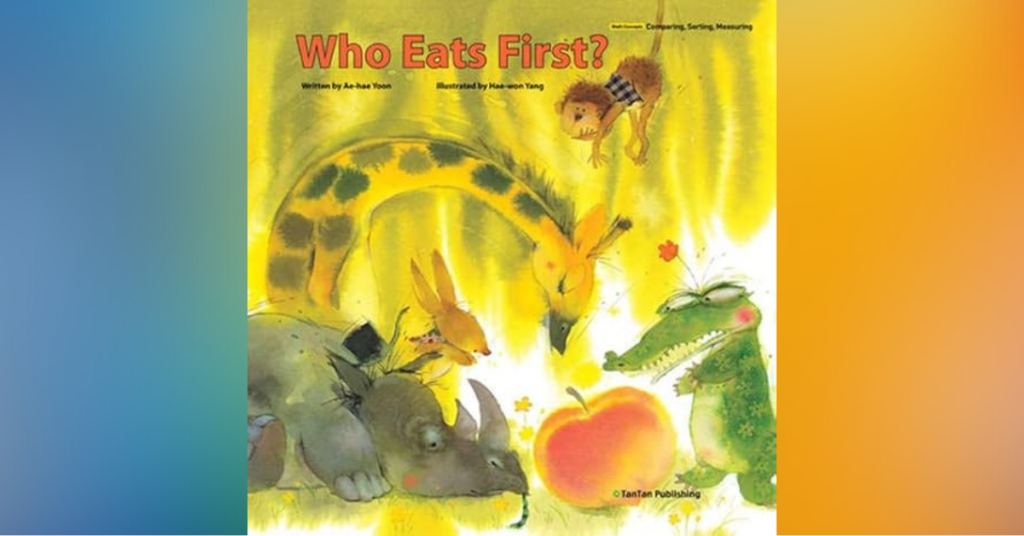
Math Subjects Explored: comparison, logical reasoning, ordering, and perspective
Recommended Ages: 4–8 years old
A variety of animals line up to eat, but who goes first depends on size, position, and perspective. The story challenges assumptions by shifting viewpoints, prompting kids to reconsider their initial answers as new information appears.
The book strengthens comparison skills and logical reasoning by showing how outcomes depend on criteria. Kids learn that answers can change when conditions change, a critical insight for mathematical thinking. Measurement concepts such as bigger, smaller, closer, and farther are reinforced visually, helping children develop flexible reasoning skills. This makes it a strong bridge between early comparison language and more formal math logic. It’s a simple children’s book about math and one of our household’s favorites.
Balancing Act By Ellen Stoll Walsh
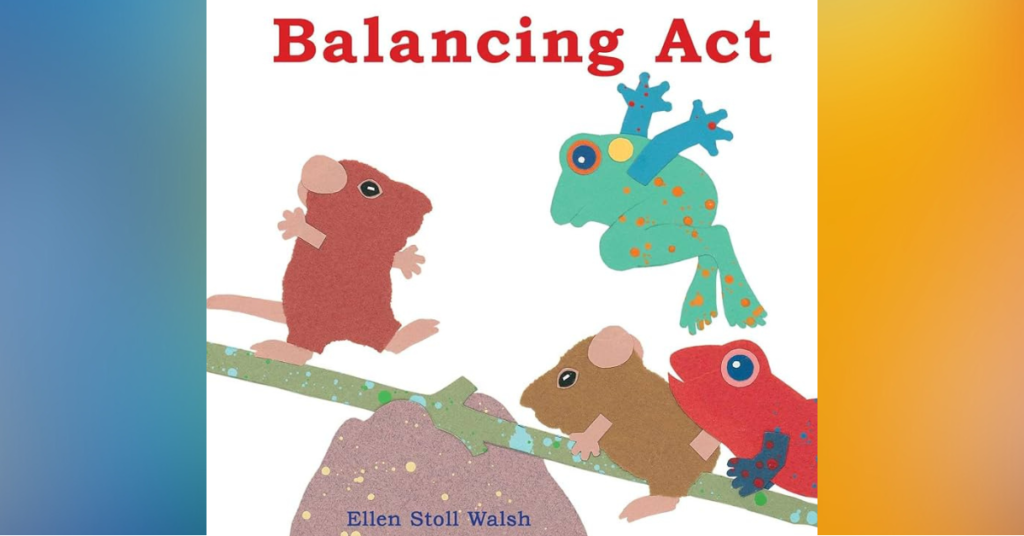
Math Subjects Explored: Equality, balance, problem-solving, spatial reasoning
Recommended Ages: 4–8 years old
Animals attempt to balance on a seesaw, adding and removing characters to keep things level. Each change alters the balance, requiring adjustment and experimentation. The playful trial-and-error approach keeps kids engaged while illustrating an abstract concept in a concrete way.
Balance is a foundational idea in mathematics, especially for understanding equality and equations later on. This book visually demonstrates that balance depends on both sides matching, even if they look different. Kids learn to predict outcomes, test ideas, and revise their thinking, skills central to mathematical reasoning. By presenting equality as something you can see and feel, the book builds intuitive understanding that supports future algebraic concepts.
The Penguin Problem By Jennifer Oxley and Billy Aronson
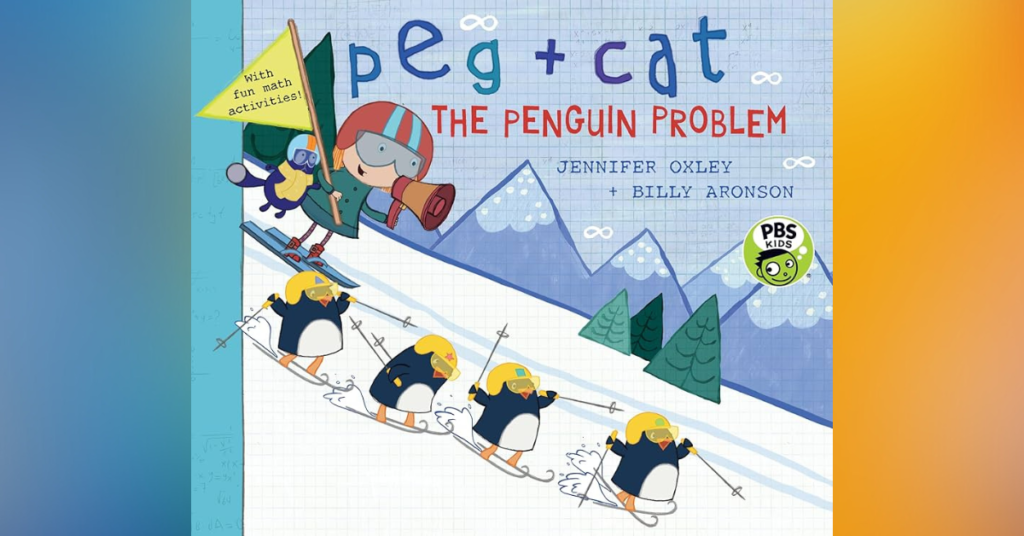
Math Subjects Explored: Counting, problem-solving, logical reasoning
Recommended Ages: 4–8 years old
When too many penguins crowd into a small space, Peg and Cat are faced with a classic constraint-based problem. The story unfolds through a series of attempts to solve the issue, each requiring careful counting and reassessment as conditions change. Rather than presenting a single “right answer,” the book models trial and error and revision, showing that problem-solving is often an iterative process.
The math emphasis is on accuracy, flexibility, and reasoning within limits. Children see that counting alone isn’t enough, numbers must be applied thoughtfully to real situations. The story highlights the importance of checking work, recognizing when a solution doesn’t fit, and adjusting strategies accordingly. This approach reinforces a healthy mathematical mindset, where persistence and adaptability matter as much as the answer itself. By framing math as a tool for resolving a tangible problem, the book helps children view numbers as practical and empowering.
The Lemonade Problem By Jennifer Oxley and Billy Aronson
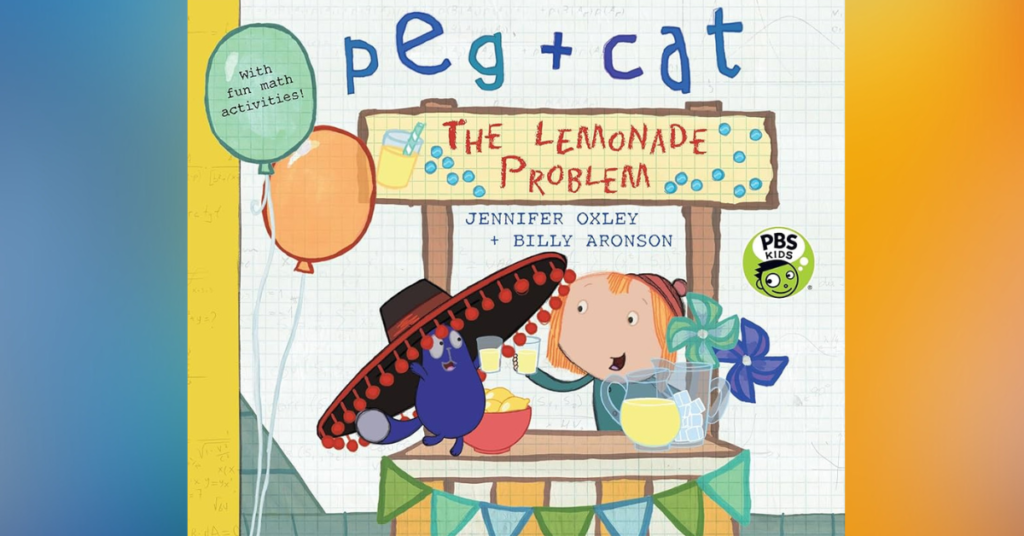
Math Subjects Explored: Counting, addition, subtraction, fair sharing
Recommended Ages: 4–8 years old
Peg and Cat are tasked with sharing lemonade fairly, but the situation keeps changing as more participants enter the picture. Each new development forces them to recount, redistribute, and rethink their plan. The setup mirrors real-life scenarios children encounter when sharing snacks, toys, or turns, making the math immediately relevant.
The book reinforces addition and subtraction as dynamic processes rather than fixed operations. Kids see how totals increase or decrease and why fairness depends on accurate counting and equal distribution. The repeated need to revise solutions emphasizes that mistakes are part of learning, not failures. This reinforces mathematical resilience and helps children understand that rechecking work is both normal and necessary. The story’s clear visuals and consistent logic make it easy for kids to follow along and even predict what might happen next.
Albert Adds Up By Eleanor May
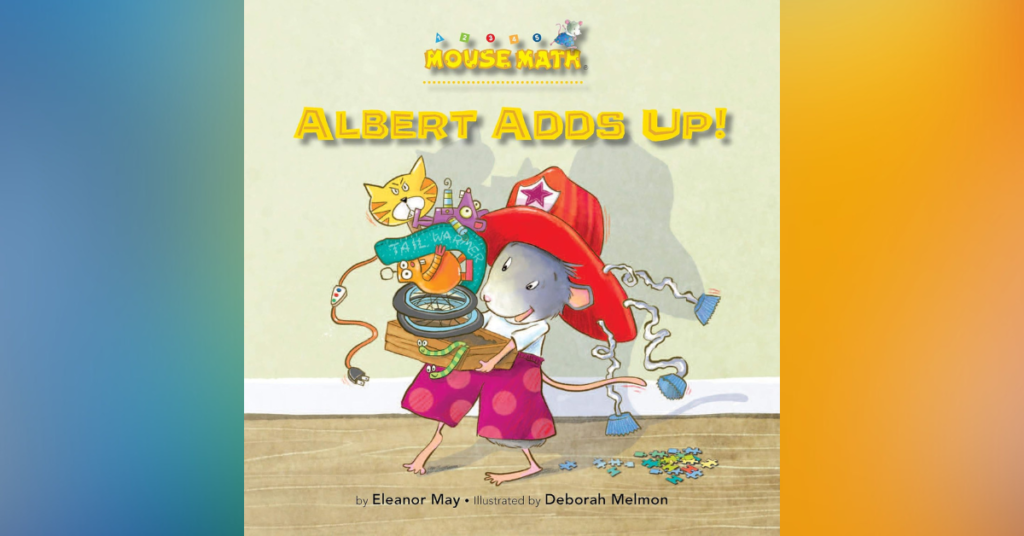
Math Subjects Explored: Addition, cumulative totals, problem-solving
Recommended Ages: 4–8 years old
Albert goes through a day filled with small, seemingly insignificant events. Individually, they don’t stand out, but together, they add up to something meaningful. As readers follow along, they begin to track how each moment contributes to a growing total.
The book introduces cumulative addition through a narrative, showing how numbers build over time. This helps children understand that addition isn’t always about isolated problems; it’s often about accumulation. The story encourages careful observation and reflection, reinforcing the idea that math helps explain patterns in everyday life. By embedding math in a character-driven story, the book makes addition feel intuitive and connected rather than mechanical. You’ll notice several children’s books about math on our list from Eleanor May because her work has really resonated with all four of my kids.
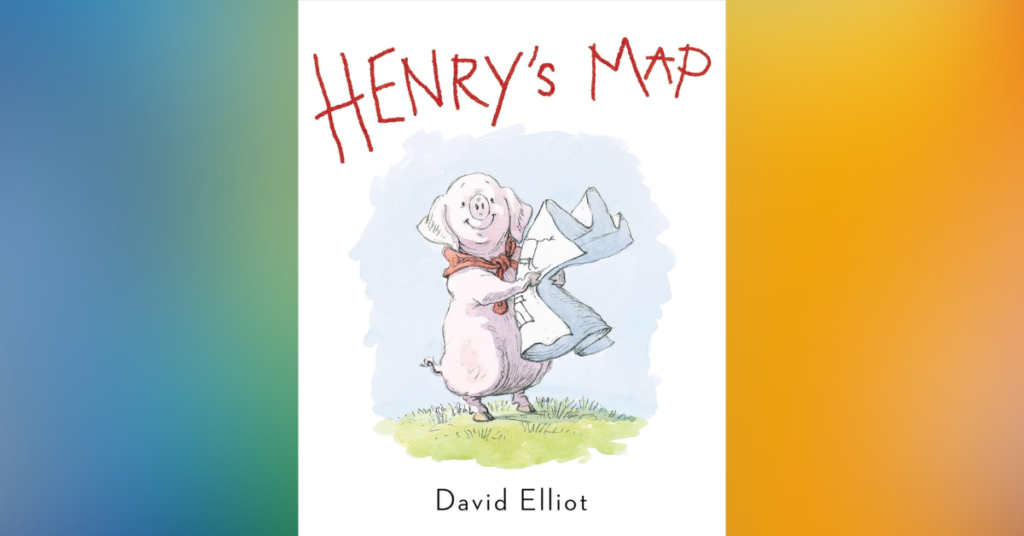
Henry’s Map By David Elliot
Math Subjects Explored: Spatial reasoning, mapping, direction, representation
Recommended Ages: 4–8 years old
Henry is a pig who thrives on order, routine, and knowing exactly where everything belongs. His careful personality leads him to create a detailed map of his farmyard, labeling locations and organizing the space in a way that makes sense to him. When Henry later ventures farther than usual and finds himself disoriented, that same map becomes the key to finding his way home. The story unfolds quietly and thoughtfully, emphasizing preparation, observation, and calm problem-solving rather than urgency or danger.
The book introduces children to the idea that maps are symbolic representations of real spaces. Children learn that drawings can represent physical locations and that distance, direction, and relative position can be preserved even when something is scaled down. These concepts form the foundation for later work with diagrams, graphs, and coordinate systems. Henry’s reliance on his map underscores that spatial tools help us make sense of the world. It also invites children to think critically about their environment —how rooms connect, where landmarks are, and how spaces can be represented visually—strengthening spatial awareness in a way that feels personal and intuitive.
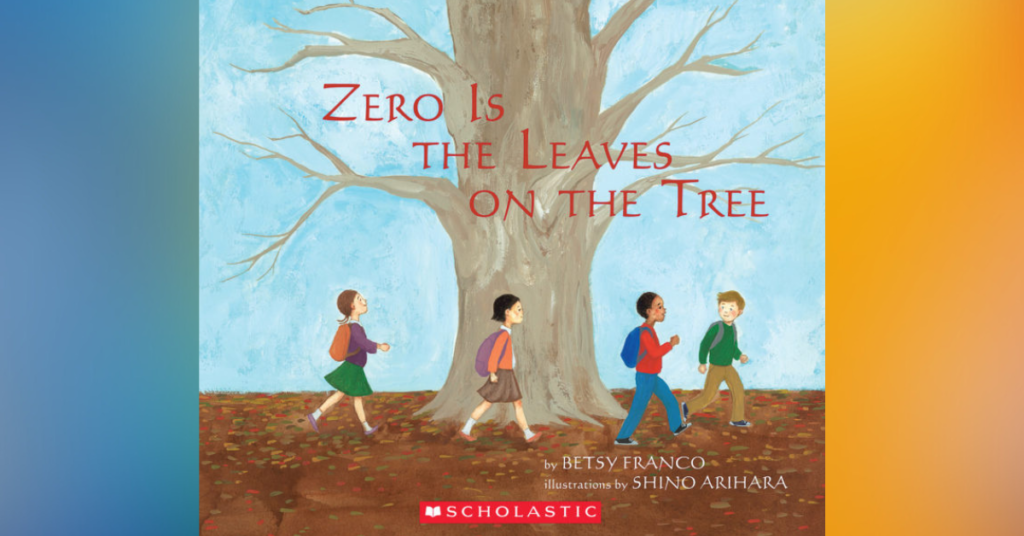
Zero Is the Leaves on the Trees By Betsy Franco
Math Subjects Explored: Counting, zero, number sense, subtraction
Recommended Ages: 4–8 years old
This book introduces the concept of zero by pairing numbers with real-world examples, ending with zero as the absence of something expected. By framing zero as meaningful rather than empty, the book helps children understand it as a legitimate number with value.
Zero can be a challenging concept for kids, and this book makes it accessible by grounding it in familiar experiences. Children see how quantities decrease and eventually reach none, reinforcing subtraction concepts alongside counting. Understanding zero is critical for place value and arithmetic later on, and this story-based approach removes confusion by giving zero a clear, visual role. It’s a thoughtful and effective way to introduce an often-overlooked but essential math idea.
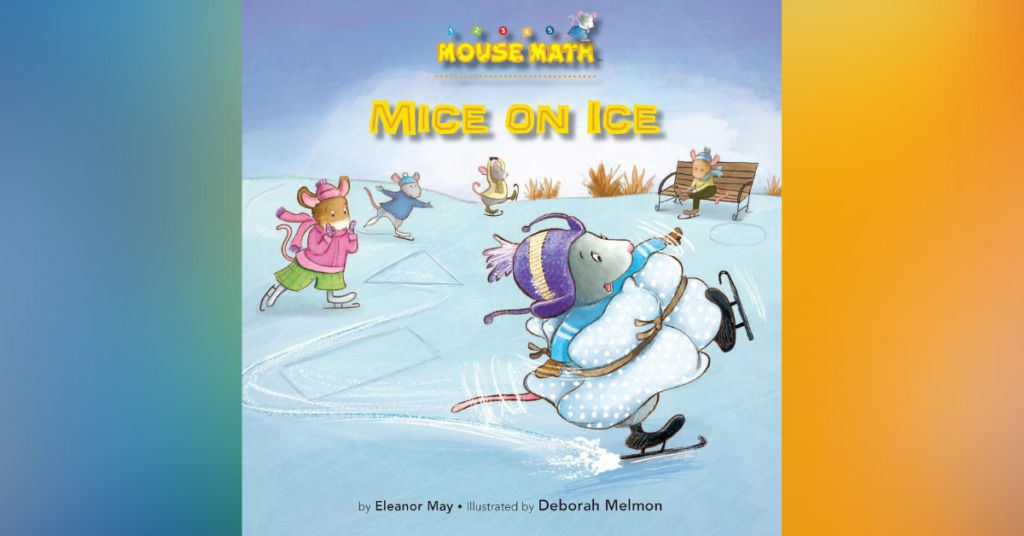
Mice on Ice Eleanor May
Math Subjects Explored: Counting, capacity, constraints, and quantity limits
Recommended Ages: 4–7 years old
A group of mice gathers on an ice floe that can only hold so much weight. As more mice climb on, others must leave to prevent disaster. The story unfolds with rising tension and clear visual cues that invite kids to track how many mice are present at each moment.
The book introduces subtraction and balance through a concrete, visual scenario. Kids see that adding too much requires adjustment, reinforcing the idea that numbers interact with real-world limits. Counting up and down becomes meaningful as children anticipate what will happen next. The concept of balance—both literal and numerical—supports early understanding of equality and constraints, which are key ideas in later math learning.
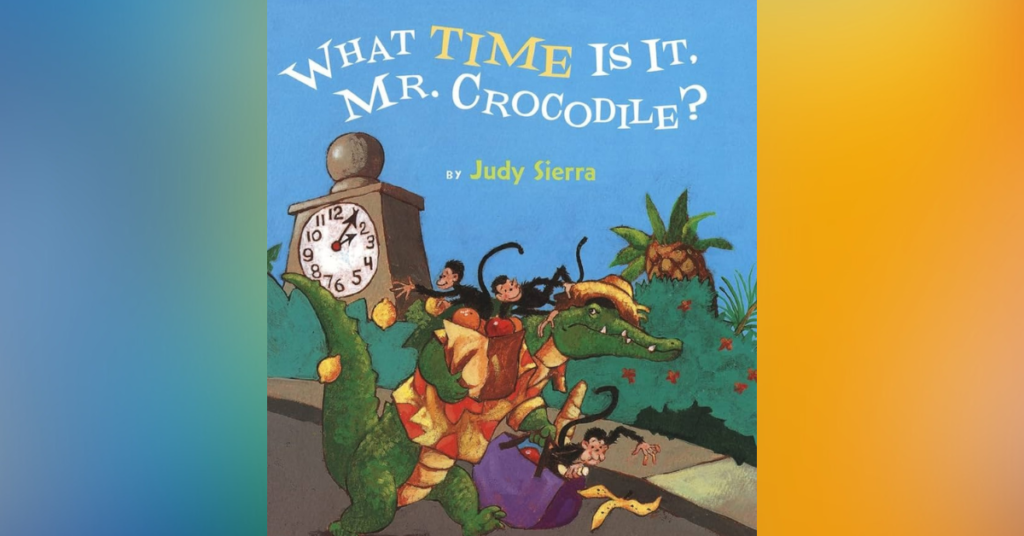
What Time Is It, Mr. Crocodile? By Judy Sierra and Stephen Gammell
Math Subjects Explored: Telling time, sequence, number line thinking, schedule reasoning
Recommended Ages: 5–8 years old
This humorous tale uses a crocodile’s expanding appetite throughout the day to introduce clocks and time. Each visit to Mr. Crocodile occurs at a specific hour, prompting your child to match activities to clock faces and time sequences. The repeated structure reinforces time concepts while keeping attention anchored in a narrative arc.
Telling time is a concrete way to practice number line reasoning — understanding order, intervals, and increments. The book naturally leads to discussion about before/after, half past, and planning. It’s an excellent bridge between number sense and real-world temporal reasoning.
How Much Is a Million? By David M. Schwartz
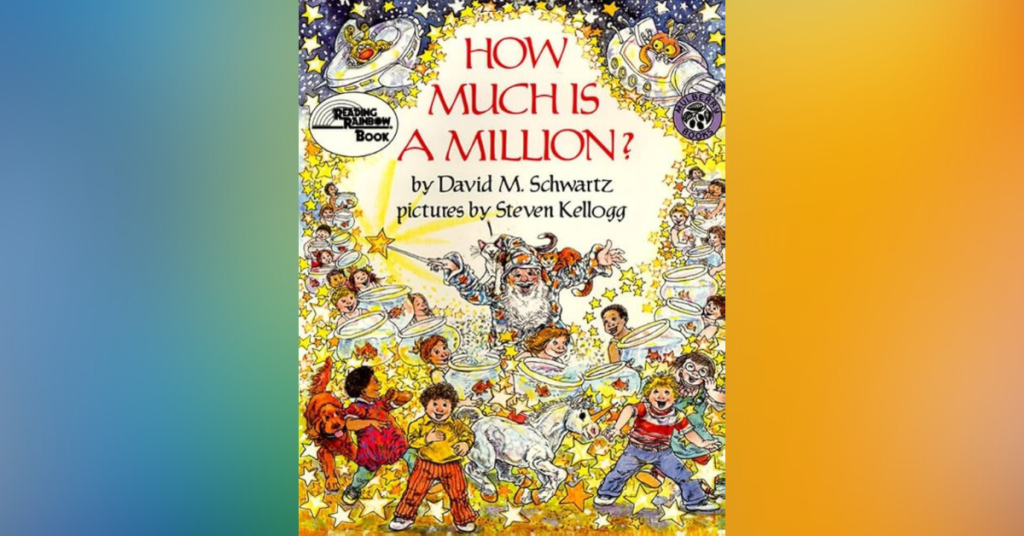
Math Subjects Explored: Place value, large numbers, estimation, scaling and visualization
Recommended Ages: 5–10 years old
Big numbers can feel meaningless to kids because they’re too large to experience directly. “A million” sounds like a magic word, not a quantity. This book tackles that problem by turning a million into images a child can picture. Instead of asking kids to accept the number abstractly, it offers concrete comparisons and visual thought experiments that help your kid build intuition about scale: how long counting would take, how big something would be if you stacked or lined things up, and why a million is dramatically larger than a thousand. The tone is playful and curious, so kids don’t feel intimidated by the size of the concept.
As a teaching tool, it’s excellent for place value and magnitude. Children start to grasp that adding zeros isn’t just “making a bigger number”; it changes the scale entirely. It also supports estimation: once your kid has a mental picture of a thousand and a million, they’re better prepared to reason about quantities in the real world. If you read it with an 8- or 11-year-old, it can also lead to discussions about millions in everyday contexts, views, dollars, and pixels, making the math feel useful rather than theoretical.
One Hundred Hungry Ants By Elinor J. Pinczes
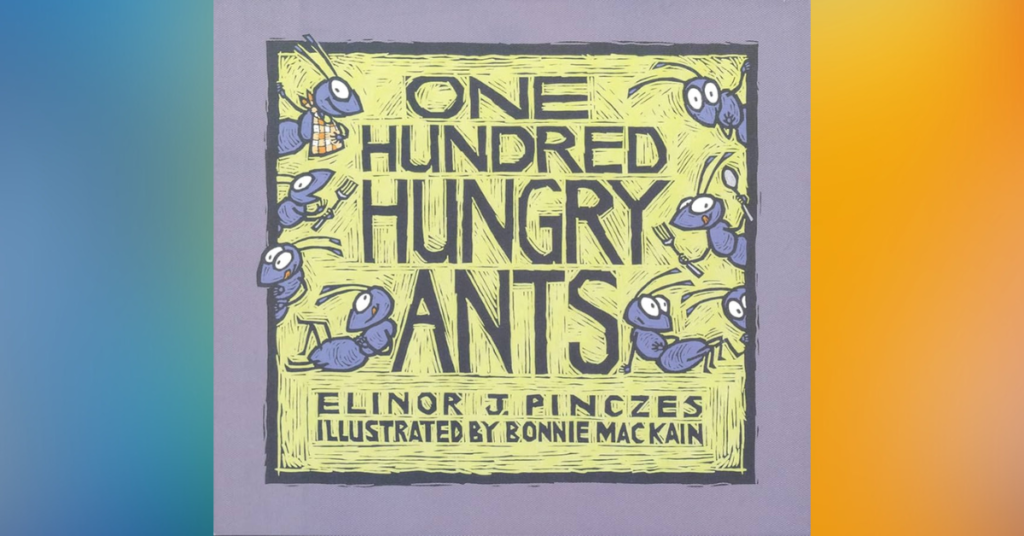
Math Subjects Explored: Division, factors, arrays, skip counting, grouping strategies
Recommended Ages: 5–10 years old
A line of one hundred ants marches toward a picnic, but the ants at the back are tired of moving so slowly. Their solution is pure math: reorganize. They try marching in different formations, two lines, four lines, ten lines—each time changing the group’s shape to see if it improves their progress. The plot is light and funny, but the visual math is the star: kids can literally see the arrays form on the page, and they begin to understand that the same total can be arranged in multiple ways.
This book is a strong bridge between early arithmetic and deeper number sense because it introduces factors and division in an intuitive, visual way. Kids start to notice which groupings “work” cleanly and which don’t, setting the stage for understanding divisibility without drilling rules. For a 5–7-year-old, it’s about counting and grouping. For an 8–10-year-old, it becomes an exploration of factors of 100, skip-counting patterns, and why some arrangements are more efficient than others. It’s also easy to extend with hands-on practice—100 small objects (or even 20 to start) arranged into different rectangles on a table.
The Greedy Triangle By Marilyn Burns
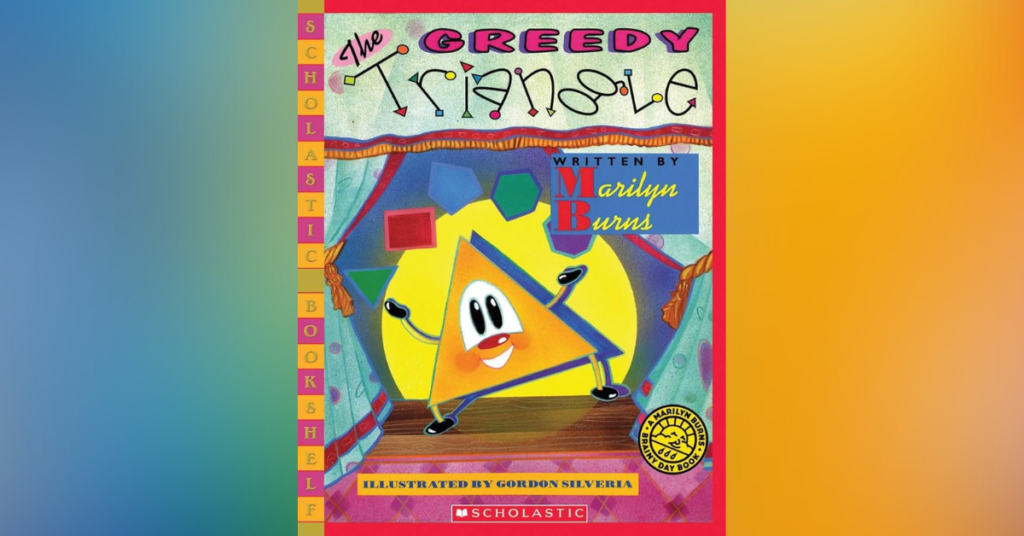
Math Subjects Explored: Geometry, shapes and attributes, sides and angles, classification
Recommended Ages: 5–9 years old
Triangle is frustrated with being “only” a triangle, so it asks a shapeshifter to change it into a different shape. The triangle becomes a quadrilateral, then a pentagon, then a hexagon, and continues—each new form brings new experiences and new problems. The story makes geometry feel like character development: the shape’s identity is tied to its attributes, and kids get to enjoy the humor of a shape trying on new “bodies” the way someone might try on new outfits. Eventually, Triangle learns that being itself has value, landing the story with a satisfying emotional beat without getting preachy.
The math is clean and verifiable: each transformation adds a side (and therefore changes angles and overall properties), giving kids repeated exposure to the defining features of polygons. It supports vocabulary such as triangle, quadrilateral, pentagon, and hexagon, and encourages classification: how do we determine what shape something is? For older kids in the 8–9 range, it can also prompt richer conversations about attributes: sides, corners (vertices), and how shapes relate to one another. If you want an easy extension, have your kid draw a triangle and “upgrade” it by adding one side at a time, naming each polygon as they go.
The Secret Birthday Message By Eric Carle
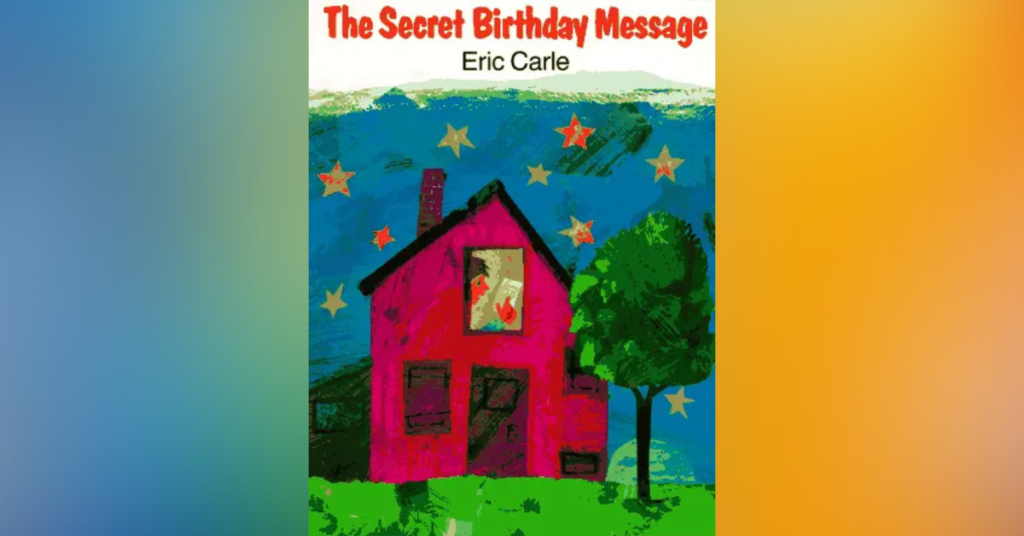
Math Subjects Explored: Geometry, spatial reasoning, following directions
Recommended Ages: 5–9 years old
A child receives a mysterious birthday message filled with visual clues that must be followed to reach a surprise. Each page presents a puzzle involving shapes, paths, and directional changes, inviting readers to decode the message step by step. The sense of discovery keeps kids engaged as they mentally trace routes and anticipate outcomes.
Mathematically, the book strengthens spatial visualization and logical sequencing. Kids practice interpreting symbols, following multi-step directions, and understanding how turns and paths work together. These skills are directly related to geometry and problem-solving, particularly in tasks involving maps or diagrams. Because the puzzles increase in complexity, the book supports repeated readings, allowing kids to deepen their understanding each time.
Taking Apart Numbers: 12 Ways to Get to 11 By Eve Merriam
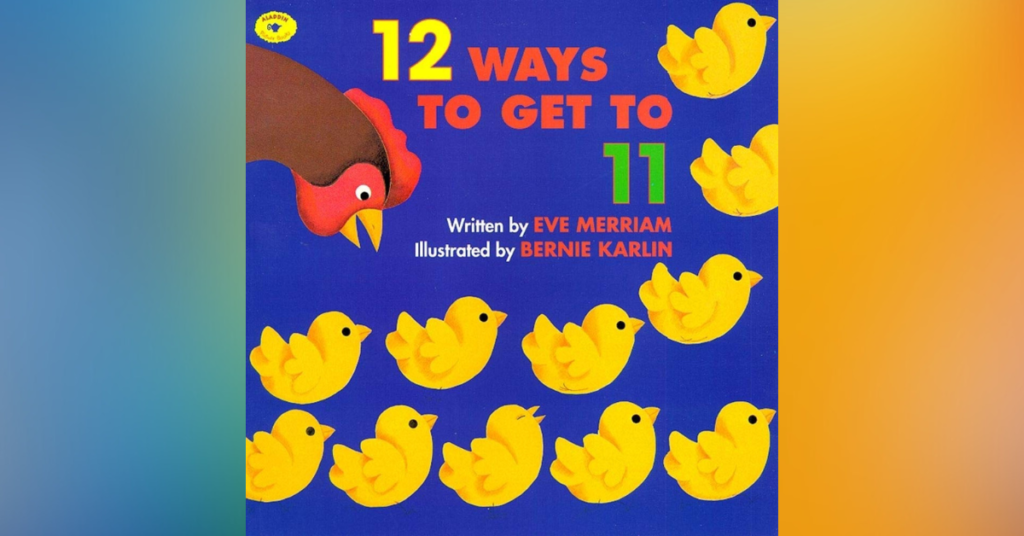
Math Subjects Explored: Number decomposition, addition, flexible thinking
Recommended Ages: 5–9 years old
This book presents multiple ways to make the number eleven, showing combinations like 5 + 6, 10 + 1, and others through engaging illustrations and rhythmic text. Each page reinforces the idea that numbers aren’t fixed objects; they can be broken apart and recombined in many valid ways.
Number decomposition is a key skill for mental math and later arithmetic fluency. By showing multiple solutions to the same total, the book encourages flexibility rather than memorization. Kids begin to understand that math problems can have many paths to the same answer. This makes it an excellent children’s book about math for building confidence, especially for kids who may feel stuck when taught only one “right” way to solve problems. The visual representations help anchor abstract ideas in concrete examples.
Two of Everything By Lily Toy Hong
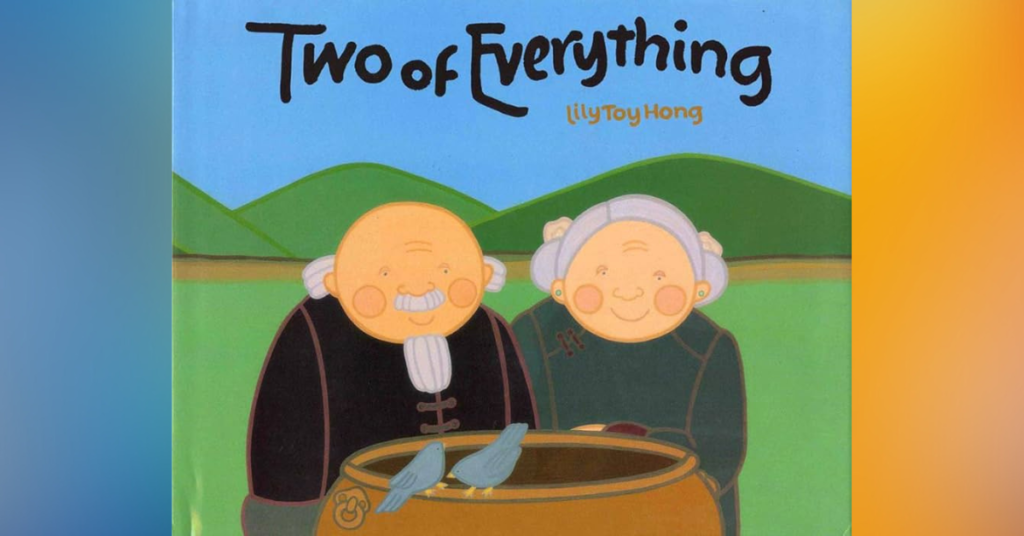
Math Subjects Explored: Doubling, multiplication, and logical reasoning
Recommended Ages: 5–9 years old
A humble couple discovers a magical pot that doubles anything placed inside it, leading to unexpected consequences when food, money, and even people are duplicated. The folktale structure keeps children engaged, while the repeated doubling creates a clear mathematical pattern that readers quickly anticipate.
The book reinforces multiplication concepts through narrative repetition. Kids see that doubling isn’t just “more,” but a predictable transformation that can quickly escalate. This helps children understand how quantities grow and why careful reasoning matters when working with numbers. It also supports logical thinking by showing how decisions affect outcomes, an essential mathematical habit of mind. The story works well for early elementary readers who are ready to move beyond counting and start reasoning about operations.
Jim and the Beanstalk By Raymond Briggs
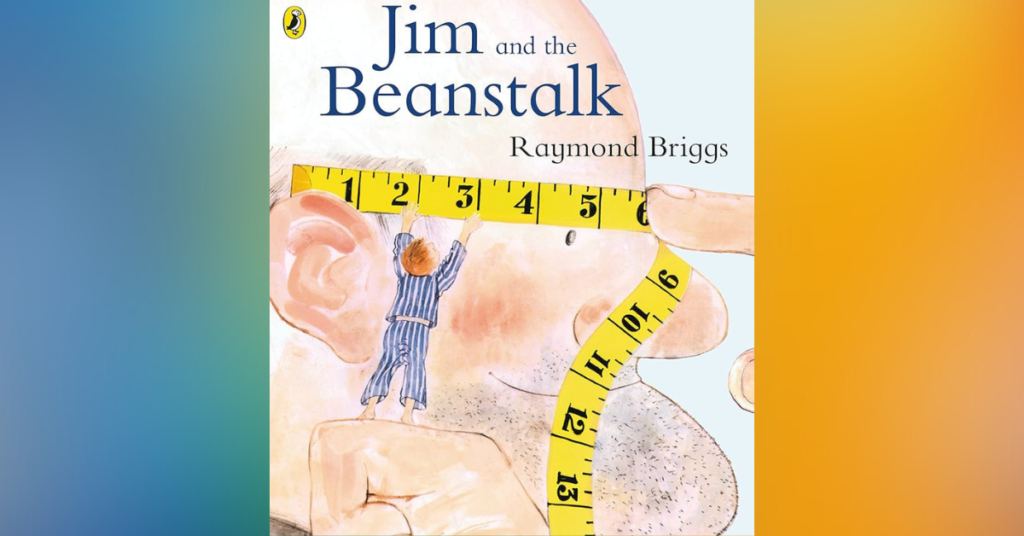
Math Subjects Explored: Measurement, comparison, size, problem-solving
Recommended Ages: 5–9 years old
This inventive continuation of the classic fairy tale Jack and the Beanstalk reframes the giant not as a threat, but as an aging character who needs practical help. When Jim climbs the beanstalk, he discovers that the giant has grown old and can no longer see clearly, chew properly, or manage his appearance. Rather than relying on magic or luck, Jim approaches each problem methodically, using careful observation and measurement to determine what the giant needs. Measuring for glasses, dentures, and a wig becomes a series of tangible challenges that children can easily follow and visualize, even within the fantastical setting.
Mathematically, the story emphasizes measurement as a purposeful, real-world skill rather than an abstract exercise. Children see why accuracy matters, glasses that don’t fit or teeth that are the wrong size won’t solve the problem. The book reinforces comparison language such as larger, smaller, longer, and shorter, while also encouraging estimation and reasoning about scale. Because Jim must adapt human-sized tools and thinking to a giant-sized world, kids are gently introduced to proportional thinking. This makes the book especially valuable for early elementary readers who are beginning to move from informal size comparisons toward more deliberate measurement concepts grounded in problem-solving.
Lucy in the City: A Story About Developing Spatial Thinking Skills By Julie Dillemuth
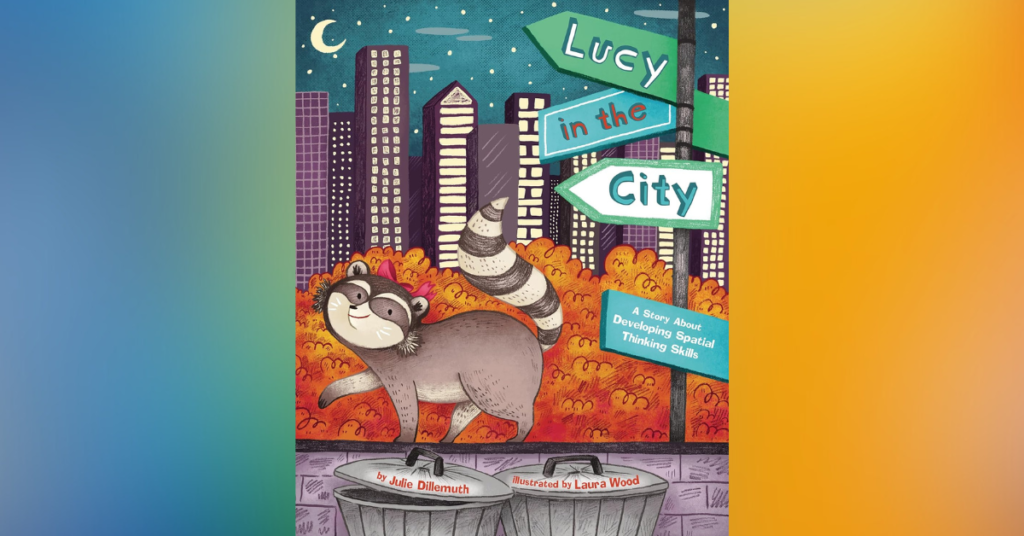
Math Subjects Explored: Spatial reasoning, mapping, navigation, perspective
Recommended Ages: 5–9 years old
Lucy the raccoon lives in a bustling city, and when she becomes separated from her familiar surroundings, she must rely on careful observation and memory to get home. As Lucy moves through streets, parks, and buildings, the story explicitly introduces spatial concepts such as a bird’s-eye view, landmarks, and retracing steps. The narrative mirrors children’s real experiences navigating unfamiliar places, making Lucy’s challenge relatable and emotionally grounded rather than abstract.
The math focus centers on how people understand and move through space. Children learn that perspective matters, what something looks like from above versus from the ground, and that maps are tools for translating three-dimensional environments into usable guides. The book’s built-in resource section extends the learning with simple parent-child activities that reinforce mapping, navigation, and directional thinking. These skills directly support geometry, geography, and logical problem-solving later on. By pairing a realistic problem with explicit spatial language, the book serves as a strong bridge between story-based learning and practical, real-world math applications.
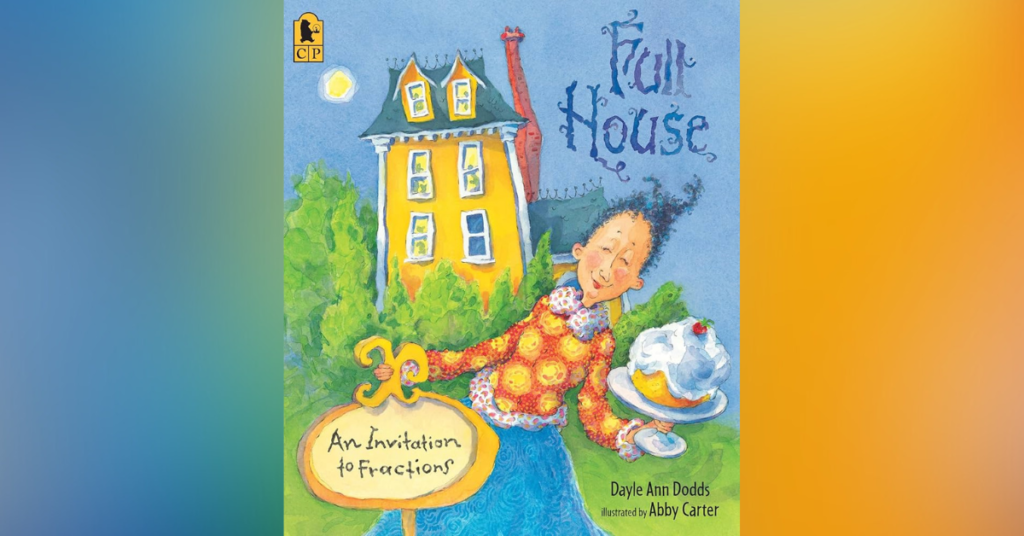
Full House: An Invitation to Fractions By Dayle Ann Dodds
Math Subjects Explored: Fractions, division, equal parts, fair sharing
Recommended Ages: 5–9 years old
Miss Bloom runs the Strawberry Inn, which has exactly six guest rooms. As visitors arrive one by one, the story carefully tracks how many rooms are occupied, visually representing each step as a fraction of the whole, 1/6, 2/6, and so on. This clear structure helps children see fractions develop gradually, rather than being introduced all at once. When the guests later gather in the kitchen to share food, the same fraction logic reappears in a more social, familiar context.
What makes this book especially effective is its consistency. Fractions are presented as parts of a whole that remains constant, whether that whole is a set of rooms or a shared meal. Children see that fractions are not mysterious symbols, but practical tools for understanding fairness and division. The visuals reinforce equivalence and proportional reasoning, helping kids grasp that 3/6 and 1/2 represent the same amount. This grounding in everyday situations makes the book particularly helpful for children who struggle when fractions are introduced too abstractly or too quickly.
The Pizza Problem By Jennifer Oxley and Billy Aronson

Math Subjects Explored: Division, fractions, equal shares
Recommended Ages: 5–9 years old
When Peg and Cat deliver pizzas, each stop presents a new sharing challenge. Different numbers of people require different ways of dividing the same number of pizzas, forcing the characters to think carefully about equal parts. The familiar context of pizza makes the math intuitive; most children already understand that slices should be shared fairly.
This book introduces division and fractions through repeated, concrete examples. Kids see how the same whole can be divided in different ways depending on the situation, reinforcing the idea that fractions are flexible representations rather than rigid rules. The visuals clearly show equal shares, helping children grasp why certain divisions work and others don’t. By grounding abstract concepts in a universally relatable scenario, the book builds a strong foundational understanding of fractions and division.
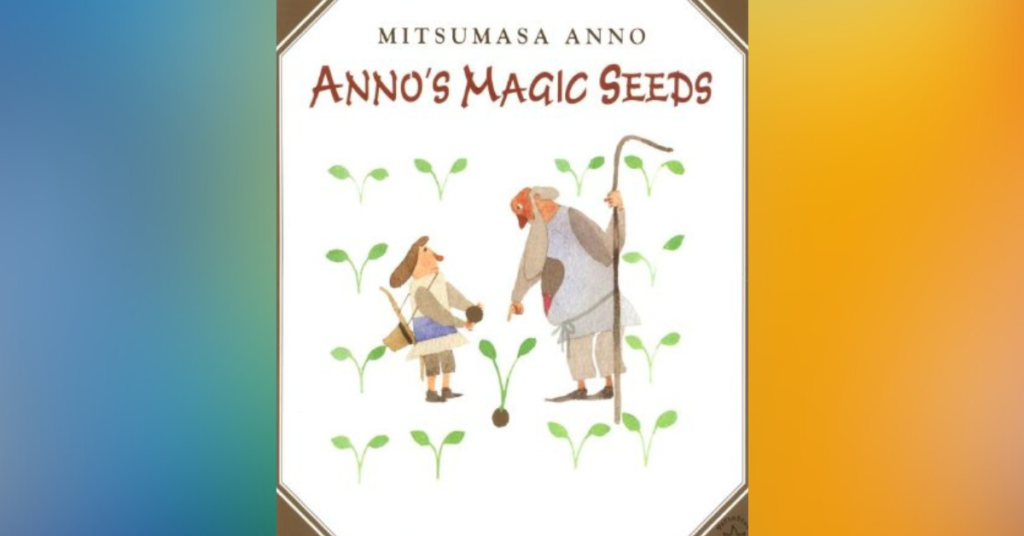
Anno’s Magic Seeds By Mitsumasa Anno
Math Subjects Explored: Multiplication, division, exponential growth, patterns
Recommended Ages: 6–10 years old
A farmer plants magical seeds that double each year, creating abundance that must be carefully managed. As the crops multiply, the farmer divides them, stores them, and plans for the future. The story unfolds slowly, giving kids time to absorb how quantities grow and change over time.
This book is a powerful visual introduction to exponential growth and division, concepts that are often difficult to grasp abstractly. By anchoring the math in a story about farming and planning, the book makes large-scale growth understandable. Kids can track the doubling visually and begin to see why numbers can grow so quickly. It’s especially effective for older elementary readers who are ready to move beyond basic operations and start thinking about patterns and long-term change.
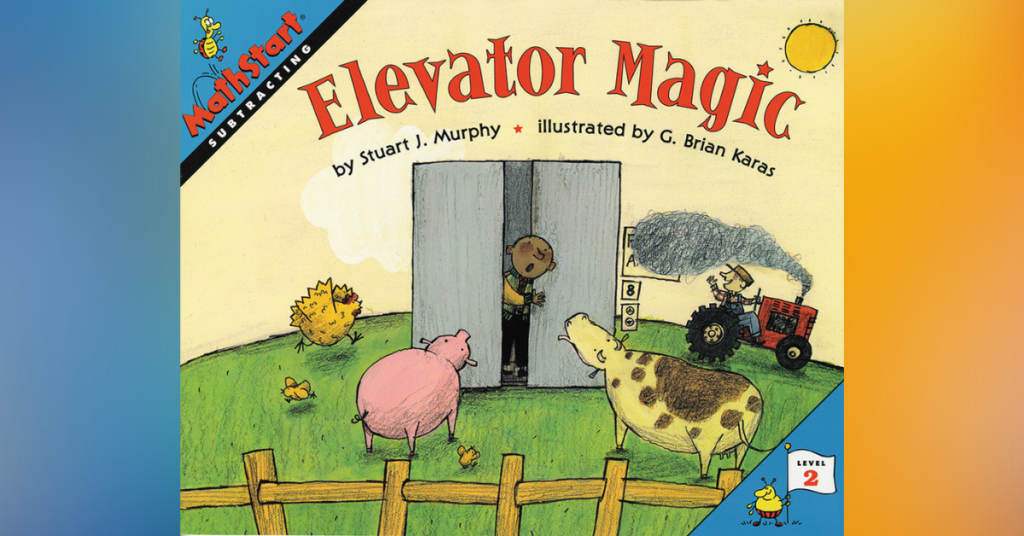
Elevator Magic By Stuart J. Murphy
Math Subjects Explored: Addition, subtraction, positive and negative numbers
Recommended Ages: 6–10 years old
A boy’s elevator ride becomes an unexpected math adventure as each stop changes his position relative to the ground floor. Going up adds floors, going down subtracts them, and the ride grows more complex as the story progresses. The elevator setting provides a concrete framework for tracking movement and change.
This book is particularly effective for introducing positive and negative numbers because it ties them to physical location. Children can visualize being above or below a starting point, making the number line concept tangible. The story supports mental math by requiring readers to track cumulative changes, reinforcing addition and subtraction in a continuous sequence. By emphasizing position rather than quantity alone, the book helps kids understand that numbers can describe location, not just amount.
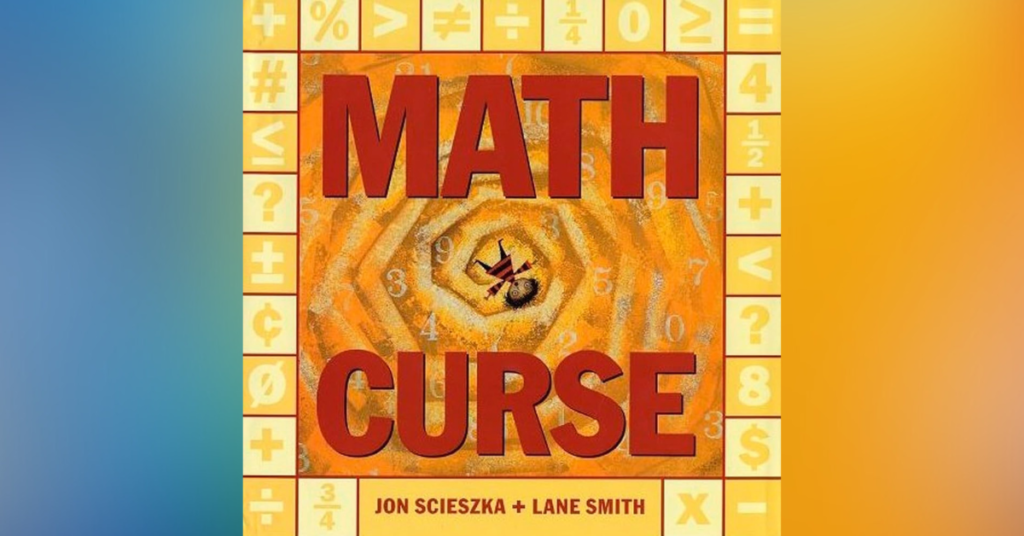
Math Curse By Jon Scieszka and Lane Smith
Math Subjects Explored: Number sense across contexts, estimation, problem solving, math in daily life
Recommended Ages: 6–10 years old
In Math Curse, a student wakes up to realize that everything in life suddenly feels like a math problem, from deciding what to wear to dividing snacks at lunchtime. Each everyday situation becomes a playful challenge that encourages your child to notice how often math appears in everyday life. What makes this book effective is that it frames math as a universal lens rather than isolated problems: kids begin to see counting, comparison, and logical thinking everywhere.
The humor and meta structure make the book memorable: your child doesn’t just practice math; they develop a curiosity about looking at the world mathematically. Older readers can predict outcomes, estimate possibilities, and enjoy the escalating absurdity, while younger kids benefit from the rhythm, illustrations, and repeated revisiting of familiar scenarios. It’s excellent for building flexible thinking and confidence, helping children see math as a tool they use every day, not just something they do in school.
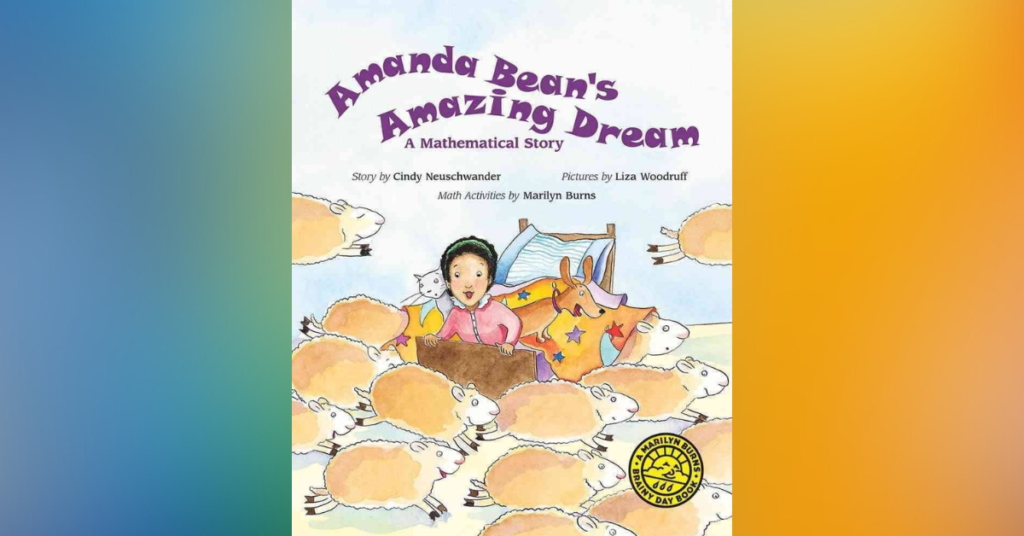
Amanda Bean’s Amazing Dream By Cindy Neuschwander
Math Subjects Explored: Estimation, place value, large numbers, number sense
Recommended Ages: 6–10 years old
Amanda Bean dreams about worlds where numbers behave in odd and exaggerated ways. Throughout her journey, she confronts large numbers, makes estimates, and explores place value, all wrapped in an imaginative narrative. The book helps children understand that numbers have scale and meaning beyond rote counting.
By embedding estimation and place value in a story, the book demystifies why big numbers matter and how they relate to everyday thinking. This is especially valuable for older early elementary readers who begin to encounter multi-digit operations and need intuition behind the symbols. It’s both fun and conceptually rich, ideal for readers ready to think about how large and how many in flexible ways.
There are many great children’s books about math to choose from, and I hope some of my family’s favorites will help your kids begin to grasp basic and advanced math concepts. These are the books my children have loved, and I’m confident your child will love at least a handful of them, too!