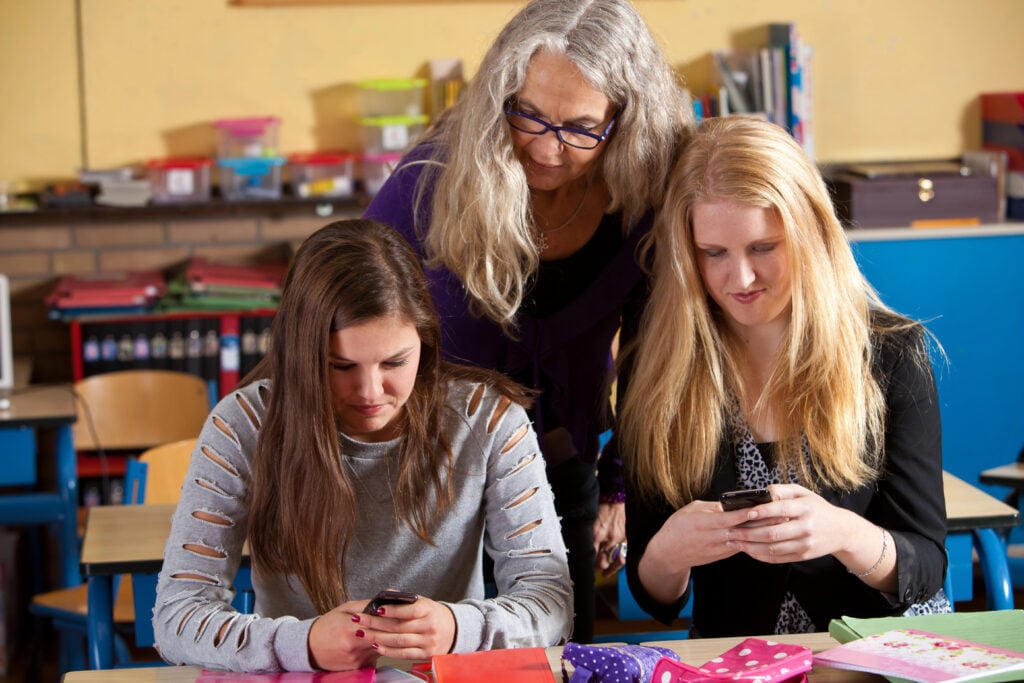
I will admit it. I doom-scroll as frequently as the next person. And yesterday, I discovered my elementary school-aged son does too.
My child does not have a phone, so it never occurred to me that scrolling through social media could be an option for him. Little did I realize he joined a small group of children circling around one friend who had a phone and access to social media, and they doom-scroll together.
After I read news articles in the morning, my son was able to give me information about the topic that evening. If something happened in sports, he was clued in before my die-hard basketball family members had any idea. His access to information, even from simply looking over a friend’s shoulder while watching TikTok, was astounding.
Social Media As Fact
Here’s the thing: the more I learned about the information he was receiving, the more I began to question his sources. Although some of the information he was receiving from social media was accurate, there were a fair number of times when he made statements that were flat-out misinformation (“The Mets have the greatest hitters in MLB history”). Sorry, Mets fans!.
So, how do we teach kids to think critically when information is constant, fast, persuasive, and opinionated? How can a parent teach critical thinking skills that are now required in this digital age?
Why Is Critical Thinking Important

First, think about the important role that critical thinking plays in our development. Critical thinking skills are developed starting in elementary school. It allows us to question information, evaluate sources, recognize bias, distinguish fact vs opinion, and reflect before reacting.
All of these skills require attention, patience, and motivation to do the cognitive work of evaluating information. Not many children are born with these abilities!
Generational Shifts in Critical Thinking
Let’s compare this experience to that of earlier generations (Xennial here!) who had no social media or AI. I grew up in a time when I was expected to engage in critical thinking because it took effort to research, read, and look for information (literally searching the stacks at a library) to support my opinions.
It’s much easier for me to consider alternative opinions, challenge my own thinking, and ask myself to seek supporting sources of information because I was required to build up my distress tolerance to uncertainty (Savin et al. 2024).
Enter Social Media
Now, let’s look at the impact of TikTok on the development of these skills. Fast-paced, hooks, trending music, and an algorithm set up to reflect your preferences and perspectives. Often, influencers are effective communicators, emotionally persuasive, attractive, and backed by the clout of thousands of people “liking” their opinions. It’s the opposite of the skills required to build critical thinking.
We Want To Believe!
Not only does social media give us access to information quickly, but it has also trained our brains to look for information that we already believe (Pariser, 2001). Confirmation bias is the tendency to look for, believe, and remember information that supports what we already think.
It is one of the primary psychological mechanisms that social media uses to create algorithms and to provide access to specific “silos” of information that support our beliefs. So, we shouldn’t be too surprised when some of the information we are fed on social media isn’t accurate. Even if it’s not exactly true, we WANT it to believe it because it supports our already established beliefs.
What Happens Without Critical Thinking?

We know that critical thinking skills are important, but what does the lack of them do to our children?
Some of the drawbacks of having less critical thinking are that we lose reflection. We stop processing information deeply and pivot to reacting to information without considering the source. We take their opinions as facts and incorporate them into our thought patterns, which eventually influences our decision-making.
Children continue to develop reasoning, impulse control, and judgment through young adulthood (Dwyer, 2023). The very nature of getting information this way prevents children from building the skill of reflection.
Evaluation Of Misinformation
Secondly, research has pointed to a lack of critical thinking skills as linked to a reduced ability to assess false information (Wineburg & McGrew, 2017). This makes sense but is also factual: when we do not have time to reflect and process deeply, we do not have time to ask the question, “Where did this person get this information?”
How To Teach Critical Thinking Skills
Although there may be plenty of barriers to developing critical thinking, we know one thing: It CAN be taught. Media literacy, or the ability to access, analyze, evaluate, create, and act across all forms of communication, has been shown to enhance critical thinking skills when taught in schools (Jeong, Cho & Hwang, 2012).
Support your schools in launching or developing these programs. Kids can learn how to analyze information and be skeptical of misinformation while still enjoying social media.
Discussion-Based Learning
Discussion-based learning also supports the development of critical thinking by strengthening reasoning and perspective-taking. If your child shares information with you from social media, approach it with curiosity and conversation.
Model Critical Thinking Skills
Lastly, modeling these skills is key. You know how you might ask yourself, “Is this real?” We can use the same skill with our children by asking them some of the following questions if scrolling on social media:
- “Who made this?”
- “What are they trying to get me to feel or believe?”
- “Is there another side?”
These questions lead to important open discussions that strengthen reflection, deep processing, reasoning and judgment.
Encourage Emotional Awareness
Emotional content in social media draws us in and makes us want to react. We can slow down our child’s emotional reactivity by bringing awareness to the impact of emotions in the videos. Slowing down emotional reactivity can be supported by asking the following questions about content:
- “What feeling is this wanting me to feel?”
- “Why might this information want me to feel that way?”
- “How might these feelings impact the choices I make?”
Introduce Fact-Checking Habits
One aspect of media literacy is the habit of double-checking. It takes time, it takes energy, and it’s much easier to skip this step. However, it is what separates someone from falling into the misinformation trap. Questions to ask to encourage this habit:
- “How was this verified?”
- “How many sources were searched before presenting this information?”
- “What credible organizations provided this information?”
Watch With Them!
Last but not least, watch content with your children! Curiosity and involvement (not criticism!) can help to organically lead to discussions about these topics. Modeling these skills in real time is one of the most effective learning strategies for kids.
Does My Child Need Help?
We may already be teaching these skills. Our children’s schools may already prioritize media literacy. Our kids may still be struggling with these skills.
We can look for a few things that may indicate our child needs more support. One, they believe everything they see online; they struggle to distinguish fact from opinion, react emotionally without reflection, and have difficulty evaluating sources. The questions above will facilitate growth in these areas.
Teaching Kids HOW To Think

The digital world is not slowing down. Social media and AI will continue to be influential and primary modes of sharing information. We can’t fight it!
What we can do is teach our children, not what to think, but how to think. Supporting our kids in creating a mental list of questions to support critical thinking skills may be one of the most important tools in our generation.