
Interrupting Chicken - The Magnificent Magician of the Mailbox / Once Upon a Chicken (S2E5)
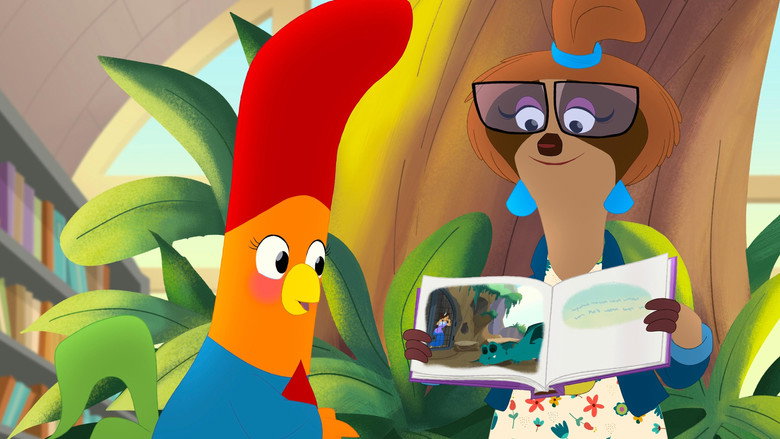
Theodore, Duckston, and Piper work together on an illustrated story. Mrs. Slothworth teaches the class about fairy-tale clichés.
| Runtime (min) | 23 |
|---|---|
| Air Date | 2023-09-28 |
| Genres | Kids, Animation |
| TV Rating | TV-Y |
| Network(s) | Apple TV |
Storyline
In "The Magnificent Magician of the Mailbox," Theodore, Duckston, and Piper collaborate on creating an illustrated story together. The trio must navigate the creative process as a team, learning to combine their individual ideas and artistic contributions into a single cohesive narrative. As they work through the challenges of collaborative storytelling, they discover how different perspectives and talents can enhance a shared project.
In "Once Upon a Chicken," Mrs. Slothworth introduces her class to the concept of fairy-tale clichés—those familiar, overused elements that appear again and again in traditional stories. Through examples and discussion, the students explore common patterns like "once upon a time" openings, predictable plot devices, and stock characters. The lesson encourages the young storytellers to recognize these conventions and think critically about how they might subvert or reimagine them in their own creative work, pushing beyond formulaic storytelling toward more original narratives.
What kids learn
Children learn valuable lessons about collaboration and compromise through Theodore, Duckston, and Piper's group project. The episode demonstrates that working together on a creative endeavor requires listening to others' ideas, finding ways to blend different visions, and respecting each contributor's strengths. Young viewers see that collaboration can be challenging but ultimately produces richer results than working alone, and that disagreements during the creative process are normal and can be resolved constructively.
The fairy-tale cliché lesson with Mrs. Slothworth develops critical thinking skills by teaching children to recognize patterns and conventions in stories. By identifying overused elements, kids learn to become more thoughtful readers and storytellers. This awareness empowers them to make deliberate creative choices rather than defaulting to familiar formulas. The episode encourages originality and shows that understanding the rules of storytelling is the first step toward breaking them in interesting ways.
Throughout both segments, children absorb the message that storytelling is both a craft that can be studied and an art that benefits from fresh perspectives and collaborative energy.
Parents' top 5 questions
| Question | Answer |
|---|---|
| What age-appropriate collaboration skills does this episode teach? | The episode models turn-taking, active listening, and respectful negotiation as Theodore, Duckston, and Piper work together on their illustrated story. Children see the characters express their own ideas while remaining open to others' contributions, demonstrating that successful collaboration requires both assertiveness and flexibility. These skills translate directly to group projects at school and cooperative play with siblings or friends. |
| How can I help my child understand fairy-tale clichés after watching? | After the episode, read familiar fairy tales together and ask your child to spot the clichés Mrs. Slothworth discussed—phrases like "once upon a time," magical transformations, or happily-ever-after endings. Encourage them to think of alternative ways these stories could begin or end. This active reading practice reinforces the lesson and helps children become more aware, critical readers who notice patterns in the stories they encounter. |
| Does this episode encourage my child to be critical of classic stories? | The episode teaches pattern recognition and creative thinking rather than dismissing traditional tales. Mrs. Slothworth's lesson helps children understand storytelling conventions as tools that writers use, not flaws to criticize. The goal is to empower young storytellers to make intentional choices, whether honoring classic patterns or inventing new ones. Children can still enjoy traditional fairy tales while developing awareness of their structure. |
| What if my child gets frustrated during group projects like the characters do? | The episode normalizes creative disagreements and shows that they're a natural part of collaboration. Use the characters' experience as a conversation starter about handling frustration constructively. Discuss strategies like taking breaks, listening to everyone's ideas before deciding, and finding compromises that incorporate multiple perspectives. Seeing characters work through similar challenges helps children understand that collaborative friction is solvable, not a sign of failure. |
| How does this episode support early writing development? | By introducing the concept of storytelling conventions and collaborative creation, the episode demystifies the writing process for young children. They see that stories are constructed with deliberate choices and that multiple drafts and perspectives can improve a narrative. This behind-the-scenes look at how stories are made encourages children to view themselves as capable authors who can experiment, revise, and create original work. |
Writing
Directing
| Season # | Episode # | Episode Name |
|---|---|---|
| 1 | 1 | Piper tries to save the Three Little Pigs from the Big Bad Wolf. When Terry Turtle hatches, Piper and friends help him get to Turtle Island. |
| 1 | 2 | Piper and the Three Billy Goats Gruff outsmart the Bridge Troll. The King's Knights help Piper put Humpty Dumpty back together again. |
| 1 | 3 | In Greece, Piper attempts to make Hercules' heroic journey easier. A lion with a thorn in his paw seeks Piper's help to outrun a helpful mouse. |
| 1 | 4 | Piper, Aladdin, and Genie search for the perfect place to host an ice cream party. Piper joins the Pony Express for a cross-country adventure. |
| 1 | 5 | At a disco roller rink, Piper investigates how Grandma and Grandpa met. Piper tries to warn Little Red Riding Hood about the Big Bad Wolf. |
| 1 | 6 | Piper transforms into Wonder Chicken to save Chickenopolis. After a shepherd boy cries wolf, Piper helps him find his lost sheep. |
| 1 | 7 | As a world explorer, Piper rescues an artifact from a hidden jungle temple. Piper reimagines Jack and the Beanstalk from the Giant's perspective. |
| 1 | 8 | On Halloween, Piper writes a spooky monster story. Piper helps the Sorcerer's Apprentice use magic to defeat a four-headed dragon. |
| 1 | 9 | When Ebenezer Wolf decides to cancel the holidays, Piper teams up with the Three Little Pigs and some ghostly friends to change his mind. |
| Season # | Episode # | Episode Name |
|---|---|---|
| 2 | 1 | Piper sets sail with a pirate crew to search for treasure. When a favorite book falls apart, Piper and friends try to piece it back together. |
| 2 | 2 | Papa's friend shares his passion for hip-hop. Piper rewrites a time-honored tale to make it a little less spooky. |
| 2 | 3 | Grandpa encourages Piper to help a struggling storybook character. A friendly lion looks to Piper for guidance on how to be funny. |
| 2 | 4 | Piper puts fun genre twists on a familiar favorite. When a royal athlete can't fall asleep, Piper leaps into action. |
| 2 | 5 | Theodore, Duckston, and Piper work together on an illustrated story. Mrs. Slothworth teaches the class about fairy-tale clichés. |
| 2 | 6 | Piper and friends help the King build an exciting new ride. Hoping to solve a mystery, Piper transforms into a detective. |
| 2 | 7 | Grandma teaches a valuable lesson as Piper suits up for a superhero mission. A popular author sparks creativity for Mrs. Slothworth's class. |
| 2 | 8 | Benjamin asks Piper to create an original story. Piper meets new friends while trying to unlock the gates of the royal kingdom. |
This product uses the TMDB API but is not endorsed or certified by TMDB.