



Every stage of parenting has its own struggles and surprises. Parents often complain about the difficulties of getting teenagers through their most awkward hormonal shifts, or about the “terrible twos.”
In fact, if you asked a group of parents what the hardest developmental stage is, you’d probably get a different answer from each, and in most cases, that answer would reflect the stage their kids are currently navigating.
Perhaps more interesting, though, are the reasons parents say each stage is harder than any other.
Why Parents Say The Newborn Stage Is Hardest
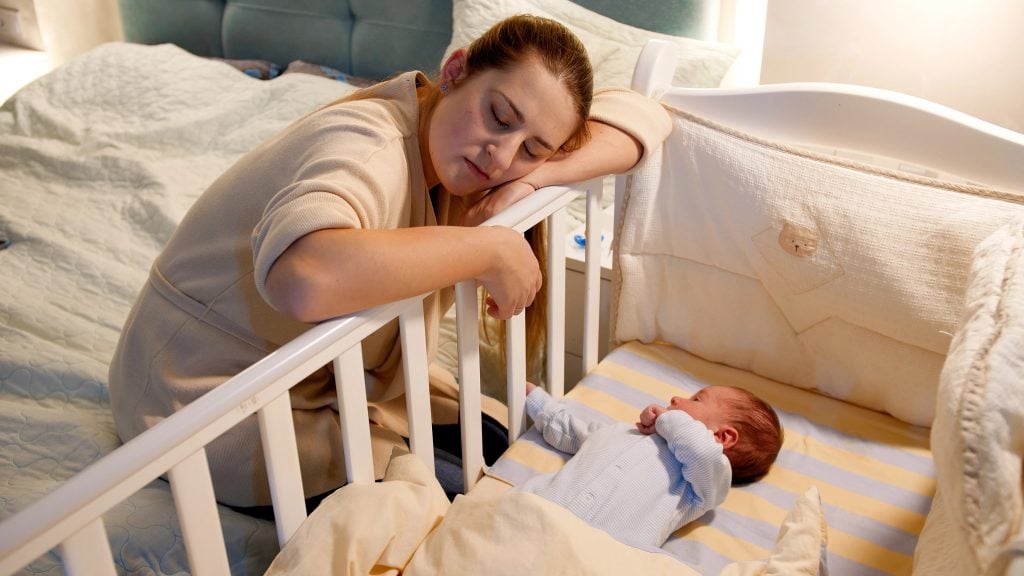
I can remember bringing home my firstborn child from the hospital, and crying because this real human person was so tiny and fragile. What if I did something wrong and broke my new little being?
Newborns are difficult because they’re brand-new to the world, and are still adjusting to existence outside the womb. They can’t adequately communicate what they need, and whatever it is, they need it every few hours, if not more frequently. This period is often called the fourth trimester because our newborns really want to stay as close to us for the first few months after birth as they did in utero, and that’s pretty intense.
At the same time, the new mom is recovering from childbirth and possibly from a serious surgery. She’s often been sleep-deprived for weeks or months as her body changed and worked to grow a baby, and she’s almost certainly been sleep-deprived in the last few days or weeks before giving birth.
Then, the sudden hormonal shifts hit. Postpartum emotions can range from mere teariness and adoration to deep depression and high anxiety levels, making everything more difficult.
Newborns are precious and it’s a beautiful stage to be treasured, but there’s little doubt that it’s one of the most difficult stages in parenting!
Why Parents Say The First Year Is Hardest

The first year of parenting is difficult for some of the same reasons as the newborn stage. For most of this year, your baby has had almost no ability to communicate exactly what they need, and since they’re usually not sleeping through the night, parents are still exhausted.
Parents say the first year is hardest because, honestly, we’re still getting to know this little person’s needs and personality, and they’re still getting to know the world. When the baby is this small, parents are still new at parenting and still learning to juggle those needs with all their other responsibilities.
In fact, according to The Bump, more than half of moms said the first year took a toll on their self-confidence, and two-thirds said sleep deprivation was getting to them. Moms said they wished for an extra set of hands, and for someone to show up and interpret exactly why the baby was crying so much.
What Parents Say Is So Difficult About The Cruising Stage
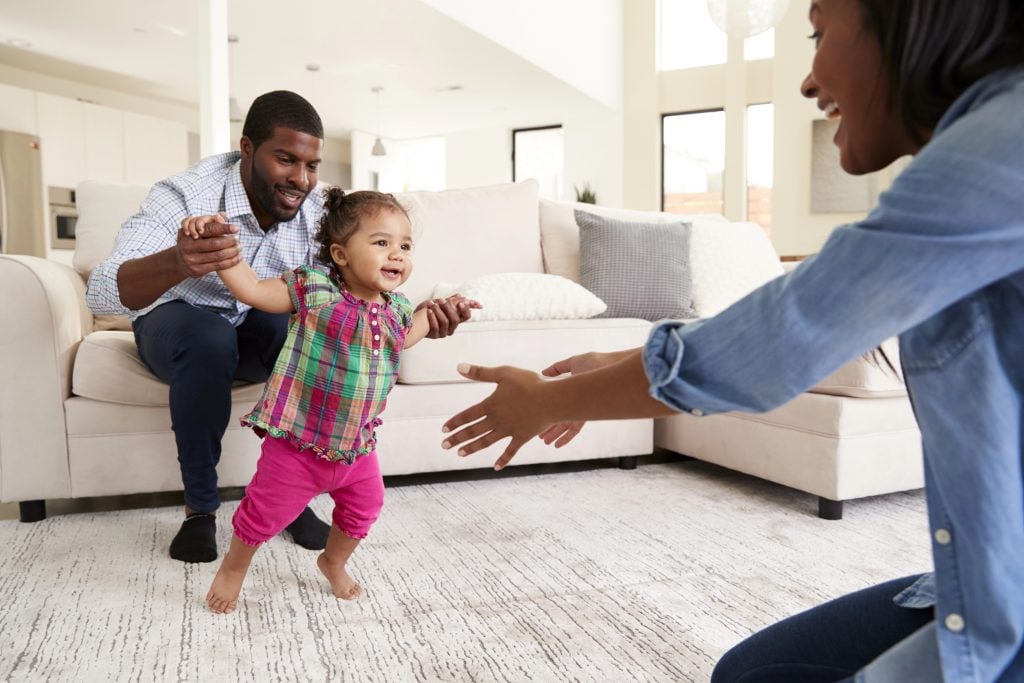
There comes a point, generally in the first year of life, when babies desperately want to get up and go, but their muscles and skill set aren’t quite prepared.
Our babies start trying to crawl or pull to standing, and since they can’t do it successfully yet, there are a lot of tears and a lot of upsetting incidents.
For many of them, like my youngest, one aspect of this is the determined effort to crawl through walls. Whether it was inside the playpen or on the living room floor, once she could crawl, she’d go straight until an obstacle stopped her, then scream with rage as her arms and legs kept working to push her forward.
Babies at this age also try to crawl while nursing, and even while falling asleep. They’ll end up with their little head pressed against one end of the crib, wailing in exhausted frustration, and unable to rest.
Then they start trying to stand, which involves a lot of falling. It gets difficult to leave the room when the baby is awake, even if she’s securely in her crib or playpen, because you know she’s going to pull up and fall down.
This is also when we are suddenly introduced to every babyproofing fail we didn’t know we’d made.
Why Parents Say Toddlers Are Toughest Of All
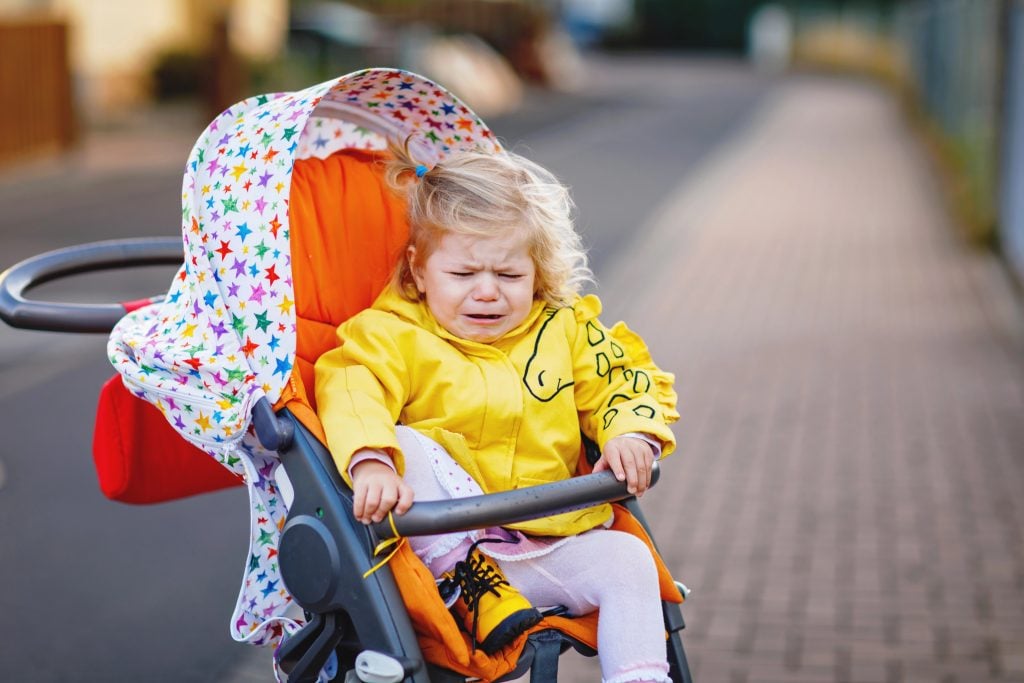
Once our babies are walking, there’s another round of learning what we missed on the last few rounds of babyproofing. Who knew she could reach that shelf! Oops, those chair cushions come off way too easily. Yep, that drawer is going to need a latch.
The other struggle here is that now our babies are wearing those little leg, arm, and core muscles out every day. You’d think this would mean great sleep every night, but instead it often throws everything off.
Toddlers are often cranky, frustrated by everything they can’t quite do yet, and still struggling to turn off the “go” setting to get any rest. They’re likely to collapse into unplanned, unscheduled naps at inopportune times, leading to more bedtime fights.
What Parents Say Makes 2- & 3-Year-Olds Impossible
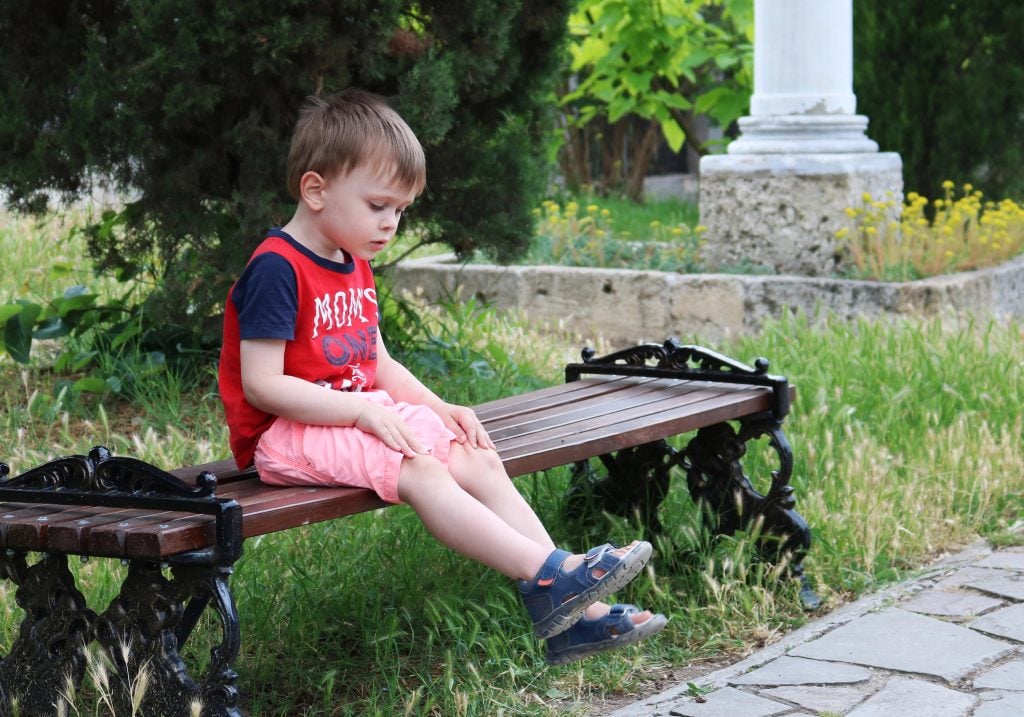
We’ve all heard of the “terrible twos.” Some parents say that age three is even tougher, hence the term “threenager.”
At this stage, kids are really beginning to develop a little independence. A two-year-old is starting to recognize himself as a separate person, apart from his parents, who can use words like “no” and engage in sit-in protests against injustices such as meals, bedtimes, and the putting away of the blocks.
Two-year-olds and three-year-olds are still developing a grasp of what they want and what they don’t, and they sometimes get overwhelmed by it. (Hence the meltdown over being given the exact sippy cup they asked for thirty seconds ago, or the food that was their favorite yesterday.)
These meltdowns can happen without warning, and at the most inopportune times.
Kids this age are also really curious, which is awesome, but it also means they engage in activities like removing their own diaper, trying to climb the baby gate, emptying the dog bowl, climbing furniture, and so on.
How 4 And 5-Year-Olds Drain Parents’ Energy

By age four or five, some things are getting a bit easier. You can reason with kids this age, to a degree. You can even bribe them a bit, if necessary. (“Once we get in the car, I can play the Cocomelon songs for you. Again.”)
At the same time, personality is developing strongly. We all want to raise kids who know how to say “no” when necessary, but it can be exhausting to be the person they practice it on.
The potty situation can be exhausting at this age. One of my older kids did what I called “Toilet Tourism,” needing to visit the bathroom at every single stop, which can really stretch out an errand day. They are also often afraid of public restrooms, which are noisy and strange places, but curious about them at the same time, in the most awkward ways. (“Hey, Mom, there’s another lady in here! Is she poopin’?”)
For many, this is also the first year of school or preschool. Not only can it be an overwhelming new experience for them, but it can also mean they come home with questions, behaviors, and vocabulary you didn’t actually intend to expose them to.
Survey Says Early Elementary-Aged Kids Are Hardest To Parent

A 2020 poll found that a majority of parents consider age 8 to be the hardest to parent, according to Heart. In this poll, parents labeled behaviors between the ages of 6 and 8 as more difficult than even those of toddlers.
These parents said that 6-year-olds are the most apt to engage in embarrassing behavior, such as shouting something inappropriate in the grocery store or taking off their clothes in public. Six-year-olds have no shame, and they don’t understand why their parents do.
They described age 7 as the worst for tantrums. Tantrums are different from meltdowns in that meltdowns tend to be outside the child’s control, whereas tantrums, by definition, are voluntary and intended to achieve a goal (such as that really cool toy, some ice cream, or more screen time).
Age 8, though, was deemed the hardest overall. This is an age when kids tend to start having homework, so there’s more need for time management. It’s another growth spurt in autonomy, with your child suddenly wanting (again) to be more independent, whether or not the ability to do so develops at the same time.
The Challenge Of Tweens & Preteens

Tweens and preteens are a tough time for kids, and if kids are struggling, it’s pretty likely their adults are too.
To us, they still look like our tiny babies. Their faces are still baby-soft, and they might still like to cuddle. However, kids their age are engaging in a lot of adult behaviors, from language to vaping and drinking, and more.
No matter how careful we are, our kids are likely getting exposed to these topics, and if we haven’t talked to them about this stuff yet, it’s time.
Hormones are also hitting, so hygiene is more vital than ever — and just at the same time that they might stop enjoying their toy boats in the bath.
Those hormones may also mean a surge in interest in dating, along with the emotional pains that go with it, plus an increase in social activity involving a lot of parental taxi duty.
The hardest part of the hormonal changes may be the mood swings. If you’re concerned about your child’s emotional state (seeing signs of depression, anxiety, self-harm, etc), don’t hesitate to talk to your pediatrician for guidance.
Surviving The Early Teen Years

The hormones haven’t stopped, and now your child may be in high school, with a stack of new responsibilities. Moreover, this is typically the point when teachers (and parents) start expecting your child to be more responsible for his own tasks, so a little slip-up is more likely to snowball into stacks of overdue assignments and missed deadlines.
Now your kids (and you along with them) may be dealing with acne, facial hair, body odors, voice changes, menstrual cycles, and/or the need for new undergarments. They’re terrified that their classmates will notice these changes, and that nobody will notice. They feel a strong need to be grown-ups, and don’t yet have the ability — and they often take that frustration out on their parents, the safest and closest adults they have.
Hormone changes can lead to greater emotional instability. There can be rage, anxiety, and depression, and according to the CDC, about 1 in 5 high school students has serious thoughts of suicide. That’s a whole new set of fears for parents.
Older Teens Bring New Parenting Fears

That baby who was just learning to walk, what seems like weeks ago, wants his driver’s license. It’s time for driver’s ed, then for a learner’s permit and lots of driving practice with parents. Then, an actual driver’s license.
The costs of insurance and a new car pale in comparison to the worries of knowing your baby is driving home at night after a football game for the first time, or taking his first trip out of state in his own vehicle, or driving on a date for the first time. (And of course, there are the stresses that come with your teen dating!)
Suddenly, your physical responsibilities may have decreased. You no longer need to drive your kid to school or work, and hopefully, you haven’t needed to remind him to bathe or change clothes in a while. Instead, there’s this terrifying transition of independence, and you might wish he were still holding your hand across parking lots.
Help, I Have An Adult!

When a Redditor asked for the hardest stage of parenting, one reply landed in a space many parents haven’t even thought about.
That space between adulthood and independent adulthood.
This parent described a situation in which a child who is legally an adult still lives at home and relies on their parents, but doesn’t expect to follow any household rules or be involved in household responsibilities, because they mistakenly think adulthood means freedom.
That’s not the only hard part of having adult offspring, though. Just because our babies are adults doesn’t mean we stop worrying about them when they’re driving long distances, when they join the military or go away to college, or when they start families of their own.