

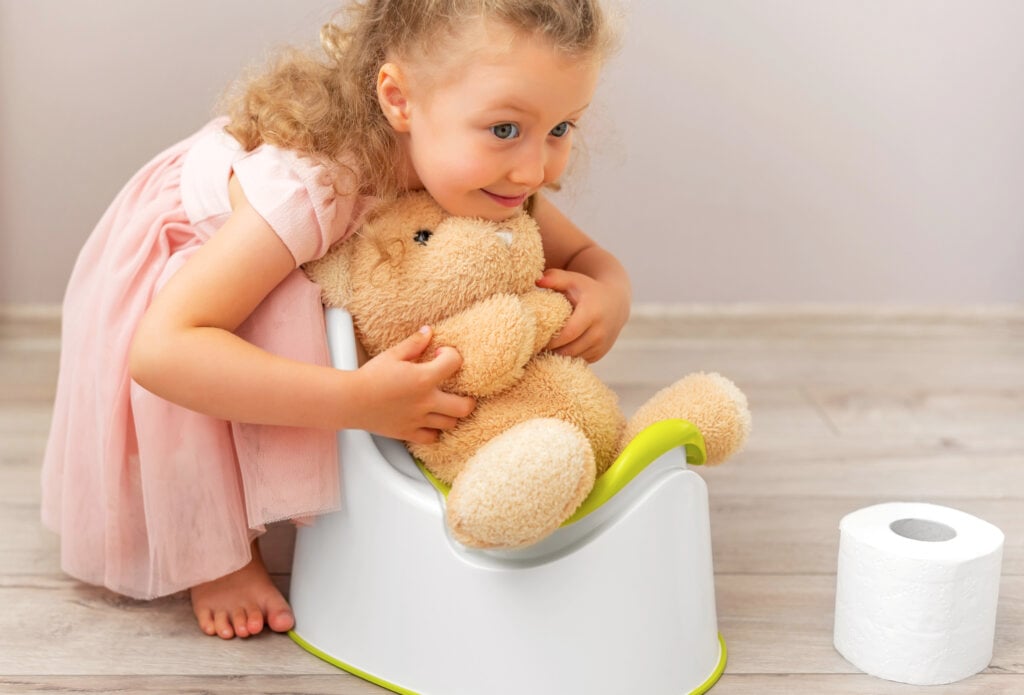
Potty training is one of the most frustrating tasks for many parents. It’s messy and complicated, and parents can feel shame and judgment when it doesn’t go as smoothly as expected.
Often, a frustrated and dysregulated parent is one who resorts to punishment, with the intent to “correct” a child’s behavior. But accidents during potty training aren’t misbehavior, they’re a sign your child is still learning.
Using punishment as part of potty training can backfire, slowing your child’s learning and leading to more setbacks.
Mom Reported To CPS After Extreme Potty Punishment
The general public will probably never know the outcome of this case, for the child’s privacy, but after one mom shared the punishment she uses when her child has an accident, TikTok went on a full-fledged fact-finding mission, and she was reported to Child Protective Services, according to Mom.
The mom herself posted a short video, referring to her own tactic as “unhinged” and describing how, whenever her child has an accident, she puts him in a cold shower. She shared that people were accusing her of abuse for this, and then she started deleting.
Other users had already scraped some data, though, and they dug deep. What happens to this mom next could range from absolutely nothing to a check-in and warning, to parenting classes, or a more serious intervention.
Meanwhile, for the child, this tactic could result in fear and shame around bodily functions that could last into adulthood.
Parents Panic When Potty Training Is Hard
Generally, parents who use punishments to try to direct their child’s potty behavior (though, in reality, it’s less about behavior than a skill set) aren’t trying to do harm.
They’re doing what they’ve been taught is the right method of potty training, or they’re responding to their own frustration, and their fear that they are ‘failing’ at potty training their child. They may fear that their child won’t be allowed at daycare or school or that they’ll be judged by other parents (we all know someone who had their kid perfectly potty trained in three days without any effort, right?) or by daycare staff, pediatricians, and others.
They worry about messes and stains and about accidents in the grocery store, and if there’s a parent out there who isn’t sick of laundry by the time potty training starts, they are by the time they get through it.
It’s always a little scary when kids miss milestones (or the point where a parent has been led to believe the milestones are) and even more so when it’s one that’s already fraught with anxiety.
Parents have long been trained that punishment is the tool to use for teaching. Experts say that’s wrong in many cases, and potty training is one of them.
What Are Experts Saying About Potty Punishments?
The Mayo Clinic warns parents that punishment should not be part of the potty training process. Even comments like “big kids don’t like pee in their pants” should be used rarely, the major medical organization says.
“Calmly change your child into a dry diaper or training pants. Don’t get angry, shame your child or use punishments such as making your child wear a dirty diaper. Use kind, gentle encouragement instead.”
The Boston Children’s Hospital acknowledges that tactics, including punishments for potty accidents, as well as forcing children to sit on the potty against their will, and treating accidents and bedwetting as ‘bad behavior’ have been normalized, but says to reject them. They cite the advice of Dr. Wanessa Risko, MD, DSc., about letting your child see you get too worked up about bodily functions.
“Toddlers are very good at perceiving what behaviors warrant a response,” Dr. Risko says. “If they perceive that using the toilet is something that carries a lot of stress, then they can get performance anxiety. And they’ll start avoiding the toilet because they’ll associate it with an emotionally loaded situation.”
Making the potty an emotionally fraught situation doesn’t make your child master it. It can, instead, result in a child who is afraid of the potty, afraid to be “caught” having bodily functions, and may learn to hold it in instead, or to hide messy or wet clothing.
Punishing Something Your Child Can’t Help
Maybe your toddler knew he needed to go to the potty, but he didn’t want to take a break from his toys. A parent might see that as a behavioral choice to correct. On the other hand, maybe your child is dealing with something that made him less aware of his body’s signals.
Stress or anxiety can cause potty regressions, even in children who have mastered the basics. Trauma can result in regressions, too. However, a UTI can disrupt a child’s awareness of the need to pass urine, and other minor ailments can mask it. Even feeling a little off or tired may result in an occasional accident, and it may be a matter of ability rather than refusal.
The Cleveland Clinic notes that sometimes even a kid who seemed fully potty trained really just isn’t ready yet.
However, if it’s a regression (consistent accidents for days, not just an occasional one) it’s a good idea to consider whether there are any current stressors (a new school, a move, bullying, parental stress that’s tangible to the child, ect) that are affecting your child.
If you do see signs of medical concerns, or if you think trauma could be involved, check in with your child’s doctor.
Otherwise, the best way to correct a regression is to meet your child where he or she is and start the process again, with calmness and understanding.
