


If your child’s math homework has ever made you feel like you missed a grade somewhere, you are in very good company. Across the country, parents of elementary-age children are sitting down at kitchen tables and encountering number lines, area models, and multi-step written explanations where they expected simple columns of addition problems.
The gap between how today’s parents learned math and how their children are being taught is real, it is wide, and it has been building for decades.
Understanding that gap, and knowing how to work with it rather than against it, can transform homework time from a nightly standoff into something genuinely productive for both of you.
How Math Teaching Actually Changed Over The Decades
The story of modern math instruction is not a single dramatic shift but a series of reforms, each one reacting to the shortcomings of what came before. For most parents who grew up in the 1980s and 1990s, the math they remember was shaped by a “Back to Basics” era that dominated classrooms during those decades.
That approach, which followed a brief and largely unsuccessful experiment with abstract “New Math” in the 1960s, put computation front and center. Multiplication tables were drilled until automatic, long division was practiced to the point of reflex, and a correct answer was all that was needed to move forward.
According to the history of math curriculum changes, there was little classroom discussion about why methods worked or how different strategies connected to one another.
What many parents may not realize is that the roots of today’s approach stretch back even further. The origins of “New Math” trace to the 1950s and 1960s, when American educators overhauled the curriculum in direct response to Cold War pressures and the space race.
The goal then, as now, was to move students beyond memorized rules and toward genuine problem-solving ability. That original reform proved too abstract for most classrooms and was largely abandoned, but its core ambition never fully disappeared.
By 1989, the National Council of Teachers of Mathematics published standards that formally shifted the conversation, emphasizing problem solving, reasoning, and communication over procedural speed alone.
Then, between 2010 and 2013, the adoption of Common Core State Standards by most states marked the most significant and visible turning point for today’s families. Those standards reorganized math around three priorities: deeper focus on fewer topics per year, logical coherence from grade to grade, and a balance of conceptual understanding, procedural fluency, and real-world application.
The viral social media moment that followed, with parents posting baffled reactions to Common Core problems, captured just how jarring the change felt to families who had no warning it was coming.
What Conceptual Math Actually Means In Practice
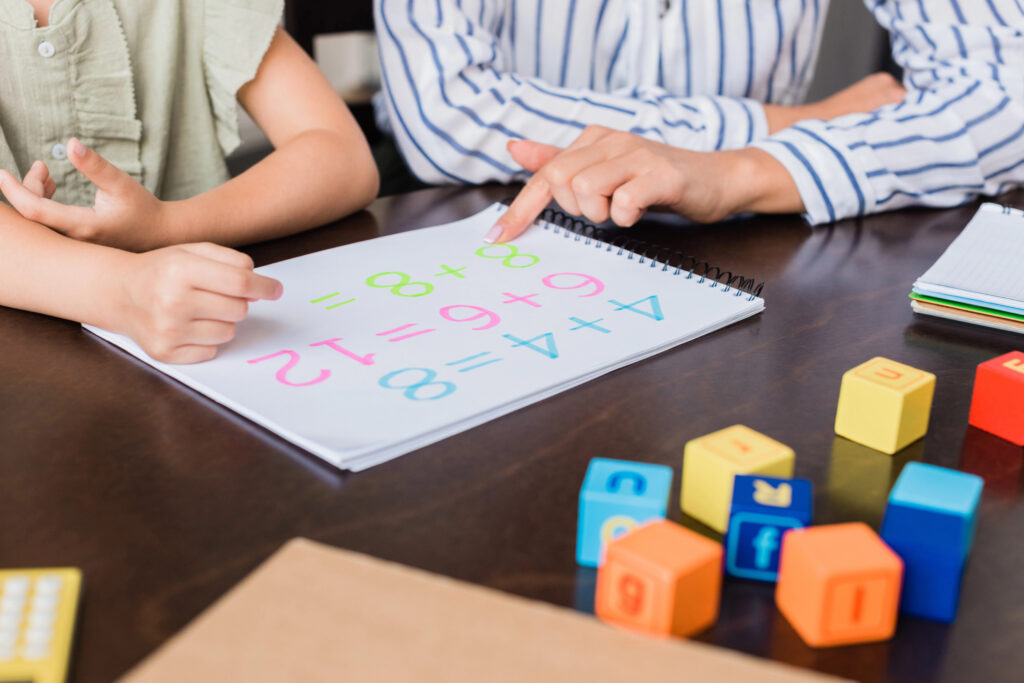
The clearest way to understand the difference is to look at a single operation taught two ways. Under the older model, a student adding 27 and 8 would stack the numbers, carry if needed, and write the answer.
Today, that same student might break the 8 into 3 and 5, add 27 and 3 to reach a tidy 30, then add the remaining 5 to arrive at 35.
Both paths end at the same destination. The newer route takes longer on paper but builds something the older method often skipped: an intuitive feel for how numbers relate to each other.
Multiplication follows a similar pattern. Where parents remember memorizing times tables and moving quickly to long multiplication, today’s students use area models and partial products, physically breaking numbers apart by place value before recombining them.
Division, once a fixed sequence of steps inside a long bracket, is now introduced through tools like partial quotients that make the relationship between multiplication and division explicit before the standard algorithm ever appears.
The underlying philosophy, as Parents.com frames it for families, is about giving children the tools to keep up with their math lessons at school without leaving parents completely adrift at home.
The goal is not to replace the standard algorithms parents know but to give children a conceptual foundation so those algorithms make sense rather than feeling like arbitrary rules to memorize.
Why The Pandemic Made This Harder, And What It Revealed
For many families, the collision between old and new math methods was theoretical until schools closed in 2020.
Suddenly, parents were the primary instructors, and the gap between methods taught thirty or forty years ago and those used in classrooms today became impossible to ignore. The pandemic did not create the disconnect, but it forced millions of families to confront it directly and all at once.
Children who had been navigating two different mathematical languages, one at school and one at home, lost the school side of that equation entirely for a period, and the confusion that followed was significant.
That experience also highlighted a specific challenge that does not get enough attention: modern math relies heavily on word problems that require reading comprehension before any calculation can begin.
For children who struggle with reading, this creates a compounded barrier that has nothing to do with their mathematical ability.
Practical Strategies That Actually Work At Home
Joan Ferrini-Mundy, the former chief operating officer of the National Science Foundation and current president of the University of Maine, has spent her career at the intersection of math education research and practice.
Her core advice for parents, drawn from NSF’s guidance on helping kids with math homework, centers on listening before explaining. Ask your child to think out loud while working through a problem.
In many cases, the act of narrating their own process helps children catch their own errors before you say a word.
Ferrini-Mundy also offers a concrete illustration of why understanding a child’s thinking matters more than correcting the answer. If a child adds 1/3 and 1/4 and arrives at 2/7, the wrong answer alone tells you nothing useful.
But if you ask how they got there and they explain that they added the numerators and the denominators separately, you have just learned something specific: they may not yet understand what a fraction actually represents. That is a starting point for real help, not just a correction to move past.
Ferrini-Mundy wrote for NSF that “communication is (excuse the pun) the common denominator when it comes to making math homework a positive experience.”
Beyond the homework table, everyday life offers low-pressure opportunities to reinforce the same conceptual thinking schools are building. Grocery shopping, for instance, is a natural setting for practicing addition, multiplication, and percentages in context.
Cooking together puts fractions and measurement into physical, tangible form. These activities work precisely because they mirror the real-world application emphasis that modern math standards prioritize, and they do it without the pressure of a graded assignment.
When you do sit down with homework, try shifting your first question from “Is that right?” to “How did you figure that out?” That single change in framing signals to your child that the process matters, keeps their confidence intact when they are on the right track, and gives you the information you need to help when they are not.
If a particular visual model, a number line, an area model, a bar diagram, looks unfamiliar, sit with it together rather than dismissing it. Most of these tools are simply the traditional method made visible, showing children what is happening behind the steps they will eventually internalize.
Finally, treat your child’s teacher as a collaborator rather than an adversary. Find out specifically how a concept is being introduced in the classroom before you try to supplement at home. A five-minute conversation or a quick email can prevent a week of conflicting instruction.
Why New Math Is Important

It is worth stepping back from the homework frustration to recognize what this change in math education is actually trying to accomplish. Children who understand why an algorithm works, not just how to execute it, are better equipped to apply math to problems they have never seen before.
That flexibility matters more in a technology-driven world than the ability to quickly reproduce a memorized procedure. The friction parents feel at the homework table is real, but it is a side effect of a genuine attempt to give children something more durable than the math education most of us received.
The goal for parents is not to master every new method but to stay curious alongside your child, ask good questions, and keep the lines of communication open with their teachers. That posture, more than any specific technique, is what makes the difference.

