


On Monday, November 2nd, clocks will be set back by one hour to end daylight saving time for the year. It’s a big adjustment for little bodies, and can be confusing for kids, but you can ease the transition for your children with some early planning.
At the same time, kids are seeing the seasonal changes that prompt the standard and may have questions about them. Helping them understand the historical reasons for a clock change and their link to the change in daylight can also help things go a little more smoothly.
Here’s what you can do to bring it all together and minimize how much the end of daylight saving time disrupts your household’s everyday routines.
What’s Happening On November 2nd?
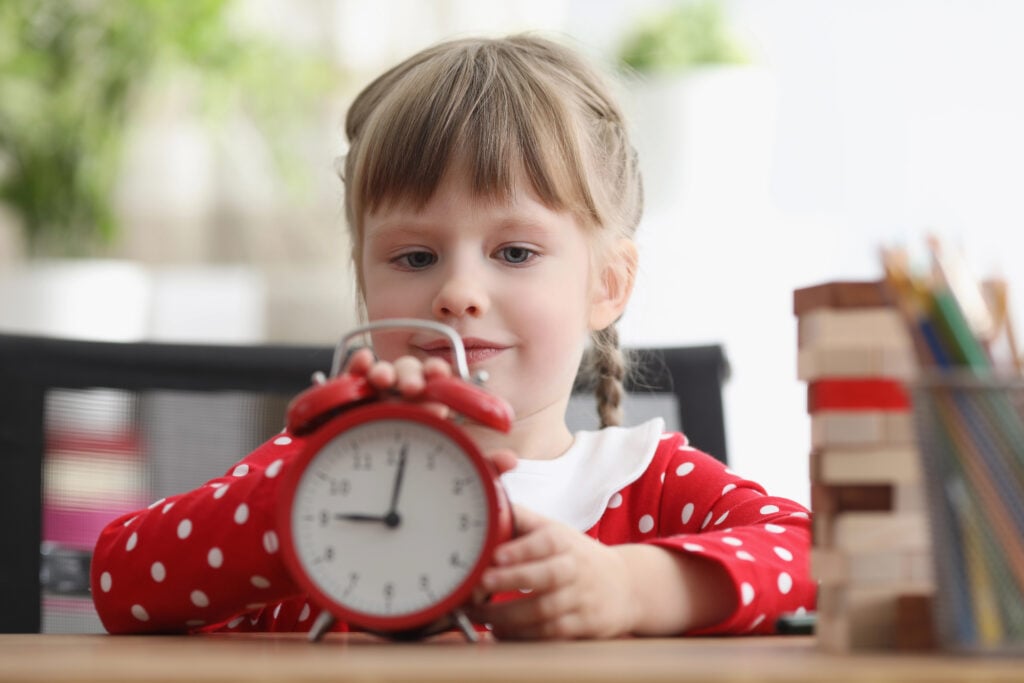
Even adults get confused by time changes, as evidenced by the annual round of social media posts and searches from folks who aren’t quite sure whether it’s time to “spring forward” or “fall back,” and the mnemonic intended to help us remember.
Every year, Daylight Saving Time (DST) ends on the first Sunday in November, meaning that if your child goes to bed and gets up at the same time according to the clock, they’ll actually get an extra hour of sleep that night. Your clocks should change from 1:59 am to 1 am that day. Officially, manual resets are done at 2 am, though in practice people change them before bed.
In some households, this can go over very easily: you wake your child up at the appointed hour, slightly more rested than usual.
However, some kids, especially toddlers and preschoolers, can have their whole routine thrown off by this, starting with waking up an hour “early” by the clock and then cascading into the domino effect of sleepiness, meltdowns, and other struggles you’d rather avoid.
How Should We Shift Sleep Times?
The amount of time and energy you’ll need to pour into this depends a lot on how your child handles routine changes.
If your kid already has a fairly loose bedtime (say, “between 9 and 9:30”) or is used to minor schedule adjustments (maybe bedtime is an hour later on Wednesdays because of a regular activity that night, for instance) then you may not need to prepare them for the time change at all, or you may be able to shift bedtime by 30 minutes each on Saturday night and Sunday night.
If your kid inevitably starts collapsing ten minutes before bedtime each night and could reliably replace your morning alarm, you’ll want a bit of prep time, though.
In that case, if your child usually eats supper at 6 pm and is in bed at 9 pm, for instance, you may want to start on Thursday evening, serving him at 6:15 and sending him to bed at 9:15. Shift bath times, book times, and other regular parts of the evening schedule accordingly.
On Friday, you’d shift each of these by a half hour, and on Saturday, 45 minutes. Overnight between Saturday bedtime and Sunday wake-up, the clock changes, and on Sunday you can revert to ‘normal’ times without your child feeling like everything is happening an hour late.
How Do We Explain DST To Older Kids?

In 2025, a majority of people in the U.S. believe Daylight Saving Time should be brought to an end, according to a Gallup poll. It’s understandable if your instinct is to explain the practice to your child with a high degree of cynicism.
However, a simple way to help them understand the original reasoning is to point out that it gets dark earlier in the winter, and that the sun stays up later in the summer. At various points in history, observers (including Benjamin Franklin) have noticed they could save energy (in Franklin’s case, fewer candles; for others, lamp oil, then electricity) by shifting their sleep schedules to more closely match the sunlight.
These days, there’s a lot of debate over whether it actually saves energy at all, and Congress has considered legislation to end the practice. For now, though, we continue to set clocks forward in the Spring and back in the Fall. Two U.S. states, Arizona and Hawaii, have opted out.
Encourage your child to notice other changes in their environment, like cooler evenings and turning leaves, and to make the connection between natural changes and intentionally made changes to stay in tune with them.
