
Since 1999, the American Academy of Pediatrics (AAP) has regularly released guidelines and recommendations for parents regarding children’s media use. In past years, these guidelines have focused primarily on simply screen time limits—how many hours per day were appropriate at different ages.
Recently, the AAP released a new policy statement that reflects a significant shift. Instead of focusing on screen time, it aims to help parents and caregivers understand the complete digital landscape that children face.
A Broader View Of Children’s Media Use
The biggest change in this year’s statement is an understanding of how children, families, and digital media interact within a socio-ecological model.
In the past, media use was often framed as a purely family-level decision: How much time should we allow? What rules should we set?
The AAP now emphasizes that children’s media experiences are shaped by multiple layers beyond the home, including schools, government policies, technology companies, and social media platforms. Individuals, groups, and companies at these different levels make choices that influence the types of content, how it’s disseminated, and the choices we all make for our children.
Factors At Play In Digital Media Decisions
The framework put forth by the AAP focuses on the five C’s to help parents consider what factors influence their media choices for their children:
Child: What are your child’s strengths? Child factors could include age, temperament, underlying conditions, and needs.
Content: What content is your child interacting with? Is the content high-quality and portraying the types of messages you want your child to adopt?
Calm: Is your child using media for calming? If digital media is becoming the go-to calming strategy, it could be time to reassess its use.
Crowding out: What is digital media crowding out in your child’s life (e.g., time with friends, family, physical activity, etc.)?
Communication: How is your family having conversations about media? Are there ongoing discussions about the content and how it makes your child feel?
Instead of simply considering screen time out of context, the 5 C’s offer you a more nuanced and complete way to look at the role that screen time plays in your child’s life.
Specific Digital Media Guidance For Families

In addition to the 5 C’s, the AAP offers some specific guidance focused on a few topics especially relevant to parents.
Digital literacy
As your child matures and begins to make more of their own choices regarding digital content, digital literacy is a key life skill. Along the way, you can help your child learn to discern high-quality media. Having conversations with your child about the motivations of the content creators and whether the media sends harmful or inappropriate ideas.
Media plan
The AAP statement encourages families to create a media plan. This is designed to help families approach digital media with intention and thoughtfulness. A media plan could include rules for family members on when and where screen time is allowed, the types of media they consume, etc.
High-quality content
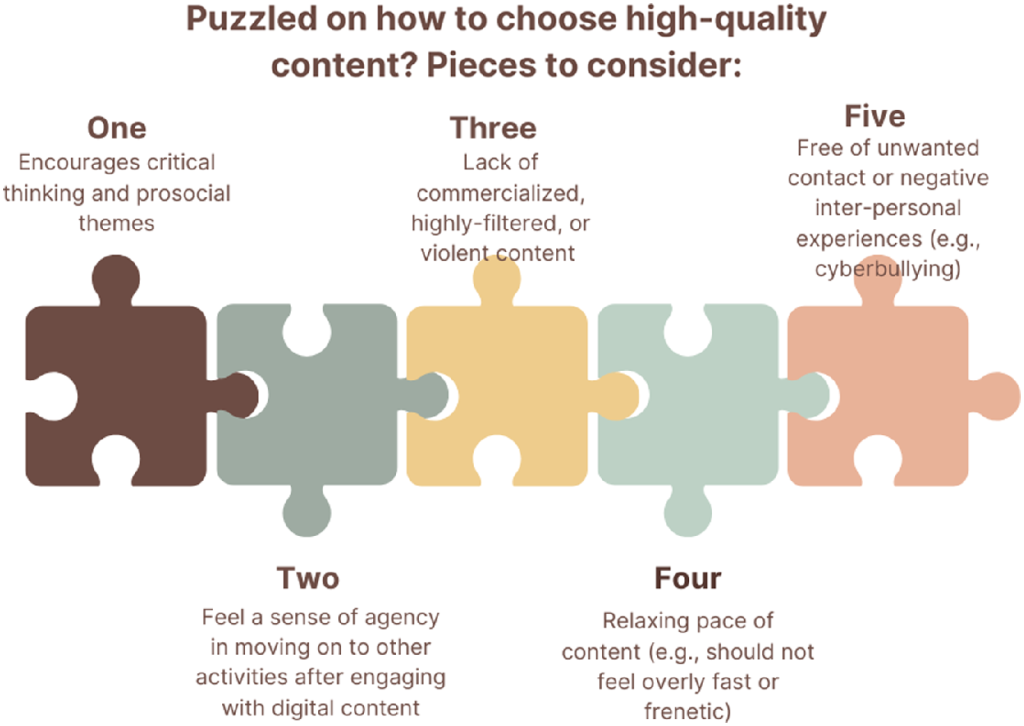
As a parent, finding high-quality digital content for your children can be challenging. To help, the AAP has provided guidelines to help parents assess content quickly. These guidelines help parents think through issues such as:
- Does the media encourage prosocial themes?
- Does the media encourage a sense of agency or promote passive viewing?
- Is the media highly commercialized?
- What is the pace of the media?
- Is the media free of unwanted or negative interpersonal contact, such as bullying
Age of first phone
Although many American tweens have smartphones, the AAP encourages families to carefully consider when to allow their child to have independent access to a phone with internet and social media. While they advise that readiness for a phone varies by child, they provide a questionnaire to help parents gauge their child’s maturity for the responsibility that comes with a smartphone.
Routines and boundaries
The AAP statement focuses on advising parents to set boundaries and establish routines for digital media use in their families. They discuss ideas for establishing a routine that ensures plenty of media-free time, especially at meals and before bed. They also encourage setting boundaries that allow your children to be physically active, spend time with friends, and, most importantly, establish healthy sleep habits so that digital devices do not interfere with much-needed rest.
Relationships and conversation
As with most aspects of parenting, having a strong, emotionally stable relationship with your child is the key to healthy digital media use. With the strong foundation established, these conversations about media and content can be an ongoing part of your family discussion. As your children mature and their needs and interests change, there can be ongoing conversations about what is appropriate and what types of content actually support their development rather than undermine it.
Overall, these guidelines are a step up from the AAP’s previous guidelines. They offer a much more comprehensive approach that helps families view media use holistically. With today’s immersive media landscape, simple screen time limits are no longer enough. Fortunately, the AAP has recognized this and expanded its guidance to families. This new statement not only offers research-backed recommendations for parents but also provides guidance for companies and policymakers working on digital media issues affecting children.