

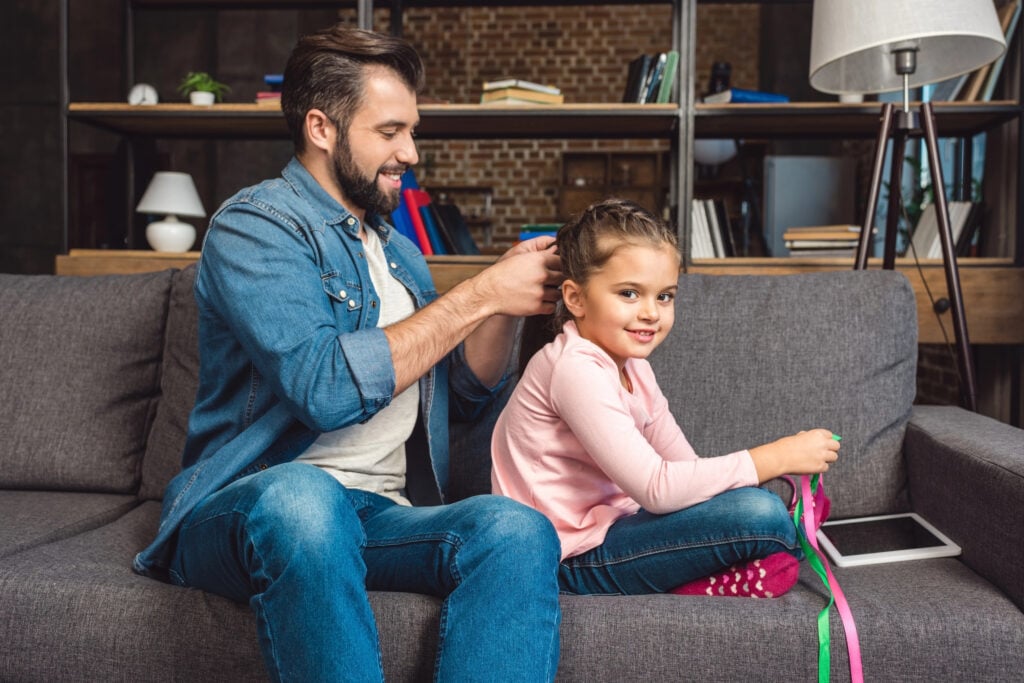
From a sold-out St Albans workshop to a 250,000-follower Instagram account, fathers are rewriting what hands-on parenting looks like, one braid at a time.
When Annis Waugh organized a hair-braiding class for fathers at a St Albans primary school, she braced for a quiet turnout. Instead, the men’s session sold out before the women’s class did, leaving a waiting list of dads who never got a seat. That small, telling detail says something large about where fatherhood is heading.
The St. Albans workshop, run by Waugh through her business Braid Maidens, was organized as a PTA fundraiser for a local primary school.
Waugh had been teaching hair plaiting for years, and while men were technically always welcome in her sessions, not one had ever booked a spot. Separating the groups, she figured, would put the dads at ease. She did not expect them to fill the room faster than anyone else.
Dads Want To Be More Involved
The rush to sign up reflects something bigger than a curiosity about French braids. As millennial men take on more childcare responsibilities, workshops teaching dads to style their daughters’ hair are quietly challenging long-held norms around fatherhood.
The trend sits at the intersection of shifting co-parenting expectations, post-pandemic changes to school-run routines, and a generation of fathers who are simply more willing to show up in spaces that were once coded as exclusively maternal.
Waugh, speaking to BBC News, put it plainly: “It’s 2022 and people co-parent and split things far more down the middle these days. Plus, after lockdowns, school runs have changed, dads are around much more in the mornings and if they can do it, it’s helpful.”
She also noted that many women in her classes had shared that some of their warmest childhood memories involved their own fathers styling their hair, a detail that reframes the whole exercise as something emotionally significant, not just logistically convenient.
What Happens In The Workshop
Waugh started the men’s session with genuine basics: how to gather hair into a ponytail, how to handle elastic bands without snapping them. In her women’s classes, she skips that entirely, because even beginners already know how to put their own hair up.
With the dads, she kept the styles simpler, but the men pushed back. They wanted the Dutch braid, a more advanced technique where three sections of hair are crossed underneath rather than over each other. Waugh had held it back, thinking it was too much for a first session. She later admitted she underestimated them.
What struck her most was how the men approached the learning itself. She described watching perfectly good braids get brushed out and restarted because a dad felt the tension was not quite right.
The competitiveness was not directed at each other; it was entirely self-directed. “The main joy for me,” Waugh told BBC News, “was that they all wanted to be there and really got into it.”
The Dads Who Showed Up
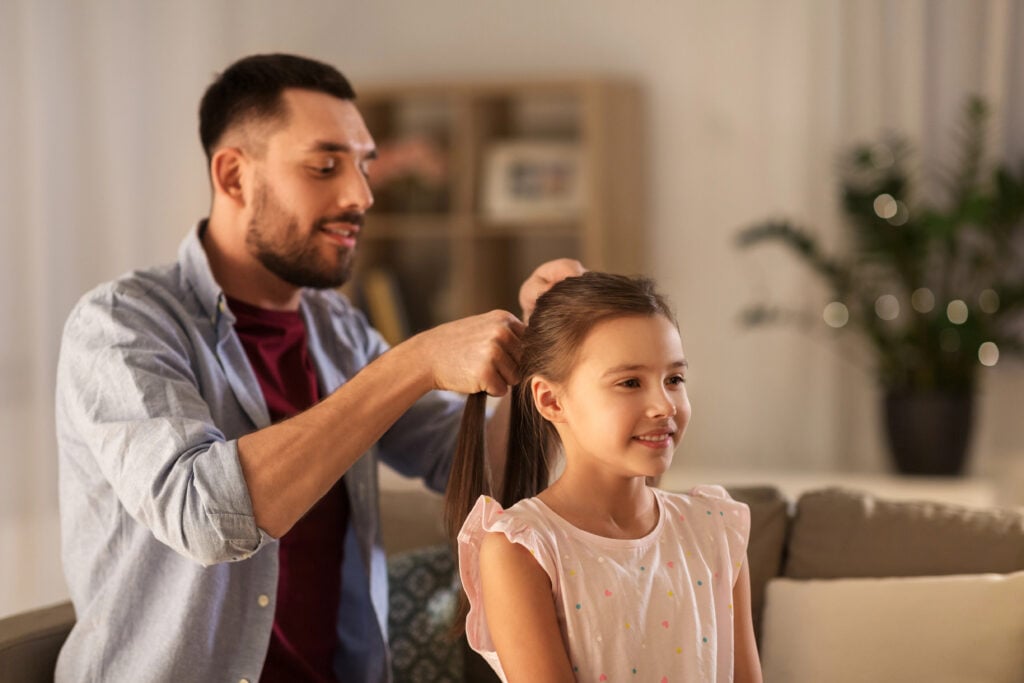
John Hardern, a pensions adviser and father of four daughters, admitted his first instinct when he heard about the class was that it sounded strange.
Then he caught himself. “I thought, ‘Why is it weird, I’ve got four daughters, why does it feel like I shouldn’t go?'” he told BBC News. He booked immediately. For Hardern, learning to braid carries a message he wants his daughters to absorb: that no skill belongs exclusively to one gender, and that the options they imagine for their own lives should not be narrowed by outdated assumptions.
Tim Angove had a different starting point. His nine-year-old daughter had taught herself to plait at a young age and refused to let him near her hair. He saw the class as a way to earn her trust.
He told BBC News that he hoped that by learning to plait properly, his daughter would be more willing to let him style her hair. After the workshop, his daughter’s first question when she arrived was whether he now knew all about plaits. She was excited. So was he.
From St. Albans To 250,000 Followers
The same impulse driving dads to workshops in England is fueling a parallel movement online. Strider Patton, an American father, started styling his daughter Imogen’s hair when she was a toddler and quickly discovered that most tutorials online were built for mothers.
The steps moved too fast, assumed too much prior knowledge, and left him behind. So he launched his own Instagram account, @Dad.Braids, filming himself doing Imogen’s hair each morning and sharing the videos with other dads who were starting from zero. The account now has nearly 250,000 followers.
Patton told TODAY.com the moment that made every hour of practice worthwhile: a stranger leaned down to Imogen and asked if her mommy had done her hair. His two-year-old turned around, pointed at him, and said, “Dad braids.”
He has since mastered lace braids, bubble braids, and a double French high pony. But the skill level, he says, was never really the point. “It doesn’t matter how bad your hair (styling) is,” Patton told TODAY.com. “Your daughter’s just going to love that you’re there with her.”
When Dad Becomes The Better Stylist
That philosophy echoes across the community of dads who have taken up the brush. Shounak Shah, a physical therapist, says his daughter Arya would choose him over her mother for hair styling every time.
He calls out “It’s salon time!” and she settles in at her little desk, watching a show while he works. Jon Studham plays his five-year-old’s favorite show while he styles her hair each morning. “I was terrible at first, but she didn’t care,” Studham told TODAY.com.
“It isn’t about getting every strand in place. It’s about showing up, being part of her rhythm, building the moments in life that matter and showing she can count on me.”
Some of these fathers have not just caught up to their partners; they have surpassed them. Scott Wormser, who works in marketing, now handles the hairstyles for his ten-year-old daughter Marni’s dance competitions, where the styles are specific, demanding, and need to survive an energetic routine.
His wife, he told TODAY.com, could not get the braids as tight as he could. He credits patience as his secret advantage.
The Bigger Picture On Co-Parenting
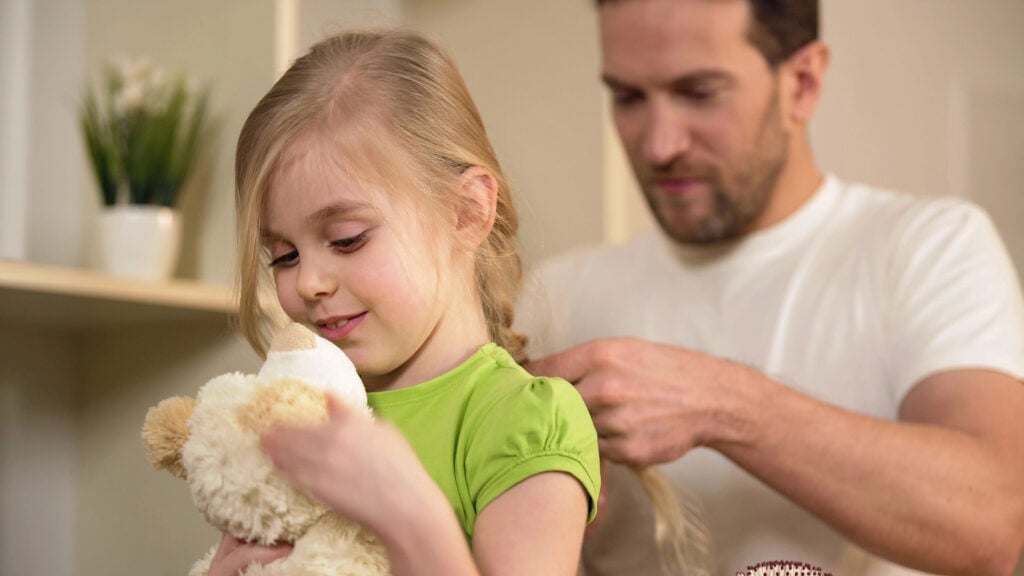
What this trend signals is not just that dads are learning a new skill. It is that a generation of fathers is actively looking for ways to be present in the daily, tactile, unhurried moments of their daughters’ lives, and finding that those moments carry more weight than they expected.
Research on how fathers are reshaping their parenting roles suggests this kind of hands-on involvement has lasting effects on children’s confidence and sense of security.
As Patton put it to TODAY.com, “At the heart of this, it’s really simple: dads want to connect with their daughters, but a lot of us don’t always know how. We’re better with tools than tea parties, better with our hands than with our feelings. Learning to braid brings those two worlds together.”
Waugh’s observation about lockdowns reshaping the school run is worth sitting with. The pandemic pushed many fathers into morning routines they had previously left to their partners, and some of those habits stuck.
The sold-out workshop in St Albans was not a one-off curiosity; it was a data point in a longer shift toward the full, unglamorous labor of raising children being shared more evenly between parents.
Waugh frames her classes as an act of preservation as much as anything else. “For me it’s about passing on a traditional skill,” she told BBC News.
“I like to see it as my legacy so it doesn’t die out.” That the people now carrying that legacy forward include a growing number of fathers, armed with elastic bands and a competitive streak, is perhaps the most encouraging part of the story.

