


Asking your own parents to put their phones away while they watch your kids can feel like an awkward role reversal, but child development experts and peer-reviewed research are increasingly clear that distracted caregiving, even by loving grandparents, carries genuine risks to children’s physical safety, emotional health, and cognitive growth.
A reader recently posed exactly this dilemma to the New York Times, describing his dread at confronting his own parents about their phone habits during babysitting.
As the family dynamics of distracted grandparent caregiving get more attention, parents across the country are wrestling with the same tension: how do you protect your child without damaging a relationship you depend on?
The Science Behind The Risk
The concern is not just intuitive; it is backed by controlled research. A study published by Oxford University Press on behalf of the Society of Pediatric Psychology observed 51 caregiver-child pairs across three conditions: cell phone use, a pen-and-paper task, and no distraction at all. The findings were striking.
According to the study abstract on PubMed, caregiver vigilance and child hazard engagement both worsened significantly whenever any distraction was present, whether digital or analog.
The researchers reported that attentiveness scores were highest when no distraction was introduced, falling in both the cell phone and pen-and-paper conditions alike.
Perhaps the most surprising finding: pen-and-paper tasks actually impaired caregiver vigilance more than cell phone use did.
That detail matters because it reframes the conversation. This is not purely a technology problem. Any activity that pulls a caregiver’s attention away from a child increases the likelihood that the child will interact with potential hazards.
The researchers concluded that professionals working with parents should educate them about the risks of supervising children while distracted and encourage what they called mindful supervision.
Beyond Bumps And Bruises: The Developmental Stakes
Physical safety is the most obvious concern, but child development specialists argue the risks run deeper.
Licensed therapist and certified parenting coach Tammy Gold, author of Secrets of the Nanny Whisperer, has written about the cognitive dimension of distracted caregiving that most parents overlook entirely. Early childhood is a period of extraordinary neurological activity, and the quality of caregiver interaction during those years shapes how a child’s brain is literally wired.
Gold argues in HuffPost that the stakes go well beyond scraped knees. “If babysitters, daycare workers or nannies are on their smartphones, texting, emailing and otherwise distracted they are not only stunting this important emotional bonding, but also cognitive growth,”
Gold wrote in her HuffPost piece on distracted caregivers.
Her point is that children require repetitive, responsive interaction with caregivers to build neural pathways during their earliest years.
Research cited in HuffPost notes that roughly 90 percent of human brain development occurs by age three, making the responsiveness of early caregivers especially consequential. A caregiver who is physically present but mentally elsewhere is not providing the kind of engaged attention that supports healthy brain development.
Gold compares the situation to other professions: a nurse or teacher would not scroll through social media during active work hours, and caregivers should hold themselves to the same standard, checking their phones only when children are napping or otherwise occupied.
Why Grandparents Are A Special Case
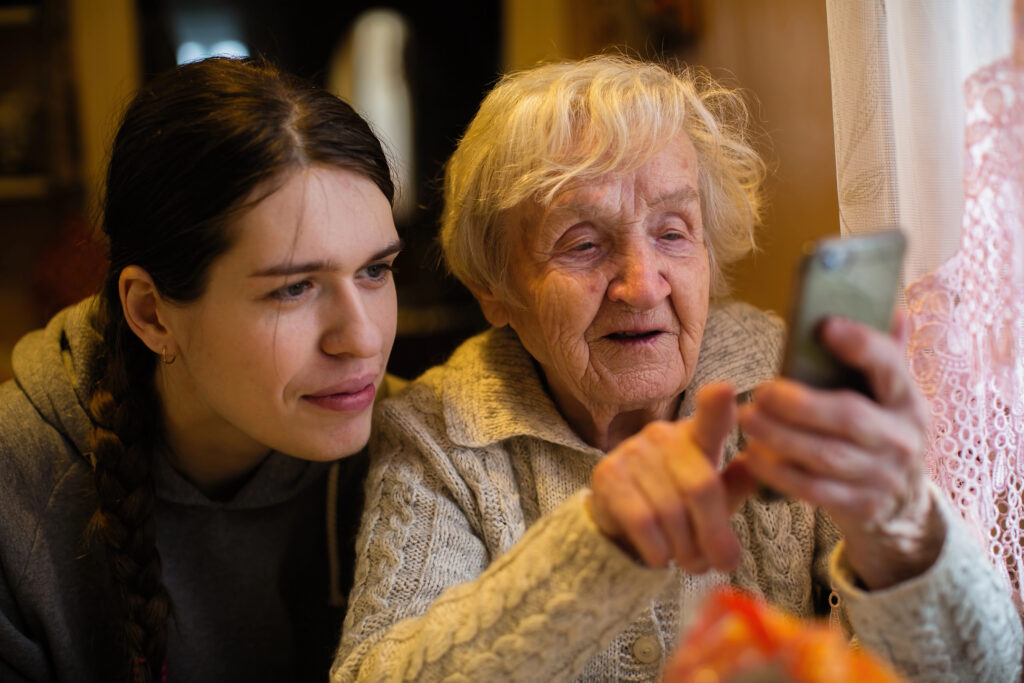
When the distracted caregiver is a paid professional, the conversation is relatively straightforward. When it is your own mother or father, the calculus changes entirely.
Many parents feel they cannot set firm expectations with family members who are doing them a favor, especially grandparents who may feel they have already raised children successfully and do not need instruction.
But experts suggest that framing matters enormously. Rather than positioning the conversation as a critique of grandparents’ judgment or parenting instincts, parents can approach it as sharing new information about child development and safety.
Grandparents raised their children in a world without smartphones, so the specific risks of phone distraction during caregiving are genuinely new territory, not a reflection of their competence or love for their grandchildren.
It also helps to make the request concrete and positive rather than accusatory. Telling a grandparent that you would love for the kids to have their full attention lands very differently than pointing out that they are always on their phone.
Setting a shared expectation before a babysitting session, rather than reacting in the moment, removes much of the interpersonal friction.
Practical Steps For Parents
If, as a parent, you are going this route, there are some easy steps you can take to reach your goal in a positive way that may receive less pushback.
- Have the conversation before it becomes urgent. Raising the topic during a calm, low-stakes moment, rather than after an incident, makes it easier for everyone involved.
- Lead with the child, not the complaint. Framing the request around your child’s specific needs, rather than the caregiver’s behavior, keeps the conversation collaborative.
- Offer a workable alternative. Suggesting that caregivers check their phones during nap time or quiet independent play gives them a reasonable outlet without leaving them feeling surveilled.
- Acknowledge the favor. Grandparents who babysit are giving a significant gift of time and love. Recognizing that generosity before raising a concern goes a long way.
- Be consistent across all caregivers. If you set phone-free expectations for grandparents, apply the same standard to paid sitters and other family members. Consistency signals that this is a household value, not a personal criticism.
For parents navigating transitions and behavioral challenges at home, it is worth noting that children who receive consistent, attentive caregiving throughout the day tend to regulate their emotions more effectively. The quality of supervision during the hours a grandparent is in charge is not separate from what you see at pickup time.
Why It Matters

This conversation is bigger than any one family’s awkward dinner table moment. As smartphones become more deeply embedded in daily life, the expectation that caregivers, paid or unpaid, remain fully present with children is increasingly countercultural.
Normalizing phone-free caregiving as a baseline standard, not a special request, is something parents, pediatricians, and child development professionals all have a role in shaping. The research is clear; the harder work is making the cultural shift stick.
Unintentional injuries are the leading cause of death among children in the United States, according to the PubMed study, and supervision quality is one of the most direct levers parents have to reduce that risk.
Asking a grandparent to put down their phone is not an act of ingratitude. It is an act of advocacy for your child, and most grandparents, once they understand what is actually at stake, will agree.
If you are also thinking about how screen time affects children’s development more broadly, the same principles apply: presence and engagement from the adults in a child’s life matter more than almost any other factor in early development.

