

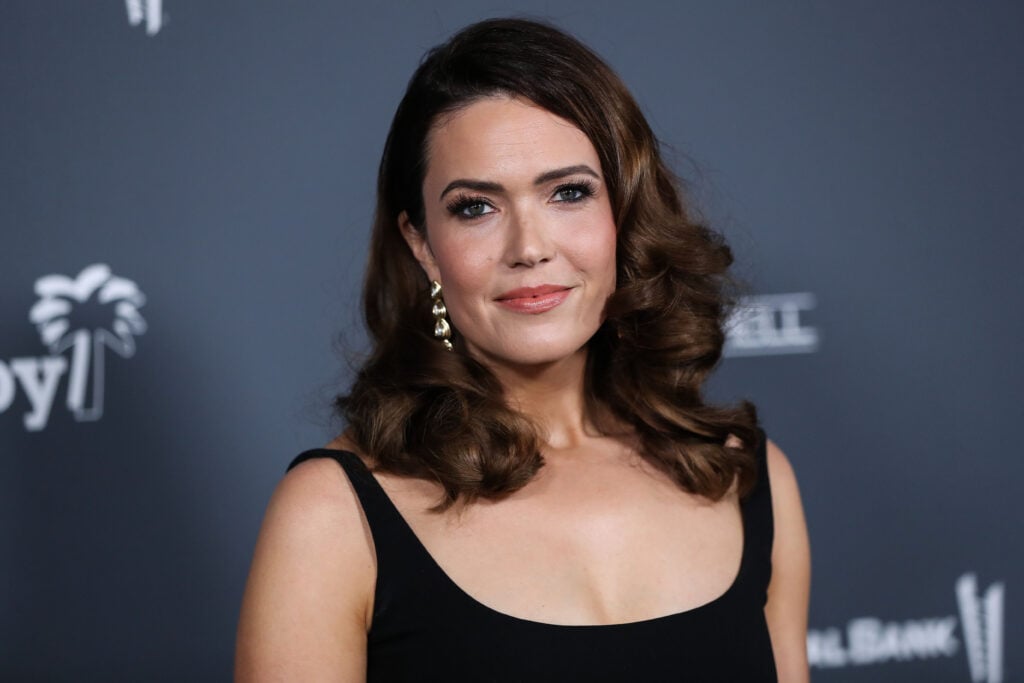
A failed IVF cycle that yielded no viable embryos preceded Mandy Moore’s third pregnancy, the actress revealed during a June 2 appearance on the Not Skinny But Not Fat podcast, hosted by Amanda Hirsch. Moore, 42, described the surprise conception of daughter Louise “Lou” Goldsmith, born in September 2024, as something she never anticipated after that setback.
For the millions of families who have sat in a fertility clinic waiting room, Moore’s candor lands with particular weight. Her willingness to discuss a treatment outcome that produced nothing, followed by an unplanned natural conception, captures a reality that fertility specialists say is far more common than most people realize.
From “Insurance Policy” To Unexpected News
Moore, who conceived her first two sons naturally, described her decision to pursue IVF as a precautionary measure rather than a response to a diagnosed fertility problem. She framed the treatment as an attempt to bank embryos for future use, a kind of reproductive safety net that would give her and husband Taylor Goldsmith flexibility about timing a third child. The plan did not go as hoped.
“So, I did a round of IVF, and it was unsuccessful; we didn’t get any viable eggs, no embryos,” Moore told host Amanda Hirsch on the Not Skinny But Not Fat podcast. “And I was like, okay, well, this just settles that. If this is something that is meant to be, it will happen naturally.”
What happened next caught her completely off guard. “And then Lou just had to show up,” Moore said on the Not Skinny But Not Fat podcast, laughing. “And she showed up very, very surprisingly. We were not trying, but obviously we were open to it because of the IVF of it all.”
A Fertility History That Goes Back Further

Moore’s path to parenthood has never been entirely straightforward. Before her first pregnancy with son August “Gus” Harrison Goldsmith, now 5, she received discouraging news from her doctor. In a 2024 Instagram post on the This Was Us podcast account, Moore wrote that “The doctor told me there was a slim chance of getting pregnant… and then lo and behold to our surprise, I became pregnant with Gus.”
That history adds meaningful context to her IVF decision. Knowing she had once been told conception might be difficult, pursuing IVF before a third pregnancy was a reasonable, proactive step, even if the outcome was disappointing.
Son Oscar “Ozzie” Bennett Goldsmith, now 3, also arrived naturally, and Lou, now 21 months old, completed the family in a way Moore had not planned.
Three Kids In Three-And-A-Half Years
The rapid pace of her family’s growth has taken a real toll, Moore acknowledged. “I had three kids in three-and-a-half years,” she said with a sigh on the Not Skinny But Not Fat podcast.
When asked whether that compressed timeline had been physically and emotionally demanding, she did not minimize it. Moore told the podcast she is “still emotionally recovering,” even while noting that pregnancy itself was physically manageable for her and that she did not experience postpartum symptoms.
That combination, physically resilient but emotionally stretched, is something many parents of young children will recognize. The logistics of caring for a five-year-old, a three-year-old, and a toddler simultaneously, regardless of how any of them arrived, is its own kind of marathon.
What Fertility Experts Want You To Know After A Failed Cycle
Moore’s experience reflects a pattern that fertility specialists work hard to reframe for their patients.
Dr. Matrika Johnson of Reproductive Specialists of the Carolinas addressed this directly in an episode of the More Than Your Infertility podcast, drawing on both her clinical expertise and her own personal IVF experience. Her message to patients who receive bad news is direct.
“When people hear, ‘your IVF cycle failed,’ many internalize it as ‘I failed,'” Dr. Johnson said, according to Reproductive Specialists of the Carolinas. Her response to that internalization is equally direct: you did not fail.
Dr. Johnson emphasizes that IVF outcomes are shaped by biology and probability, not by a patient’s effort, character, or desire to become a parent. Factors such as embryo chromosomal health, uterine receptivity, and the precise timing of implantation can influence whether a cycle succeeds, and many of these variables are simply beyond anyone’s control.
A cycle that produces no viable embryos, as Moore experienced, is a medical outcome, not a verdict on the person going through it.
For patients navigating that grief, Dr. Johnson recommends naming the loss explicitly, resisting the urge to make immediate decisions, and leaning on professional support, whether through therapy, fertility coaching, or community.
She is clear that the sorrow accompanying a failed cycle is genuine and warrants real acknowledgment, not dismissal or minimization.
Why Moore’s Openness Matters For Families
Moore is not the first public figure to discuss fertility struggles, but the specific combination of details she shared is unusually instructive.
She pursued IVF not because she had been told she could not conceive, but as a precaution. The cycle failed completely. She made peace with that outcome. And then a natural pregnancy arrived anyway.
That sequence does not follow the narrative arc most people expect from fertility stories, and that is precisely why it is worth hearing.
Her account on the June 2 podcast episode also underscores something fertility specialists consistently stress: a single failed cycle is not a final answer. It is data. It is a starting point for a follow-up conversation with a care team about what to try differently, or, as in Moore’s case, sometimes the body finds its own path forward.
Stories like Moore’s do something that clinical statistics cannot: they give shape to the emotional experience of fertility treatment in a way that feels human and specific.
When a well-known actress describes sitting with the news that a cycle produced nothing, and then describes laughing about the daughter who “just had to show up,” she is holding two truths at once, grief and gratitude, that many parents carry simultaneously.
That kind of honesty normalizes the full range of fertility experiences, including the ones that do not resolve neatly, and that matters for every family still in the middle of their own story.

