
How do babies learn language? On the surface, the answer seems obvious. We all know that hearing language is the key to babies picking up words. Whatever language they’re surrounded by in their everyday life, is the language they absorb. However, new research is illustrating that hearing is not the only crucial piece. What babies see may be another key aspect of language learning.
Research On Babies’ Language Development
This new study looked at 8 to 10 month old babies as they listened to a new language that they’d never heard before (a made-up nonsense language). In some situations, the adult speaking the language was wearing shades to cover their eyes so the babies couldn’t make eye contact. In the other setting, babies could see the adults’ eyes as normal.
The results were fascinating. Researchers measured babies’ brain activity while they listened and looked at the adult speaker. They also measured if the babies learned any of the new “nonsense” words the adult spoke to them.
The first thing they found was that eye contact between the adult and the baby was very important. It triggered this pattern of brain activity in which the baby and adult’s brains were “in sync.” This synchronization between the adult and the baby’s brains are important to language development.
They found that they tended to be in sync more when the babies were able to make eye contact with the adult. This was linked to better language learning for the baby. When the eye contact was consistent with the adult, the baby tended to pick up more new words. When the adult’s eyes were covered by shades, the synchronization between the adult and the baby’s brain tended to be less or non-existent. This resulted in the baby not being able to learn as many words of this new language.
Eye Contact Gives Babies Cues For Learning
What the researchers really showed was that babies use eye contact with adults to figure out what to pay attention to when it comes to learning language. What does this mean for parents with babies at home? Babies’ brains are eager for new information. They’re absorbing so much information each minute of the day. There are so many things to look at, so many things to hear, and so their brain has to try to sort out what they should pay attention to and what’s important to learn.
Tips For Supporting Your Baby’s Language Development
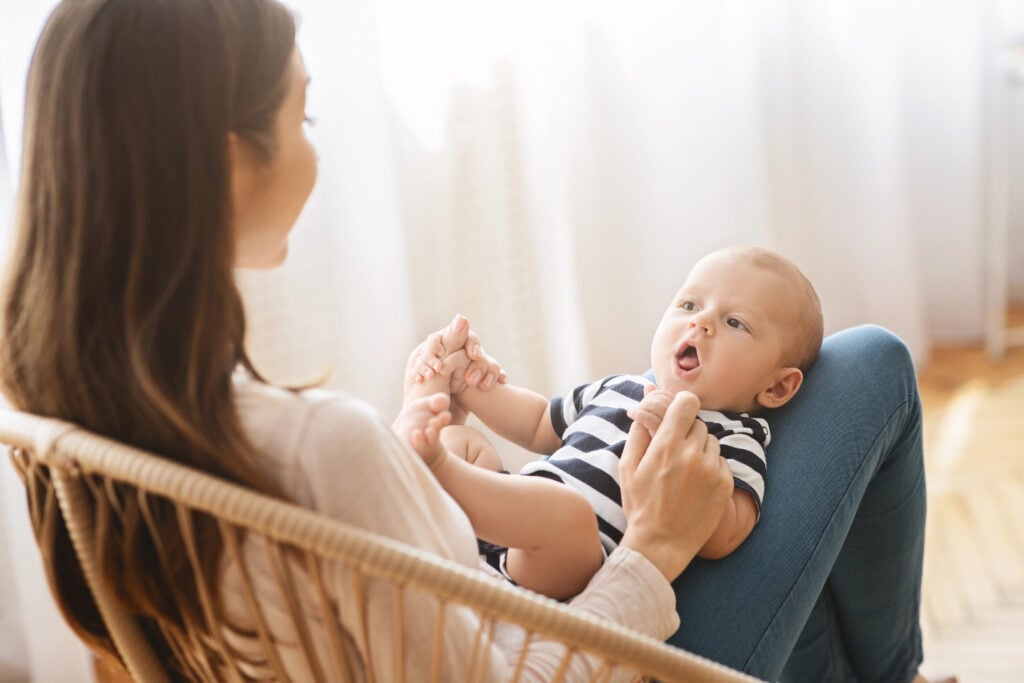
Researchers think that making eye contact with your baby and even using their name gives them a social cue as to what is important to pay attention to. When you share your attention with the baby and you speak to them, they’re not only hearing what you’re saying, they’re also seeing your eyes and seeing your mouth move. All of this is crucial to helping them learn the language that you’re speaking in everyday life.
Here are some tips to help you put this research into practice with your baby:
- Get plenty of face time with your baby. While you’re changing diapers, feeding, or caring for your baby, make eye contact frequently. Your baby thinks your face is the best thing to look at.
- Use your baby’s name. If even your baby doesn’t know their name yet, they will learn it sooner than you think (usually by 5 to 7 months old). Use their name often as you go about your daily activities. This helps them learn it and know what to pay attention to.
- Limit phone use around your baby. Phones are a big distraction for all of us. Try to avoid using your phone extensively (in front of your face) while interacting with your baby. Looking at a phone causes your gaze to avert away from your baby, limiting eye contact.
- Follow your baby’s attention. If your baby is mesmerized by an object or toy (even the ever-fascinating ceiling fan), follow their gaze and look at the object together. This joint attention is key to early attunement and language development. Label the object (e.g. “fan”) when they see it so they can learn the word for it.