

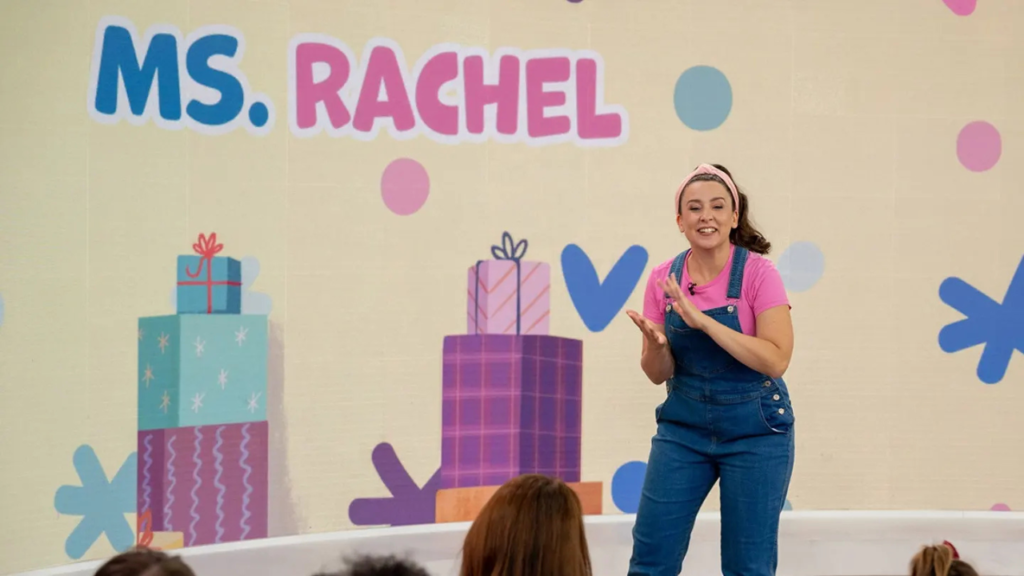
Ms. Rachel is pushing back against criticism of her political activism, arguing that children’s entertainers have a long history of addressing social issues. Her comments have renewed a complicated question for parents: Where should the line be between children’s entertainment and an entertainer’s personal beliefs?
Ms. Rachel, whose real name is Rachel Griffin Accurso, has faced criticism from some parents over her increasingly public activism on issues including Gaza and immigration. Fox News reported in January that her enormous audience—more than 18.7 million YouTube subscribers at the time—has made her activism particularly visible to families who primarily know her as a children’s educator.
In a recent interview, Accurso defended her approach by pointing to Fred Rogers and his history of addressing social issues through children’s television. “Mr. Rogers was political,” she said, arguing that his work demonstrates that children’s programming and social issues have never been completely separate.
Her comparison has itself generated disagreement. Psychotherapist Jonathan Alpert, quoted by Fox News, said Rogers addressed serious social issues but distinguished that approach from what he described as Accurso’s more explicit commentary on current political controversies.
From Mister Rogers to Pixar’s Hoppers
There is little question that Fred Rogers used children’s television to address difficult subjects. In 1969, Rogers invited Black Officer Clemmons, played by François Clemmons, to join him in a wading pool at a time when racial segregation still affected swimming pools in the United States. Clemmons later described the scene as “a definite call to social action on Fred’s part.”
More recently, Pixar’s Hoppers has become another example of activism appearing in children’s entertainment. The film follows Mabel, a young environmental activist who tries to protect a local forest from development, although a Washington Examiner review criticized the movie’s depiction of activism as potentially encouraging reckless behavior.
These examples also show that activism in children’s entertainment can take very different forms. A character’s actions, a story’s themes and a performer’s personal political statements can all communicate values, but audiences may interpret those approaches differently.
What Should Parents Do When Kids’ Favorites Take a Stand?
Parents don’t necessarily have to choose between ignoring an entertainer’s activism and banning their child’s favorite show. Instead, they can treat these moments as opportunities to talk about how people can hold different beliefs and why someone might choose to speak publicly about an issue.
Parents can also distinguish between the content their child watches and the person who creates or performs it. A child may enjoy Ms. Rachel’s songs, a Pixar movie or another program without adopting every opinion expressed by its creators.
For older children especially, discussing those differences can help build media literacy. The goal isn’t necessarily to tell children what to think, but to help them understand that entertainers, characters and creators can communicate values—and that families can discuss those messages thoughtfully.

