

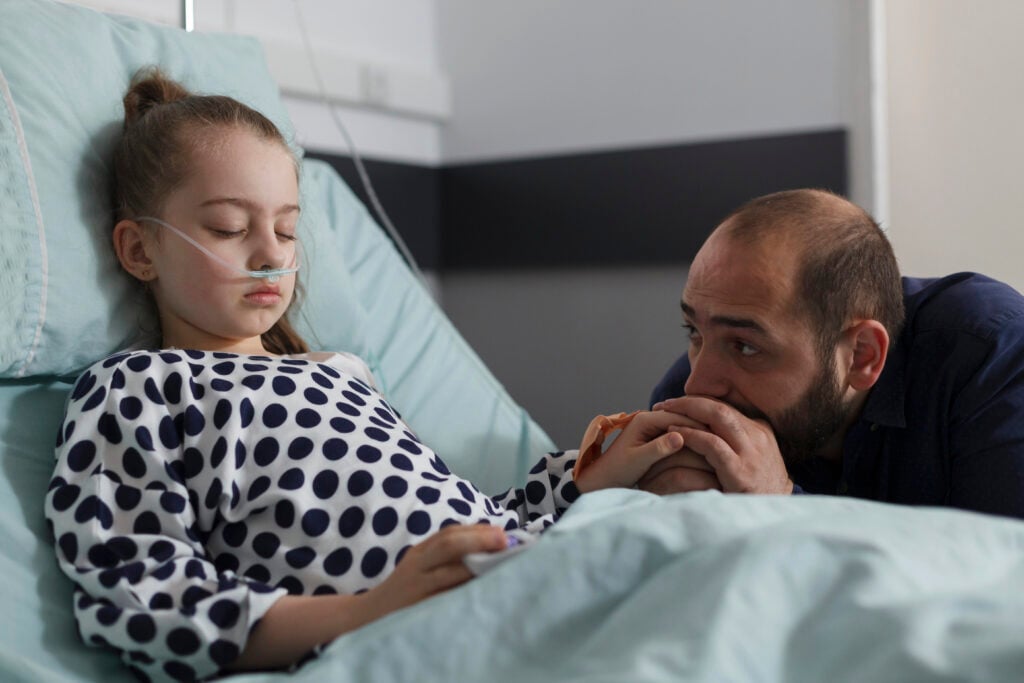
My daughter had the same respiratory symptoms her siblings had been experiencing, but something wasn’t quite right. I didn’t like something about her manner. I decided to take her to the emergency room.
I knew I was being ridiculous. It was silly. Every kid gets sick, and even though she spent the first year of her life utilizing supplementary oxygen, that was years in the past, and the hospital was guaranteed to laugh me right out of the waiting room.
Instead, they admitted her and transferred her by ambulance to a pediatric hospital. I was right, it was serious. I join the ranks of so many parents who were fortunate to spot that something was ‘off’ and right to act on it.
The Mom Who Spotted Her Daughter’s Eye Cancer On A Baby Monitor
For Kristen Draime, it started with a concern about her daughter’s “lazy eye.” When a child’s (or adult’s) eyes don’t align in the typical way, there can be a few different causes, and Draime tells People that her daughter’s pediatrician scheduled a visit with an ophthalmologist for a few months later.
The condition isn’t typically considered an emergency. Treatment might start with glasses and, in some cases, progress to more serious corrective measures. But Draime kept feeling that something was not right, and as she searched the internet for more information, she found a story of another mother who had discovered her child’s eye cancer by an oddity on the baby monitor camera.
“I ended up researching after she went to bed and saw an article of a mom that found out her daughter had a tumor on a baby monitor because her daughter’s eye was just black,” she says. “I then looked at the monitor and Miley’s eye was black.”
Now, her daughter is progressing through treatment, and she hopes other moms will listen to their instincts when something doesn’t feel right, even if they don’t have the medical knowledge to understand why.
How One Mom’s Instinct Resulted In A Life-Saving Initiative
It was 2021, and Merope Mills’ daughter, Martha, was admitted to the hospital after a bicycle accident. She contracted an infection in the hospital, and her parents were concerned about some symptoms they saw.
They thought their daughter was experiencing sepsis and might be at risk for septic shock; the doctors didn’t agree. The parents thought Martha should be examined for possible escalation to the ICU. Merope writes in The Guardian that a duty consultant declined that examination on the grounds that it would increase the parents’ anxiety.
“We were reassured time and again it was “just a normal infection”. On Sunday, the consultants discussed Martha’s severe sepsis among themselves. She had very low blood pressure and, later, a rash, which the registrar misdiagnosed: against all common sense and ignoring my opinion, he concluded it wasn’t caused by sepsis. I had no one to turn to.”
Mills lost her daughter to the septic shock she feared. She didn’t stop fighting, though, and the UK has since implemented what’s known as Martha’s Rule, potentially preventing other families from facing the same tragedy. The NHS lists the three core components:
Patients will be asked, at least daily, about how they are feeling, and if they are getting better or worse, and this information will be acted on in a structured way.
All staff will be able, at any time, to ask for a review from a different team if they are concerned that a patient is deteriorating, and they are not being responded to.
This escalation route will also always be available to patients themselves, their families and carers and advertised across the hospital.
When Medical Experts Listen, They See What Parents See

As previously reported, a recent study found that parental instinct, when considered as a factor in a child’s well-being, is an important diagnostic tool.
Parental concern alone can’t provide a diagnosis, but when given a questionnaire about their child’s symptoms, those who marked that they were extremely concerned had a very high correlation with their child’s illness being defined as “severe,” and requiring either admission to the pediatric ICU, a 24-hour or longer hospital stay, surgical intervention, or one of a few other serious interventions.
Doctors spend years in school, learning to identify typical and less common symptoms of various illnesses. They have their knowledge and a variety of diagnostic tools at hand to help them draw conclusions about a patient’s health.
A patient, or in pediatric cases, a patient’s parent, has one dataset that their doctor lacks, though: their own lived experience.
Combining what a parent knows about their child’s typical behavior and status, and how much their child has strayed from those norms, with what a doctor knows about symptoms and illnesses, yields a more complete picture and better diagnostics.
Does Trusting Your Instincts Mean Your Doctor Is Just Wrong?
Of course not. Parents can be subject to anxiety and overthinking. It’s possible for a worried parent to see lethargy where there’s really only a child getting the rest they need to heal. We might think there’s a broken bone where there turns out to be a mild sprain.
Most of us are not doctors and do not have medical expertise to lean on. Our knowledge is of our kids, and what we witness from them day in and day out, and how that changes when they’re not feeling well.
Parents should remember that this is just one diagnostic tool, not a full kit, and doctors and other medical professionals should acknowledge that it is an important tool.
What this means for parents is that if you feel strongly that something isn’t right, you should feel confident in taking your child to a doctor.
I mentioned that I expected to be “laughed out” of the hospital waiting room. That fear almost kept me from taking my daughter in that day. We have to trust those instincts and know that even if we’re wrong, we were right to be cautious.
It also means we should feel confident in pressing for a second opinion or for specific tests or reviews. If doctors had listened to Merope Mills when she pleaded for a consultation, her daughter might have made it home. Merope was not wrong or out of line to call for an examination of her daughter.
It means that every parent is allowed to trust their instincts, and to fight for the care their child needs, even if it feels like being ‘pushy’ or ‘annoying’ or ‘demanding.’
We know our kids.
