

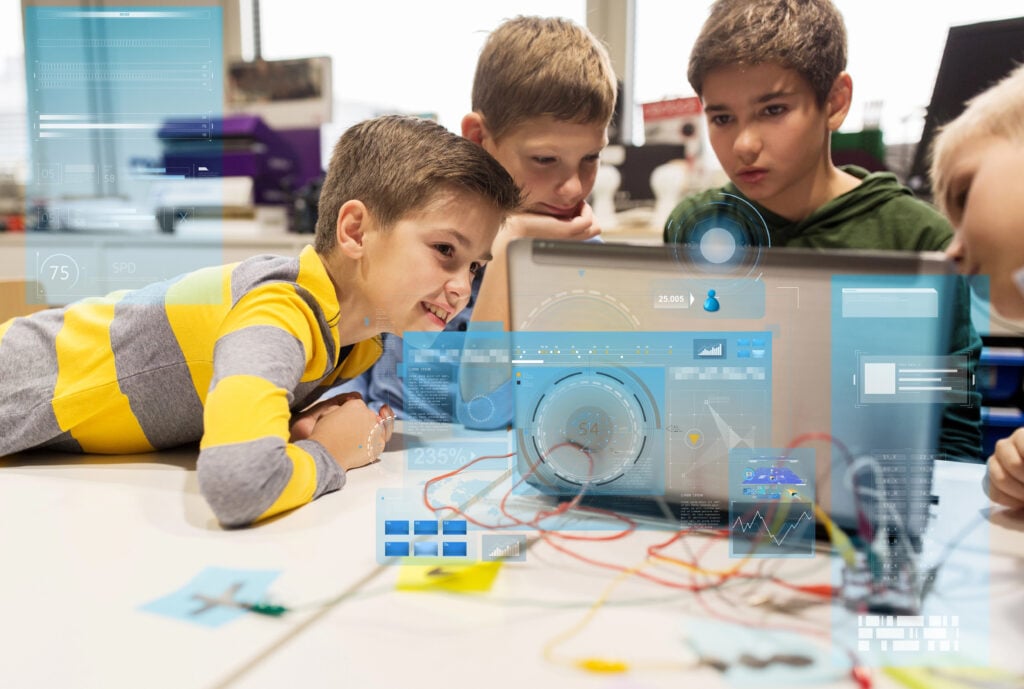
Artificial intelligence tools are quietly embedding themselves into K-12 classrooms across the country, pre-installed on school-issued laptops, woven into writing assignments, and backed by major tech corporations. A growing body of research suggests parents have every reason to pay close attention.
The central question researchers, educators, and families are now wrestling with is not whether AI has arrived in schools, but whether it is genuinely helping children learn or quietly eroding the cognitive and social skills they need most.
If you feel like you have seen this story before, that is because you have. As the New York Times has noted, AI in schools is repeating the pattern followed by every previous wave of education technology marketed as a quick fix, from tablets to interactive whiteboards to online learning platforms.
Each cycle promised transformation; each left educators sorting through the wreckage of unmet expectations. What makes the current moment different is the speed and depth of AI’s penetration into daily classroom life, and the particular vulnerability of the young brains it is now reaching.
The corporate pipeline driving this expansion is worth understanding. Google’s dominance in school technology, built on the widespread adoption of Chromebooks during the COVID-19 pandemic, has created what one parent writing for the New Yorker described as a vast captive market.
A national survey conducted by the Times found that roughly 80 percent of K-12 teachers reported their districts use Chromebooks. Those devices now come pre-installed with Gemini, Google’s suite of AI tools, meaning millions of students encounter AI prompts before they have even opened a blank document.
What The Research Actually Shows
The most comprehensive look to date at AI’s impact on children’s education comes from the Brookings Institution’s Center for Universal Education.
The Brookings report on AI and children’s learning drew on focus groups and interviews with K-12 students, parents, educators, and technology experts across 50 countries, as well as a literature review of hundreds of research articles. Its conclusion was stark: the risks of using generative AI to educate children and teens currently outweigh the benefits, and the harm already done, while fixable, is significant.
Rebecca Winthrop, a senior fellow at the Brookings Institution and one of the report’s co-authors, put the cognitive concern plainly in an interview with NPR. “When kids use generative AI that tells them what the answer is,”
Winthrop told NPR, “They are not thinking for themselves. They’re not learning to parse truth from fiction. They’re not learning to understand what makes a good argument. They’re not learning about different perspectives in the world because they’re actually not engaging in the material.”
The report describes a cycle in which students increasingly hand their thinking over to AI, thereby weakening the very cognitive muscles they need to develop. As one student told Brookings researchers, summing up the appeal with uncomfortable honesty, “It’s easy. You don’t need to use your brain.”
A separate study this year from researchers at MIT, Carnegie Mellon, UCLA, and the University of Oxford found that people who relied on AI tools for math problems and then lost access to those tools performed significantly worse and were more likely to give up entirely, a finding the researchers called particularly concerning because persistence is one of the strongest predictors of long-term learning.
The View From Inside A Classroom, And A Home
For parents trying to understand what this looks like in practice, a firsthand account published in the New Yorker offers a ground-level view. The writer, a parent of a third-grader and a sixth-grader in Massachusetts public schools, describes her daughter’s school-issued Chromebook as a source of persistent AI nudges: prompts to get help writing an essay, to visualize a presentation, to edit a draft, to beautify a slide. The daughter pushes them away, but the AI prompts keep returning, persistent and uninvited.
The same parent describes her son’s third-grade class receiving a “Certificate of Completion” for an AI awareness activity produced by Code.org in partnership with Amazon Future Engineer, a branding exercise dressed up as education.
These two anecdotes capture something important: AI is entering children’s school lives through multiple doors simultaneously, some obvious, some not.
Mary Helen Immordino-Yang, a professor of education, psychology, and neuroscience at the University of Southern California, framed the broader stakes in stark terms for the New Yorker.
“We are potentially undermining complex thinking, changing the development of sociality, and mistaking the learning goal,” she said. “We are cutting off learning at the knees.”
Where AI In Schools Actually Helps

To be fair to the full picture, the Brookings report does identify genuine benefits. Teachers surveyed for the study said AI can meaningfully support language acquisition, particularly for students learning a second language, by adjusting the complexity of reading passages in real time and offering a lower-stakes environment for students who struggle in large-group settings.
AI can also help students overcome writer’s block and support editing at the revision stage, provided it is used to assist rather than replace the student’s own effort.
For teachers, the time savings are real. One U.S. study cited in the Brookings report found that teachers who use AI save an average of nearly six hours per week, adding up to roughly six weeks over a full school year.
That is time that could be redirected toward the kind of individualized, relationship-based instruction that no algorithm can replicate.
The equity dimension is more complicated. AI has the potential to reach students who have been excluded from traditional schooling, including girls in Afghanistan who have been denied access to formal education.
But Winthrop cautioned that free AI tools, the ones most accessible to under-resourced schools, tend to be the least accurate. “We know that richer communities and schools will be able to afford more advanced AI models,” she told NPR, “and we know those more advanced AI models are more accurate. Which means that this is the first time in ed-tech history that schools will have to pay more for more accurate information.”
What Experts Say Parents Should Do Now
Even advocates for AI in education are drawing lines. Amanda Bickerstaff, co-founder and CEO of AI for Education, an organization that trains educators and students on AI literacy, told the New Yorker plainly: “Children should not be using chatbots under age ten.
These tools require expertise and evaluation skills that even many adults struggle to apply well.
The Brookings report’s recommendations for parents include pushing for AI literacy education that goes beyond surface-level familiarity, advocating for school policies that treat AI as a supplement to human instruction rather than a replacement, and staying engaged with what specific tools your child’s school is deploying and why.
The report also calls on tech companies to design AI tools for children that are less sycophantic and more willing to push back, challenging users to think rather than simply validating them.
For families navigating this at home, the conversation about AI use is increasingly inseparable from broader conversations about screen time and digital habits.
Understanding what your child’s school is actually deploying, and asking hard questions about the pedagogical rationale behind those choices, is a reasonable starting point.
What stands out across all of this research is that the window for course correction is narrow. ChatGPT launched just over three years ago, and AI is already woven into the daily school experience of millions of children.
The Brookings researchers framed their report as a warning issued while there is still time to act, not a postmortem on damage already done. Parents who engage now, who ask their school boards what AI tools are installed on district devices and what guardrails exist, are not being alarmist.
They are doing exactly what the evidence suggests is necessary.

