

COVID hit the world hard. Globally, folks lost loved ones, found themselves unemployed or trying to juggle a different way of working, and everything from dental appointments to grocery shopping changed.
For kids, it hit even harder, snatching them out of their school environments, taking away their sports and social lives, and forcing a sudden shift to online learning. Along with other factors, this had a significant effect on mental health, physical health, academics, and overall development.
The good news is that what seemed like lasting damage may be starting to heal at last.
The Pandemic Shutdowns & The Kids Who Lived Them
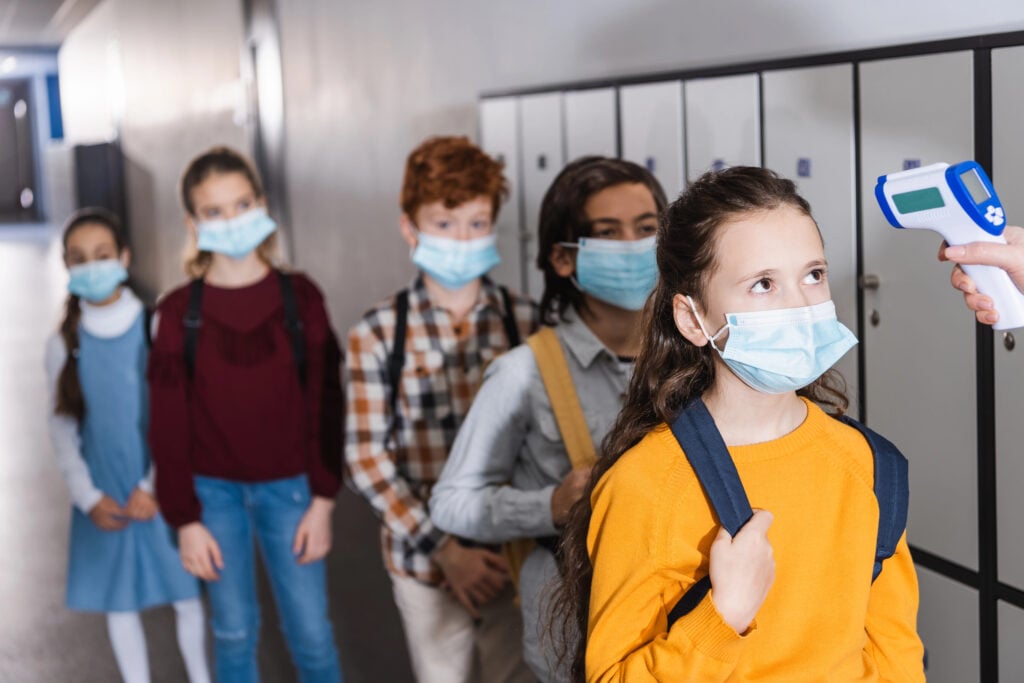
To limit the spread of a disease that was taking so many lives, most schools shut down for in-person classes for several months starting in 2020 and running into 2021. In some cases, schools reopened only to close again when the virus reared its ugly head, and in others, schools reopened with new norms, ranging from morning temperature checks to plexiglass dividers between students.
Some kids were shuffled from in-person classes to online learning with little warning, whether or not they had adequate internet access at home, and schools grappled with finding ways to navigate learning disabilities, distractions, and other complications of distance learning.
It’s little wonder that kids struggled academically and that their mental health suffered. No one was prepared for this.
Now, though, the kids who were in high school at that time, and many who were in middle school, have graduated. Kids who lost their kindergarten experience to COVID are in middle school. Kids who are in elementary school today may not even remember the height of COVID.
And, at last, statistics show that kids are healing.
Behavior, Friendship, & More
According to eSchool News, a recent analysis of student data shows good news across many areas.
First, kids’ social wellness seems to be not only returning to pre-pandemic norms but actually surpassing them. Researchers compared stats from the 2018-2019 school year (pre-COVID) to the 2023-2024 school year, and found that the percentage of kids who say they’ve never been bullied has grown from about 52.5% to about 60.5%.
Friendships are building back, too. Pew Research found last year that about 98% of kids report having at least a few close friends (a third have five or more close friends), and of those, almost all (89%) say that at least one of those friends is someone they could turn to for emotional support.
On the whole, there’s some evidence that empathy and social connections are rebuilding, especially with in-person socialization, even if there’s still plenty to be concerned about.
Academics Are Improving, Albeit Slowly
There’s no doubt that kids are still struggling academically, and there may be many factors involved in that.
Some schools are shifting more learning off of tablets and laptops, back to pen and paper, in hopes of correcting this, since there’s evidence that kids aren’t internalizing new information as firmly when they get it from a screen, and that may help. There are also reasons to remain concerned here, especially when kids graduating are still unable to read or write (although this isn’t new).
That said, there’s some hope here too. The percentage of kids who have never repeated a year of school is currently 94.6%, up from 93.6% in 2018-2019. High school graduation rates have also increased by 1 percentage point (from 86% to 87%) during the same period.
While there’s still much work to be done, public education is not a lost cause, and these statistics can provide some encouragement.
Even Substance Use Stats Prompt Some Optimism
One surprising positive effect of the pandemic and its social distancing was that substance abuse among kids decreased.
Even as other stats have rebounded since 2021, this one hasn’t, and that’s actually good news. A report in the American Journal of Managed Care found that during the pandemic, the use of nicotine, THC, and alcohol by high schoolers dropped significantly, and as of 2024, it was still dropping.
“Notably, 67% of 12th graders, 80% of 10th graders, and 90% of 8th graders reported no past 30-day use of these substances. In 2017, these rates were 53%, 69%, and 87%, respectively, marking significant improvements for older high schoolers and defying expectations from researchers.”
As of December 2025, the National Institutes of Health was reporting similar stats, indicating that kids are still doing pretty great in this metric too.
“Abstaining from, or not using, marijuana, alcohol, and nicotine remained stable for all grades, with 91% of eighth graders 82% of 10th graders, and 66% of 12th graders reporting abstaining in the past 30 days.”
What’s The Takeaway For Parents?

The news and the world around us are full of plenty of things to worry about. There are multiple school shootings every year; parents are struggling; families are dealing with financial crises; and our kids face dangers in the virtual world as well.
However, the outlook is not as bleak as it may look at times. Our kids are great. Every generation has its problems, but we’re raising kids who care about each other, kids who are inclusive and welcoming and understanding, and kids who are beginning to restore their academic skills.
Parents should be having conversations with their kids about the risks and dangers of peer pressure, online bullying, mental health struggles, and substance abuse, and instill the resilience to handle a world that’s changing rapidly and does have its dangers.
What parents should not do is become hopeless or think that our kids are doomed or lost. There are good things happening, and our kids are the ones who are shaping them.
