

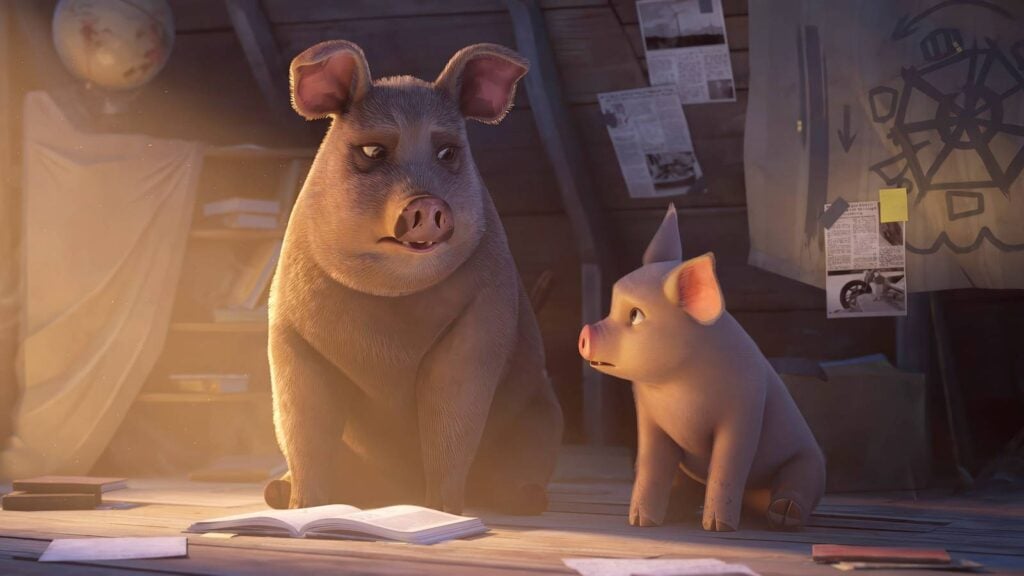
Critics say the new animated adaptation softens Orwell’s sharp edges. Child psychologists say parents should resist the same temptation when talking to children about hard things.
When critics describe the new animated Animal Farm, directed by Andy Serkis and featuring voice performances from Seth Rogen, Glenn Close, Kieran Culkin, Woody Harrelson, Laverne Cox, and Gaten Matarazzo, as a ‘dumbed down’ version of George Orwell’s classic, they mean it as a criticism of the film. But for parents, that phrase carries a different kind of warning: the instinct to simplify difficult things for children, while well-intentioned, can actually do more harm than good.
The Hollywood Reporter’s review of the animated Animal Farm frames the adaptation as a missed opportunity, one where a star-studded cast cannot compensate for a story stripped of its most challenging ideas. Orwell’s 1945 novel is a brutal, clear-eyed allegory about how power corrupts, how propaganda works, and how revolutions betray the people they were meant to serve. Softening those edges may make for a more comfortable viewing experience. It also makes for a less honest one. Sound familiar?
Why Parents Are Tempted To Dumb Things Down
The impulse to protect children from difficult truths is natural and loving. But clinical psychologists who work with children and families are consistent on this point: honesty, delivered in an age-appropriate way, is almost always the better path. The American Psychological Association’s guidance on how to talk to children about difficult news and world events emphasizes that children are far more aware of what is happening around them than adults tend to assume. They pick up fragments of overheard conversations, sense the emotional temperature of a room, and detect when the adults around them are anxious or distressed. What they often lack is not information but context — and that is exactly where a parent’s voice matters most.
The APA recommends that parents start by asking children what they already know before launching into an explanation. This approach lets you meet a child where they actually are, correct any misinformation they may have absorbed, and avoid overwhelming them with details they were not yet wondering about. Assuming children are unaware of something difficult is rarely accurate — and leaving that gap unfilled can generate more anxiety, not less.
What Honest Conversations Actually Look Like
Being honest with children does not mean delivering an unfiltered account of everything frightening in the world. It means calibrating the conversation to what a child can actually process at their developmental stage. For very young children, that looks like simple, direct language: short sentences, concrete facts, no euphemisms. A Psychology Today piece on talking to kids honestly about difficult events says that keeping language simple and answering follow-up questions are easier ways to introduce and discuss difficult topics.
For older children and teenagers, the APA advises letting the child’s own curiosity guide how deep the conversation goes. If a child keeps asking follow-up questions, that is a signal to keep going. If they seem satisfied with a brief answer, that is a signal to pause and let them process. Honest reassurance matters here too. Promising a child that nothing bad will ever happen is not reassurance — it is a false guarantee that sets up future distress. Grounded, factual comfort sounds more like acknowledging a real risk while explaining what your family does to stay as safe as possible.
It’s also important to remember that children should be allowed to share their own feelings before a parent shares theirs. Hearing that a caregiver is devastated or terrified can be more frightening for a child than the event itself. Validate what the child is feeling first, then connect your own emotions to theirs in a way that feels shared rather than overwhelming.
Using Stories and Media As A Starting Point
This is where a film like Animal Farm — even an imperfect one — can actually serve families well. Shared stories give children and parents a common reference point for discussing ideas that might otherwise feel too abstract or too charged to approach directly. Calgary Public Library’s guidance, developed by Dr. Nicole Racine, clinical psychologist in the Department of Psychology at the University of Calgary, and Kate Schutz, Service Design Lead at Calgary Public Library, regarding using books and media to open conversations about difficult subjects with children, recommends being proactive rather than waiting for a child to bring something up. Initiating the conversation in an age-appropriate way helps children feel safe and secure.
For families with teenagers, watching Animal Farm together and then discussing where the film simplifies Orwell’s original — and why those simplifications matter — could itself become a lesson in media literacy and critical thinking. Sesame Workshop, whose resources on helping children cope with difficult topics and traumatic experiences span everything from grief to displacement, emphasizes that caring adults hold real power to help children process hard material. The key word is caring, not shielding.
Age Matters — But Not The Way You Might Think
The animated format of Animal Farm may lead some parents to assume it is appropriate for all ages. The story involves violence, death, political betrayal, and a genuinely tragic ending. Children under ten may find it confusing or upsetting without significant parental guidance. For middle schoolers and high schoolers, it could be exactly the kind of shared cultural experience worth seeking out — one that opens real conversations about fairness, leadership, and how societies can go wrong.
But the age question cuts both ways. Parents sometimes underestimate how much younger children can handle when the conversation is handled well. Research cited in the Psychology Today piece found that children who repeatedly viewed footage of the September 11 attacks showed elevated rates of PTSD — not because the subject was too hard, but because they lacked adult guidance to help them understand what they were seeing. The problem was not the difficult content. It was the absence of a caring adult to provide context. The APA echoes this finding, noting that limiting children’s exposure to graphic or repetitive media coverage is among the most protective steps a parent can take during a frightening news cycle.
Parents looking for animated films that build empathy and critical thinking in younger viewers might also explore animated children’s movies that teach empathy and other important life lessons, which cover titles better calibrated for younger audiences. For families with sensitive kids who need gentler content, our roundup of family movies that are safe for sensitive kids offers a useful alternative.
What This Says About How We Talk to Kids
The criticism leveled at Serkis’s Animal Farm, that it trades Orwell’s sharp political intelligence for something more palatable and less demanding, is a useful mirror for parents. The temptation to smooth over hard truths, to offer easy comfort instead of honest conversation, comes from a good place. But children who grow up with adults who talk to them honestly about difficult things develop something more durable than comfort: they develop resilience. That is the real lesson Animal Farm was always trying to teach, and it is one no adaptation can dumb down on your behalf.

