


When a mother recently peeled the safety labels off her baby’s car seat because she preferred the cleaner look, the public reaction was swift and alarmed, and child safety experts say that alarm is completely justified.
Those labels are not decorative fine print; they are the precise instructions that determine whether a car seat actually protects a child in a crash.
The incident, which drew widespread concern from parents online, touches on a much larger problem: car seat misuse is common, it is often well-intentioned, and it can be deadly.
Motor vehicle collisions remain a leading cause of death among young children in the United States, and a car seat that is used incorrectly, whether through a missing label, a skipped installation step, or a malfunctioning indicator, offers far less protection than parents assume.
Why Those Labels Are Not Optional
Every label, sticker, and indicator on a car seat serves a specific function. Some tell caregivers the correct harness position for a child’s weight. Others show whether the seat is reclined at the right angle to keep a newborn’s airway open.
Still others confirm that the seat has clicked securely into its base. Remove any of them, and you remove a layer of protection that engineers built into the product precisely because crashes happen fast and parents cannot rely on memory alone under pressure.
The stakes of ignoring or removing those indicators became starkly clear in late May 2026, when Maxi-Cosi issued a recall of its FamilyFix Slide Pro base after discovering a dangerous flaw.
According to a UK Office for Product Safety and Standards alert reported by The Guardian, the base’s safety indicator could show green even when the car seat was not fully attached. “The indicator, which shows whether the seat is correctly fitted, may display ‘green’ even when the car seat is not fully attached to the base,” the OPSS alert stated.
“As a result, a user may believe the seat is properly connected when it is not. This could cause the seat to move or detach, potentially injuring the occupant.”
If a functioning indicator on a properly manufactured seat can mislead parents, then a missing label on a seat whose owner removed it for aesthetic reasons creates an even more dangerous blind spot.
The Three Pillars Of Car Seat Safety
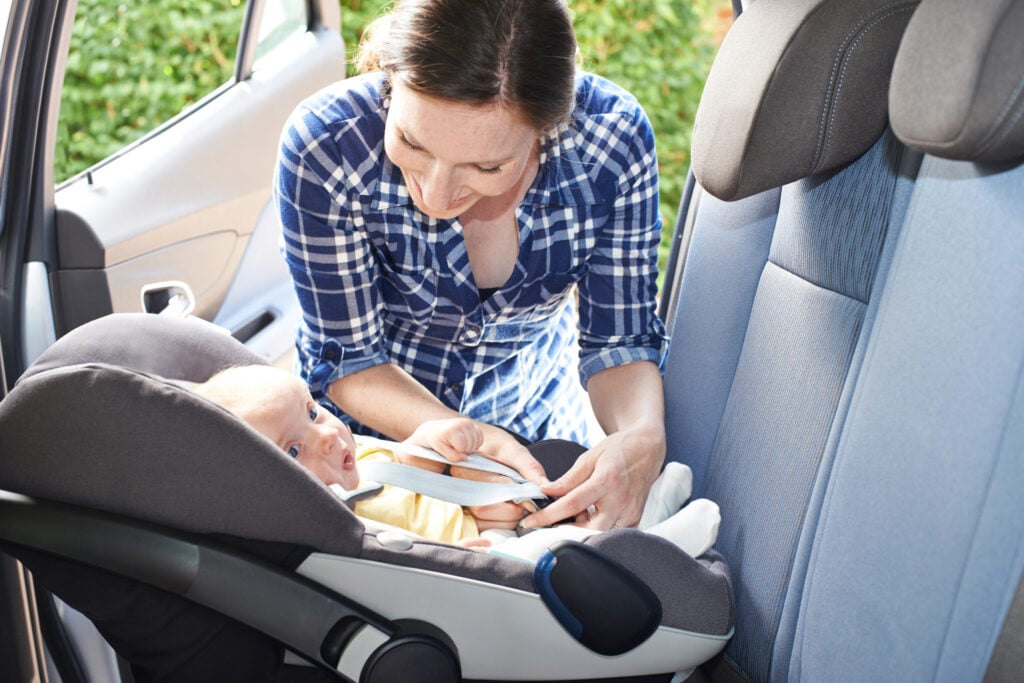
Pediatricians frame car seat safety around three non-negotiable principles. “Car safety for your child is a matter of safety and reliability,” Dr. W. Kyle Mudd, DO, told Cleveland Clinic. “It comes down to choosing the right seat, installing it properly, and making sure you use it right, every single time.”
Each of those three pillars depends on information, and labels are a primary source of that information. The right seat is determined by a child’s height and weight, both of which are printed on the seat itself. Proper installation depends on angle indicators and base-click confirmations.
Correct use requires knowing harness slot positions, chest clip placement, and weight limits, all of which are typically printed directly on the seat or its base. Stripping those labels does not make the seat safer or simpler; it makes every one of those steps harder to get right.
Dr. Mudd also cautions parents against using secondhand seats with unknown histories, noting that car seat safety is highly regulated in the U.S. and that all seats must meet federal safety standards to be sold legally.
An altered seat, one whose labels have been removed, poses a similar problem: its original safety communication has been compromised.
Misuse Is More Common Than Most Parents Realize
The mother who removed her car seat labels may have acted on aesthetic grounds, but car seat misuse takes many forms, and research shows it is widespread.
One of the most documented errors is transitioning children to forward-facing seats too early. A University of Michigan study published in Academic Pediatrics found that nearly one-quarter of parents switched to forward-facing before their child’s first birthday, despite AAP guidelines recommending rear-facing until at least age two.
“Almost one-quarter of parents are turning their children before their first birthday,” said Dr. Michelle L. Macy, the study’s lead author at the University of Michigan’s C.S. Mott Children’s Hospital, in comments to ScienceDaily. “And few parents report waiting until that second birthday to make the turn.”
The same research found that in Sweden, where rear-facing until age four is culturally normalized, child traffic fatalities rank among the lowest in the world. The data suggest that parental behavior, not just seat technology, is a critical variable in child passenger safety.
Even Well-Designed Seats Can Be Misused

Part of the problem is that car seats are genuinely complicated. Child passenger safety technicians, the certified professionals who help families install and use seats correctly, regularly encounter parents who have made errors despite reading the manual.
Some seats have more rules than others, and those extra rules create more opportunities for mistakes.
Safe in the Seat, a resource developed by certified child passenger safety technicians, notes that certain seat designs are prone to misuse not because they are unsafe in principle, but because their instructions are difficult to follow.
“All car seats are safe when they’re used correctly. Yes, even the ones on this list!” the Safe in the Seat editorial staff wrote, emphasizing that correct use is the determining factor in whether any seat protects a child. Seats with multiple recline indicators, unusual harness routing rules, or confusing installation steps present a higher risk of user error, even among experienced caregivers.
That context matters when evaluating the label-removal incident. The mother in question may not have understood that those labels were functional rather than decorative. But the outcome, a seat whose safety communication has been partially disabled, is the same regardless of intent.
What Parents Can Do Right Now
If you have a car seat with labels that are peeling, faded, or missing, contact the manufacturer for replacement stickers before using the seat again. Never attempt to reconstruct label information from memory or online photos, since small details like weight ranges and harness slot positions vary by model and year.
Cleveland Clinic’s guidance also recommends practicing installation before your baby arrives, using a doll to rehearse the process, and watching manufacturer-approved videos. If you are unsure whether your seat is installed correctly, a certified child passenger safety technician can check it for free. The national helpline is 1-866-SEAT-CHECK (1-866-732-8243).
Additional reminders worth reviewing:
- Keep children rear-facing until they reach the maximum height or weight limit for their seat, not just until a birthday.
- Avoid aftermarket accessories, including strap covers, head supports, and add-on padding, that did not come with the seat. These can interfere with crash performance.
- Check your seat’s expiration date. Many seats expire after approximately six years as materials degrade.
- Never use a seat that has been in a crash or whose full history is unknown.
The mother who removed her car seat labels probably did not think she was putting her child at risk. That is precisely what makes this story worth paying attention to.
Car seat safety failures rarely stem from indifference; they arise from gaps in understanding of what each component of a seat actually does. Labels, indicators, and manufacturer guidelines are not bureaucratic clutter.
They are the interface between engineering and real-world use, and when parents remove or ignore them, even for the most benign reasons, the margin of safety shrinks in ways that only become visible in the worst possible moment.

