

Her living room doesn’t have a single toy in it. Her children’s playroom is perfect. Her kids’ clothes are spotless, and they’re currently reciting a geography lesson three grade levels above their age while eating something organic and homemade.
You may be wondering why her life looks so much different from yours, and how you could ever do enough “mommaxxing” to catch up.
The answer is that you’re comparing reality to a stage show, and trying to make your 24-7 look like someone else’s nine-to-five, and the trend is harming real moms.
Social Media Is A Highlight Reel
Most of us have stories we share and ones we don’t. Sometimes that’s a matter of pride in one story and shame in another, but it can also be that we just recognize not everything makes a shareable story. For instance, maybe you talk about watering your garden, and don’t go into a long ramble about exactly how many kinks you had to untwist from your hose after winter storage, because it’s just not an interesting detail.
Or, maybe you frame photos of your kids heading out to trick-or-treat, but not photos of them sitting up in bed amidst the evidence of a stomach bug that hit in the night.
This is normal. This is reasonable. Not every moment is for memorializing and centering.
The difficulty arises because so many of us see the moments others share, the moments that, without the social media context, we might think of as photos on our living room wall or family Christmas letters, and mistake them for the whole picture. (And, let’s be honest, sometimes that’s by design.)
As parents, we have to practice understanding that we can’t compare our everyday to someone else’s studio moments.
The Influencer Effect
Influencers make a show of pretending that their staged, planned, and curated moments are everyday. Like any advertisement, the message is that if you buy this product, you too can have this level of joy/cleanliness/organization/peace/etc., and, like any advertisement, we should be considering it rationally and critically.
To take a specific subset of the influencer genre, for example, one study published in Psychology of Women Quarterly earlier this year examined tradwife content. That study found that these videos actively promoted ‘traditional’ gender roles, stay-at-home non-career moms, and efforts to recreate the past, but that paradoxically, the same videos were monetized. That is, these moms are making a career of influencing other moms to feel bad about having to work!
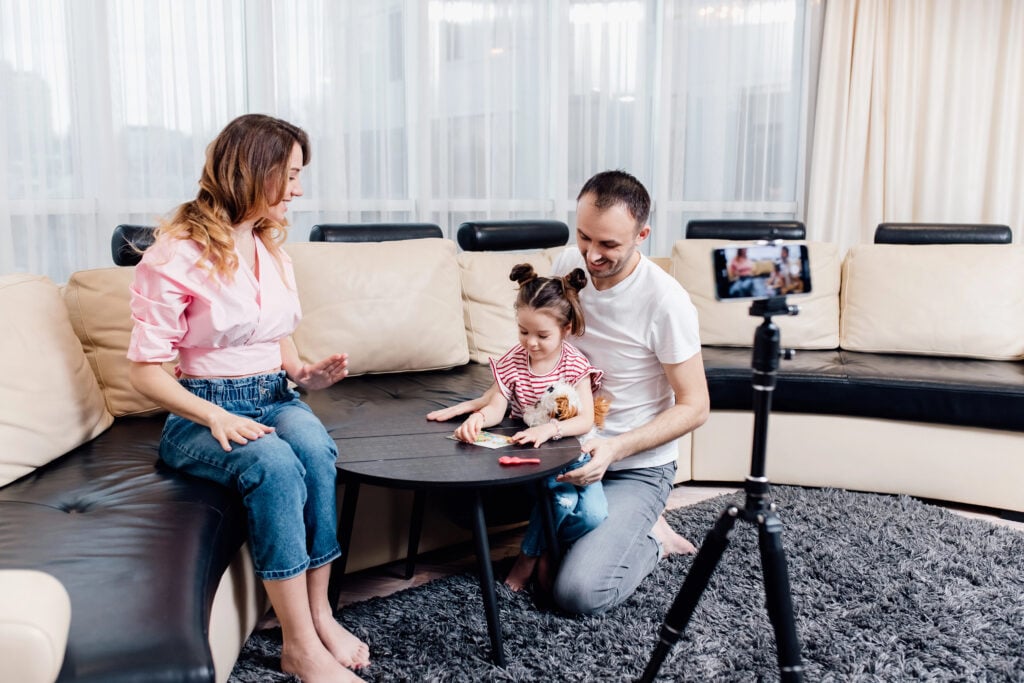
Also, it may look like you’re seeing daily life, but the truth is, many of these influencers batch content. That means they may spend a day filming curated content, and release it over a week or more. In fact, last year the Today Show reported on one influencer mom who saddened an observer when she “casually knocked over” her daughter’s sandcastle to redo for better content, then took her to the water to splash “for about ten seconds” before ending the fun to edit her videos.
On social media, those sandcastle and sea-splash videos might have looked more like a successful day at the beach than some family trips, but the reality was very different.
We’re Harming Ourselves With These Unreasonable Standards
When I say ‘unreasonable standards,’ I’m talking about the idea that it’s every mom’s duty to have creative crafts, innovative snacks, and perfect playdates on deck day after day.
Let me be extremely clear: it’s fine if there are days when your kid has to figure out their own entertainment using the toys and games they already have. I’m not saying fast food is the healthiest daily choice, but I am saying that buying your kid a Happy Meal sometimes instead of making homemade nuggets from the best-sourced free-range chickens isn’t damaging to their souls.
In fact, as parents report, this type of “mommymaxxing,” a term that plays off the manosphere’s “looksmaxxing” trend, isn’t realistic and is harming moms. Deana A. Rohlinger, PhD, Associate Dean and Pepper Distinguished Professor of Sociology at Florida State University, tells the publication that the trend is hurting maternal mental health.
“A mother sees enough of this content and it stops registering as ‘content,’ and starts registering as the normative baseline of what ‘good’ mothers are apparently doing,” Dr. Santorelli explains. “She enrolls the toddler in the enrichment class, signs the 8-year-old up for the third travel sport, hires the college consultant in ninth grade because it seems like that is what is expected. The performance ends up becoming [her] life.”
The Mommymaxxing Mindset Is Hurting Our Kids, Too

When you show up for your kids with special treats, fun activities, and family time, that’s great for bonding and building memories. However, if the mommymaxxing culture has conned you into thinking that every snack needs to involve enrichment (look, we can only build so many pretzel stick log cabins, let’s be real) and every afternoon needs an outing, playdate, or coordinated activity, there’s a very real risk of both you and the kids ending up burnt out.
Burnt-out parents have more mental and physical health issues, and are more likely to lose their temper or overreact.
Meanwhile, kids who have a constantly curated life of entertainment do not get the benefits of learning to be creative on their own. They never have to figure out something to do to handle boredom. They don’t have to learn to problem-solve.
Where’s The Line?
Parents may think they’re living up to a standard when they try to match everything the influencer mommies seem to be doing. In reality, it puts a parent at risk of burning out, and may not be the best outcome for the kids, either.
So, how much is too much? Does this mean you shouldn’t vet the ingredients in your kids’ food, buy them adorable outfits, and take videos of their first time trying the slide at the playground?
The answer is that every family will have to find their own balance. What works will vary from family to family, and maybe even kid to kid.
However, the line will generally be somewhere in the range that results in kids who are taken care of and have their needs met, but who also have unstructured time, and whose parents aren’t too overwhelmed with comparison to enjoy family life.
