
Tuttle Twins - Needs, Rights and Flamingo Fights (S2E1)
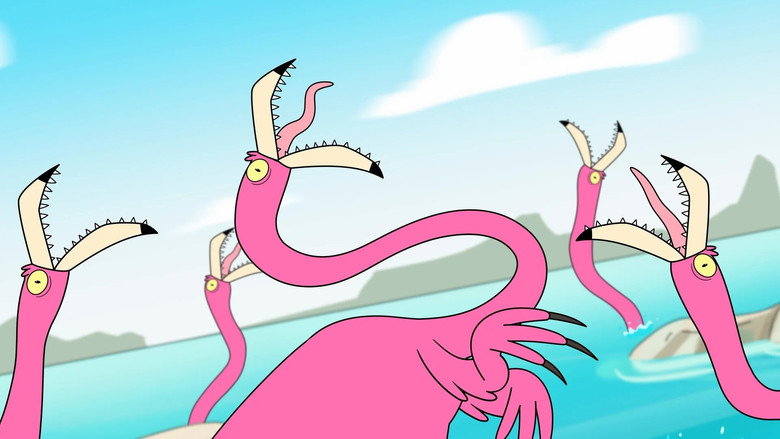
When a field trip goes wrong, the twins question if needs are actually rights. They learn about natural rights from John Locke and fight for their lives on an island of ferocious flamingos.
| Runtime (min) | 24 |
|---|---|
| Air Date | 2023-03-07 |
| Genres | Animation, Kids, War & Politics |
| TV Rating | TV-PG |
| Network(s) | Angel |
Storyline
In this season premiere, the Tuttle twins embark on a field trip that takes an unexpected turn when they find themselves stranded on a remote island inhabited by aggressive flamingos. The mishap forces Ethan and Emily to rely on their wits and survival skills while grappling with a fundamental question: what is the difference between a need and a right?
As the twins navigate the dangers of the island and contend with the territorial flamingos, they recall lessons about natural rights from the philosopher John Locke. Through their predicament, they explore whether things people need—like food, shelter, or safety—automatically qualify as rights that others must provide. The episode uses the twins' adventure to illustrate the distinction between natural rights (life, liberty, property) and material needs, challenging viewers to think critically about entitlement, self-reliance, and the proper role of government in meeting citizens' demands.
What parents say
Parents familiar with the Tuttle Twins series note that the show consistently presents libertarian and free-market principles in an accessible format for children. Many parents who share these values appreciate the episode's focus on natural rights philosophy and the distinction between needs and entitlements, viewing it as a useful counterpoint to messages their children might encounter elsewhere. Some parents have praised the show for introducing thinkers like John Locke in an age-appropriate adventure context.
Parents have also commented on the show's didactic approach, with some noting that the lessons are presented quite explicitly rather than subtly woven into the narrative. A number of parents recommend watching together so they can discuss the concepts and answer questions that arise. Parents from different political perspectives have expressed concern that the show's ideological framework is presented as objective truth rather than one viewpoint among many, suggesting that families should be prepared to contextualize the lessons within their own value systems.
What kids learn
Children watching this episode learn about the philosophical concept of natural rights as articulated by John Locke, specifically the rights to life, liberty, and property. The episode teaches that these rights exist inherently and are not granted by governments or other people. Through the twins' island predicament, kids explore the idea that having a need for something does not automatically create an obligation for others to provide it.
The episode encourages critical thinking about the difference between wants, needs, and rights—distinctions that can help children understand political and economic debates they may hear in the world around them. Kids see the twins problem-solving and taking responsibility for their own survival rather than expecting rescue, which reinforces themes of self-reliance and personal agency.
Additionally, the flamingo-filled adventure provides lessons about assessing danger, working together under pressure, and thinking creatively when resources are limited. The episode invites children to question assumptions about entitlement and to consider where rights come from, fostering early engagement with civic and philosophical concepts in a memorable, story-driven way.
Parents' top 5 questions
| Question | Answer |
|---|---|
| Is the political philosophy in this episode presented in a balanced way? | The episode presents a libertarian perspective on rights and needs, drawing specifically on John Locke's natural rights theory. It argues that needs do not automatically create rights or obligations for others to fulfill them. This viewpoint is presented as the lesson to be learned rather than one perspective among many. Parents from different political traditions may want to watch together and discuss how their own family's values relate to these ideas, providing context and alternative viewpoints as appropriate for their children's age and understanding. |
| How scary is the flamingo danger for younger viewers? | The episode features flamingos portrayed as aggressive and territorial, creating tension as the twins must avoid or contend with them while stranded on the island. The show is animated and aimed at children, so the peril is presented in an adventurous rather than graphic way. Younger or more sensitive children might find the survival scenario and animal conflict stressful, but the tone remains within typical animated adventure bounds. Parents know their children best and can gauge whether the premise will be exciting or anxiety-inducing. |
| What age is appropriate for understanding the rights versus needs concept? | The distinction between needs and rights is an abstract concept that older elementary and middle school children are generally better equipped to grasp. Younger children can follow the adventure and understand basic ideas about helping oneself versus expecting others to provide, but the philosophical nuances of natural rights theory may be beyond their developmental stage. Parents can use the episode as a starting point and tailor follow-up conversations to their child's maturity level, focusing on fairness, responsibility, and community in age-appropriate terms. |
| Does this episode encourage kids to be selfish or uncaring about others' needs? | The episode emphasizes self-reliance and questions whether people are entitled to have others meet their needs, which some parents worry might discourage compassion. However, the distinction being made is philosophical—between rights that cannot be violated and needs that individuals or communities may choose to help with voluntarily. Parents can use the episode to discuss the difference between forced obligation and voluntary charity, helping children understand that caring for others and recognizing their agency are not mutually exclusive. Clarifying these nuances can prevent misunderstanding the lesson. |
| How can I use this episode to start a conversation about rights with my child? | After watching, ask your child what they think the difference is between something they need and something they have a right to. Discuss examples from the episode and from your own family life. You might explore questions like: Where do rights come from? What responsibilities come with rights? When should we help people who need something, even if they don't have a right to it? Encouraging your child to think through these questions rather than simply accepting the episode's conclusions helps develop critical thinking and allows you to share your family's values. |
Writing
Directing
| Season # | Episode # | Episode Name |
|---|---|---|
| 1 | 1 | When Grandma Gabby moves in with the Tuttle Twins, she takes her twin grandkids on a wheelchair time machine to France and the Old West to learn about laws and try to save their lemonade stand. By learning about the principles Frédéric Bastiat writes in his groundbreaking book, The Law, the twins are able to save their stand! |
| 1 | 2 | A science camp rivalry threatens to destroy Emily’s dreams. Grandma takes the twins to India and a worm battlefield to learn about the golden rule before it’s too late. By learning about the golden rule of fiscal policy, the twins are able to save Emily’s dreams! |
| 1 | 3 | Argh! The twins encounter space pirates, a Scotsman, and ice cream people as they learn about free trade and why no one can make a pencil by themselves. |
| 1 | 4 | With the help of Ben Franklin, the Twins learn what it means to be an entrepreneur and start their own corndog stand. By learning about entrepreneurship, the twins are able to grow a business… Too bad Karinnie has some business plans of her own. |
| 1 | 5 | The Twins learn that big businesses like Big Bob's BBQ can sometimes produce laws that keep smaller businesses like Food Trucks from being able to survive. They visit Atlantis and try to stop the protectionism there before things get too wet. |
| 1 | 6 | Why does your money increasingly lose its value? With their eyes set on a big carnival prize, Ethan and Emily learn that printing more tickets causes prices to rise. They visit Ancient Rome and Modern Zimbabwe to see the Inflation Monster at work then rush back to save the carnival. |
| 1 | 7 | Even though everyone learned a lot and some people got delicious desserts, Derek is the real winner of this episode, because he found love. |
| 1 | 8 | Why doesn't everyone get equal pay? Join Ethan and Emily as they travel back in time to visit people like Babe Ruth and learn about the economic value that people provide. |
| 1 | 9 | Ethan and Emily’s film set gets shut down because of a dumb regulation. The twins learn about civilly disobeying unjust laws with the help of Rosa Parks and a funny Boat-Dweller named Doug. This Episode features Dark Dumpster Derek. |
| 1 | 10 | The Twins learn how surrendering powers to the government during times of calamity almost always results in long-term loss of freedoms. They play a fantastical game "Crisis & Creatures" and learn how to rely on the community rather than the government to help each other through challenging times. |
| 1 | 11 | Karinne is back to causing trouble and this time she’s spreading lies about Ethan. But, with the help of James Madison, the Twins learn what happens when you restrict free speech even if it’s mean or deceptive. This is a hip-hoppin’ episode so start warming up your voice for some Free Speech Freestyle! |
| 1 | 12 | Desperate to save Grandma Gabby, Ethan and Emily are thrust into a future world where the government runs every part of daily life. Tune in for the epic finale of season 1, an adventure about persuasion vs force as the twins fight for the future. |
| Season # | Episode # | Episode Name |
|---|---|---|
| 2 | 1 | When a field trip goes wrong, the twins question if needs are actually rights. They learn about natural rights from John Locke and fight for their lives on an island of ferocious flamingos. |
| 2 | 2 | When the twins hit the jackpot with a trash can cleaning business, Karinne makes them question if success is selfish. They learn about true entrepreneurship from Joyce Chen and the grumpy Gurmbledons of Grumbletown! |
| 2 | 3 | Holy Satoshi! When the twins are forced to choose between accepting dollars and bitcoin at a garage sale, they travel through the internet and a retro video game to learn what makes money well…good. |
| 2 | 4 | After their softball team starts bending the rules, the twins jump through famous paintings, meet George Washington, and try to save a divided farm from a big bad wolf and dangerous tribalism! |
| 2 | 5 | After a T-rex destroys their treehouse, the twins struggle to save Rapunzel’s cramped kingdom and discover that good ideas can come from imperfect people. |
| 2 | 6 | When the twins are unfairly cut from a talent show, Grandma takes them to meet Frederick Douglass and an itsy bitsy spider to learn how to conquer victim mentality. |
| 2 | 7 | |
| 2 | 8 | |
| 2 | 9 | LUCHA! After a failed kids club fundraiser, the gang runs into William Bradford, the pilgrims, and Karl Marx as they wrestle with socialism and its consequences. |
| 2 | 10 | After Emily fails a test, the twins wonder whether school is the best way to learn--prompting Grandma to whisk them off to a familiar place in the past, before stopping by the most famous mind in history, and then a rumble in the jungle... |
| 2 | 11 | Invaders from another world kidnap Derek, launching Grandma and the twins on a dangerous rescue mission. On a dark planet, the twins encounter mysterious clues, cyborgs and spy gadgets as they solve the mystery of why capitalism is failing. |
| 2 | 12 | When the twins argue about saving money versus spending it, Grandma Gabby introduces them to a board game that unleashes creatures and chaos into the Tuttle's home. |
| Season # | Episode # | Episode Name |
|---|---|---|
| 3 | 1 | The twins discover a crucial life lesson when they meet the legendary Mike Rowe, who emphasizes that not all careers require a college degree. |
| 3 | 2 | The twins travel to a magical island with Dr. Ben Carson to learn about the fatherless epidemic. |
| 3 | 3 | GUEST STARRING Ashley St. Clair and Seamus Coughlin - When field day is mysteriously canceled, conspiracies abound! Ethan and Emily visit JFK to learn about critical thinking and then crack the conspiracy about what really happened to Humpty Dumpty. |
| 3 | 4 | The cul-de-sac kids discover Karinne has gained access to their private digital lives! The Twins get a lesson in digital privacy from a mysterious guide, then rush to rescue Prince Charming from the Not-Evil Queen's digital control! |
| 3 | 5 | When inflation wrecks movie night, Grandma takes the twins—and stowaway Karinne—back to the Bitcoinverse. There, they learn about the risks of controlled money, CBDCs, and the freedom of Bitcoin. Plus, rocks. Lots of rocks. |
| 3 | 6 | GUEST STARRING Adassa - The cul-de-sac kids are ready for a big soccer game, but when Kevin can’t play due to a religious holiday, Karinne votes to kick him off. With guidance from unexpected sources, the twins learn the value of religious freedom. |
| 3 | 7 | During a gym class dodgeball game, a new kid creates chaos by judging others on appearance. Emily and Ethan turn to Grandma, who introduces them to Martin Luther King Jr., teaching them the value of character over judgment. |
| 3 | 8 | The twins visit President Eisenhower to learn about the military industrial complex. |
| 3 | 9 | The twins learn the value of failure from the Wright brothers and a world afraid to fail. |
| 3 | 10 | Sep transforms into a monster and sends the twins to a ruined alternate world, where they uncover the dangers of irresponsibility. With help from their not-grandmother, they inspire change and prove that true freedom comes from taking responsibility. |
| Season # | Episode # | Episode Name |
|---|---|---|
| 4 | 1 | When the twins earn a trip to Bird Land Amusement Park, they discover that some charities do more harm than good. With help from friends, they must learn to give better—before the park shuts down forever! |
| 4 | 2 | When the Tuttle family debates buying a fancy new fridge, the twins meet John Maynard Keynes, Saifedean Ammous, and a world of quirky food. Together, they discover the hidden risks of melting money and thinking only in the short term. |
| 4 | 3 | After a machine threatens the twins’ jobs, they travel to 1920s Michigan to learn from Henry Ford about creative destruction. But when they return home, nothing is quite as they left it. |
| 4 | 4 | After Emily unfairly loses a pie bake-off, the twins turn to Thomas Sowell to learn the dangers of equity, only to be swept into a fantastical world of elves, orcs, and basketball! |
| 4 | 5 | After a price hike puts a new board game out of reach, the twins travel to Russia to learn about price controls. With economist Ludwig von Mises and a very persistent Copernicus, they discover why controlling prices can backfire. |
| 4 | 6 | After a suspicious news story airs, Grandma and the twins rescue Benjamin Franklin Bache but become trapped in a world where speaking out leads to deadly consequences. They must use journalism and the power of truth to fight back and survive. |
This product uses the TMDB API but is not endorsed or certified by TMDB.