

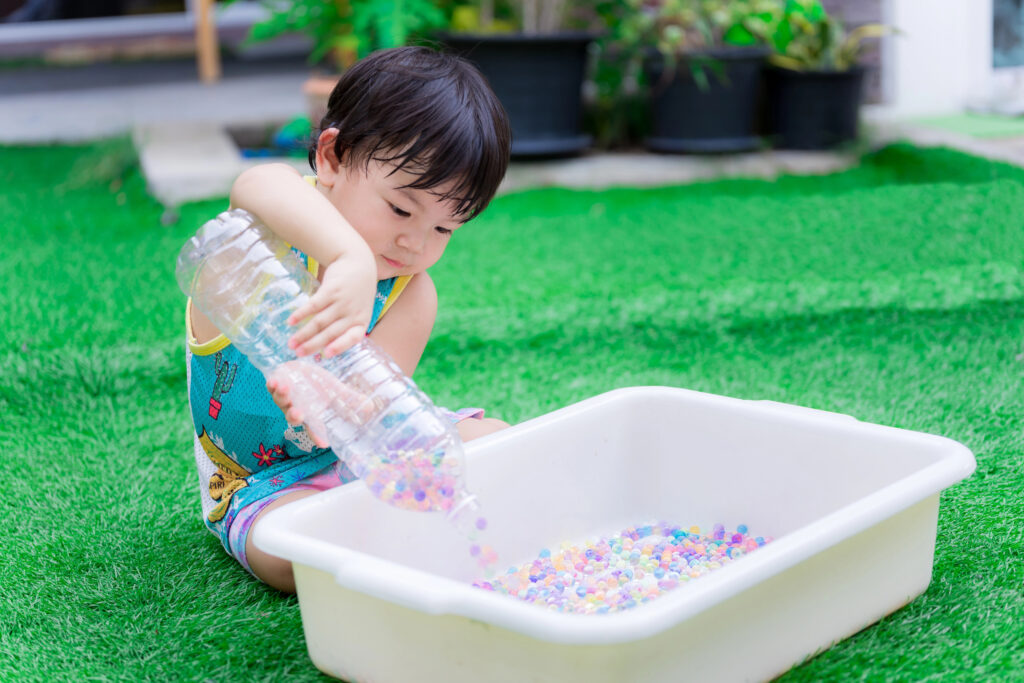
We’re always looking for fun things to play with that don’t have screens, batteries, or sound boxes, and we love fidgets and sensory toys. Spinners and squishes, items with soothing textures or motions.
One common favorite for sensory stations, alongside the sand, water, and clay, is water beads. You may know these—they’re funny little gel orbs that remind you of the contents of silica packets in your shoeboxes, but they’re colorful and have a boingy texture that makes them incredibly appealing.
Unfortunately, they are also incredibly dangerous, to the extent that some stores have pulled them from shelves, new safety standards have been passed, and some even contain chemicals that exceed allowable levels. The question is, do these new standards go far enough?
Moms Fought For Water Bead Safety Standards
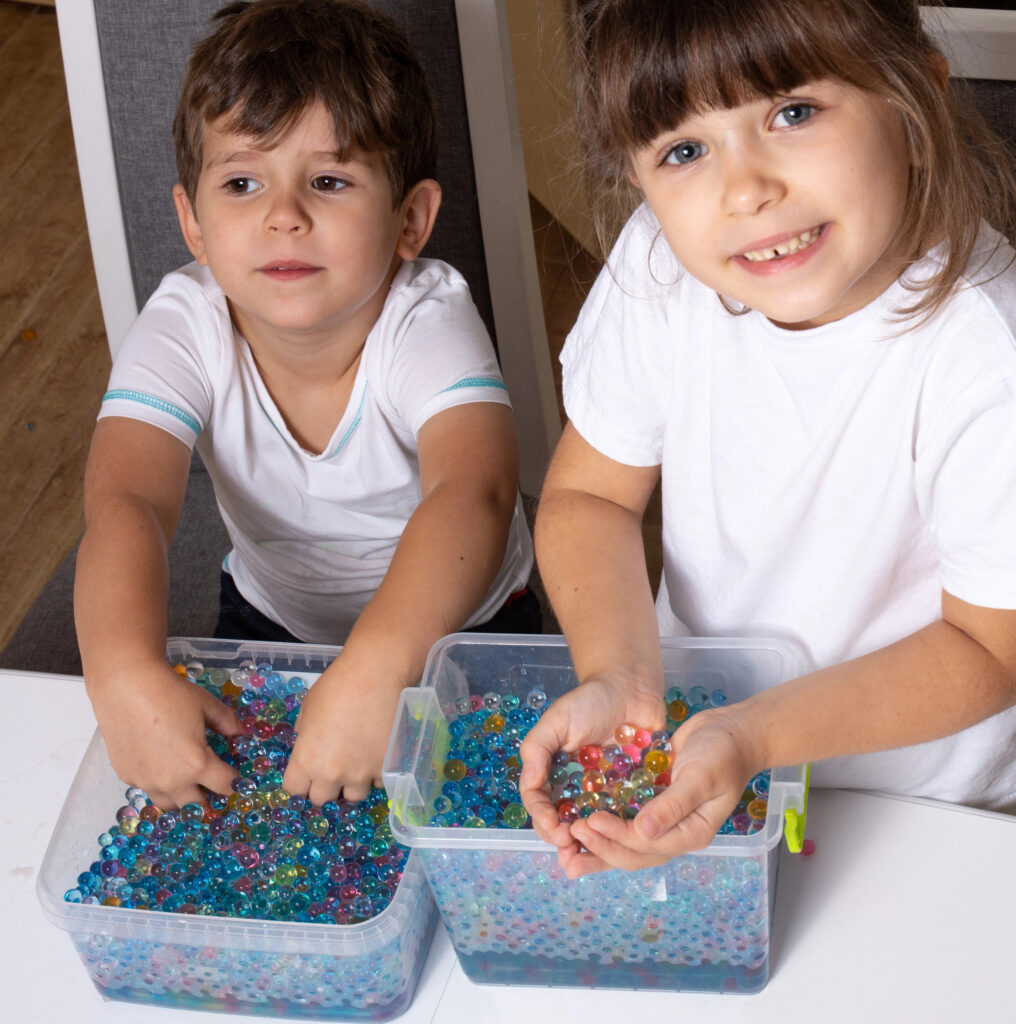
In the summer of 2023, 10-month-old Esther Jo Bethard found some water beads. Her older siblings had played with them months before, under adult supervision. Her mom, Taylor Bethard, testified to the Consumer Product Safety Commission:
“Esther was a baby. She never once played with them, or even allowed in the same space when they were used. So when I learned that a water bead caused her death, I was shocked. We hadn’t even had them out to play with in months. I followed the directions. There is no warning about what could happen if ingested. If there had been, I would’ve never allowed water beads in my home for my older kids to use. The risks are far too great. But I wasn’t warned.”
By the time Ms. Bethard knew, though, her baby wasn’t breathing, and CPR didn’t bring her back.
Ashley Haugen has a similar story, which she shares on her advocacy site, The Bead Lady. Her daughter, Kipley, was not allowed to play with the water beads that had been bought for her six-year-old sister. Nonetheless, after Kipley developed a rash, vomiting, and other symptoms, she ended up having surgery. The surgeon found water beads in her small intestines. Even after the removal, Kipley showed more symptoms — more rashes and new developmental delays.
Haugen learned that the beads she had purchased contained a chemical considered non-toxic but made by polymerizing a neurotoxin called acrylamide, which can remain in unknown residual amounts. Her daughter’s life was changed, and she received a diagnosis of Toxic Brain Encephalopathy caused by acrylamide monomer poisoning, along with language delays, muscle incoordination, and other new struggles.
These and other moms have fought for legislation that would keep water beads out of the hands of small children.
Their Fight Was Multi-Directional
Even as moms testified to legislative and safety groups, they also reached out directly to corporations.
In 2023, major retailers (Walmart, Target, and Amazon) all said they would no longer market water beads as children’s toys, according to the Associated Press. Today, I can find water beads on Walmart and Amazon’s websites, but they are sold as vase fillers and decorations, not as toys. (Amazon still has a storefront for the Orbeez brand, but categories are empty, and where items are listed, they’re described as “currently unavailable.) On Target’s site, I couldn’t even find them as a vase filler.
However, that doesn’t mean they’re unavailable. Parents have thanked the big retailers for their help in making kids a little safer, but I still found water beads for sale, marketed for kids’ sensory tables and in playsets, at smaller retailers, and from certain sites known for their massively discounted prices on fast fashion and other imported goods.
(Reminder yet again: items bought from these sites are rarely if ever subjected to the rigorous safety testing that the U.S. requires of its companies. The lack of testing can contribute to both low prices and higher risks. Parents should use extra caution if purchasing toys or other items for children from these sites.)
The removal from major retailers is a big success, but moms are still buying these toys, often unaware of how dangerous they can be.
Just How Dangerous?

Kinsey and Esther Jo’s moms are among those who took up the fight to save other babies from what their little ones experienced. However, their experiences are far from unique or rare. Research published in American Pediatrics found that more than 20,000 poison control calls have originated from water beads, and many of the cases have been similarly devastating.
The numbers:
- 20,279 water bead ingestions among children <6 years old reported to US poison centers from 2019 to 2024
- 987 cases occurred somewhere other than home, meaning the child was exposed to water beads at a school, daycare, or some other location
- 191 required hospital admission; 20 to critical care units
- 30 required surgical treatments
In one particularly frightening case, a child “was admitted to the critical care unit, experienced multiple bowel surgeries for obstruction with complications, sepsis, and coagulopathy, and was on mechanical ventilation, received vasopressors, and had a hospital stay of approximately 1 month” — after ingesting a single water bead.
This specific study did not find any fatalities but acknowledges that they have occurred.
What’s Happening Now?
The Consumer Product Safety Commission has just announced that new standards are now in effect.
These new rules limit the maximum size to which water beads can expand; limit the allowable amount of acrylamide in the product; and require strongly worded, highly visible warning labels.
“This new rule establishes clear safety standards for water beads and gives the CPSC officials at our nation’s ports the tools they need to quickly identify noncompliant products and stop dangerous shipments before they reach American homes,” said CPSC Acting Chairman Peter A. Feldman. “Water beads that fail to meet the new federal standards are now illegal to sell in the United States. Manufacturers of these products, most of whom are based in China, must meet the new federal standard or face the full weight of CPSC enforcement.”
These new rules should reduce the risks of toxicity and of harm from ingested water beads expanding inside the body.
However, parents should remember that non-compliant products can still slip through the cracks. It’s also important to note that there are water bead products (not marketed as toys or to children) that may not be affected by these new rules.
If you must purchase water beads, it’s ideal to buy them from reliable companies, never allow children to play with them unsupervised, and store them out of reach of small children.
The American Academy of Pediatrics recommends that parents skip water beads altogether and has endorsed legislation that, if passed, would ban their sale as children’s toys, crafts, or educational materials.
