

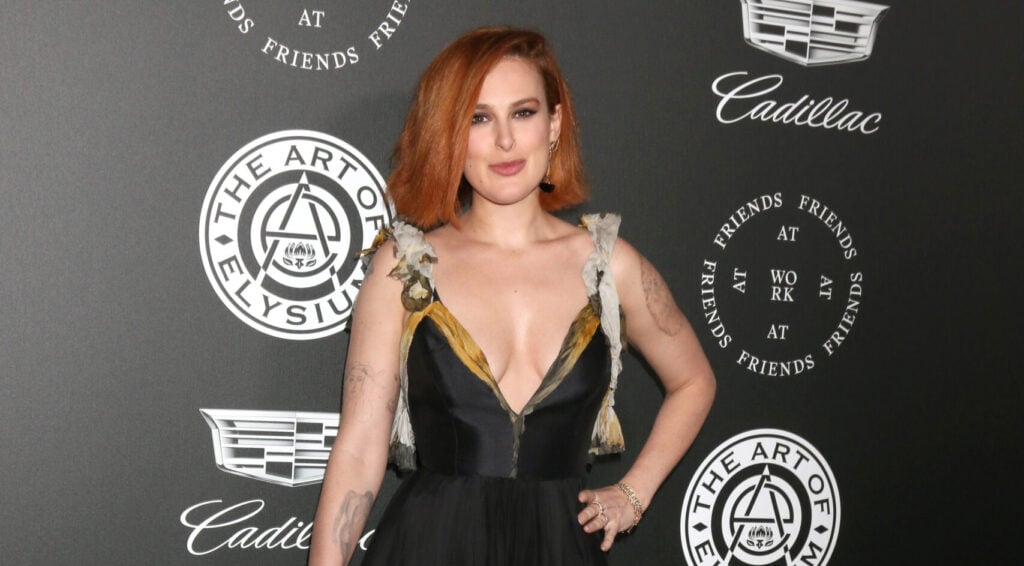
Rumer Willis says she genuinely tries to find common ground with the online critics who have questioned her decision to breastfeed her 3-year-old daughter, Louetta, but admits the judgment still lands hard on certain days.
Rather than simply tuning out the noise, Willis spoke to E! News about actively working to bridge the gap with those who disagree with her choices.
“My goal is not to try and behave in this way that seems like I’m totally unconscious of what’s going on,” she told E! News. “But I’m really trying to find the places that are the same — that we can connect, that we can support each other.”
The breastfeeding video that sparked the latest wave of commentary was posted on Instagram on April 4. In it, Willis nurses Louetta while gently stroking her hair, and the clip drew both warm support and sharp criticism from followers who felt her daughter was too old to still be nursing.
Willis, who serves as Global Creative Partner for EWG Verified brand Pura, addressed the reaction to that October breastfeeding post and the broader pattern of parenting judgment she faces as a public figure during her E! News interview.
“It’s just so crazy. People are just so aggressive about it. It kind of makes me laugh. People get so hopped up about it. Everybody has opinions about how you should parent, whether you should sleep, what you should feed them, what you should wear,”
What The Science Actually Says About Extended Breastfeeding
The criticism Willis faces runs counter to what health authorities and researchers have long established. The World Health Organization recommends breastfeeding up to 2 years or beyond, and extended breastfeeding is considered a cultural designation rather than a medical one — meaning what counts as “too long” varies entirely by society, not by biology.
CDC data from 2018 shows that roughly 35 percent of babies in the United States were still breastfeeding at 12 months, with that figure dropping to 14.8 percent at 18 months. Anthropologist Katherine Dettwyler has noted that across human history, children were typically nursed for several years.
Alexandra Shanks, information manager at the Australian Breastfeeding Association, told 7NEWS there is no recommended upper age limit for breastfeeding.
Research suggests the natural weaning age falls somewhere between 2 and 7 years. “Breastfeeding also helps children form secure attachments, which fosters their independence as they grow,” Shanks told 7NEWS.
She also pointed to documented health benefits of extended nursing that include reduced risk of ear infections, obesity, type 2 diabetes, and childhood leukemia, along with maternal benefits such as lower risk of breast and ovarian cancer.
Shanks attributed much of the public backlash to a fundamental misunderstanding of how breasts function. “In addition, breasts are often viewed in our society as sexual rather than reproductive, leading some people to believe breastfeeding should be done in private,” she told 7NEWS.
Willis Is Not the First Celebrity Mom To Face This Backlash
Willis is hardly alone in navigating this particular brand of public scrutiny. Back in 2019, Coco Austin faced a similar storm after sharing a photo of herself nursing her daughter Chanel, who was nearly 4 at the time.
Austin ultimately breastfed Chanel until age 6. Her husband Ice-T pushed back against critics at the time, telling Us Weekly that their daughter was not nursing for nutrition alone: “She only breastfeeds … like, when she cries [and] she just wants to get close to her mama. She throws the boob out and … holds on. She’s not doing it for nourishment. This chick eats chili fries, OK?”
Austin herself framed the decision in terms of bonding: “It’s about giving love to your child and bonding with your child and also giving them good nutrition,” she told Us Weekly.
Extended Breastfeeding Doesn’t Hurt Anyone
What makes Willis’s situation worth paying attention to is not the celebrity angle; it is the broader reality that parenting judgment is nearly universal, and the targets are almost always mothers.
Medical experts are clear that extended breastfeeding carries real health benefits and no documented medical drawbacks past age 1, yet the social stigma persists.
For the millions of parents navigating similar criticism without a platform to respond, Willis’ candor may offer something more useful than advice: validation that the judgment is about control, not about what is actually best for any individual child.
As Louetta grows and Willis continues to speak openly about the realities of solo parenting in the public eye, the conversation around extended breastfeeding and mom-shaming is unlikely to quiet down — but the science and a growing number of voices are firmly on her side.

