
Tiny Creatures - Florida (S1E6)
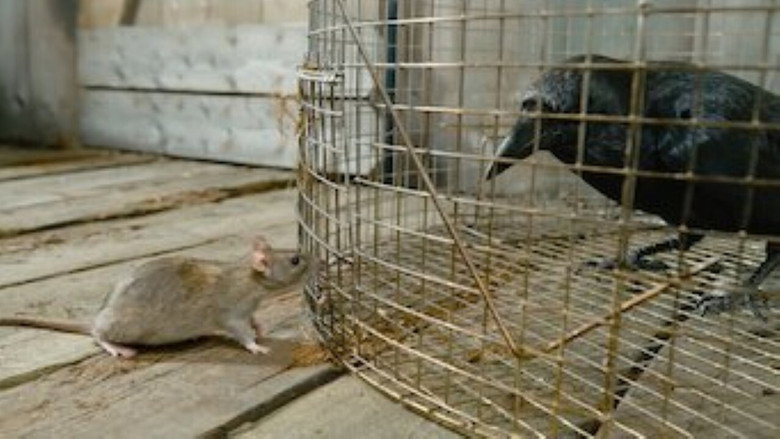
Intellect meets agility in the Florida Everglades as a high-stakes game of raven vs. rat goes down in a fishing hut. Can these foes ever be friends?
| Runtime (min) | 26 |
|---|---|
| TMDB Rating | 4.0 (2 votes) |
| Air Date | 2020-08-07 |
| Genres | Documentary |
| TV Rating | TV-PG |
| Network(s) | Netflix |
Storyline
In the Florida Everglades, a clever raven and a resourceful rat find themselves locked in a battle of wits inside a fishing hut. The raven, known for its intelligence and problem-solving abilities, spots the rat scavenging for food scraps left behind by fishermen. What begins as a territorial standoff quickly escalates into a high-stakes game of strategy as both animals attempt to outwit each other for access to the limited food supply.
The episode showcases the contrasting survival strategies of these two creatures: the raven's aerial advantage and tool-using intelligence versus the rat's agility, speed, and ability to squeeze into tight spaces. As the confrontation unfolds, viewers witness moments of near-misses, clever maneuvers, and surprising adaptations. The episode explores whether these natural competitors can coexist in the same space or if one must ultimately yield to the other, all while highlighting the unique ecosystem of the Florida Everglades and the daily challenges faced by its smallest inhabitants.
What parents say
Parents have praised the Tiny Creatures series for its stunning cinematography and ability to make the natural world accessible to young children. Many appreciate that the show presents animal behavior without anthropomorphizing the creatures, allowing kids to observe genuine wildlife interactions. The narration by Mike Colter has been noted as engaging without being overly dramatic or frightening.
Some parents have mentioned that certain episodes, including predator-prey scenarios, might be intense for very sensitive younger viewers, though the show generally handles these moments with care and avoids graphic content. Parents appreciate that each episode is short enough to hold preschoolers' attention while still delivering educational value. The series has been recommended by parents as a good alternative to more fictional animal programming, offering real-world nature content that sparks curiosity about ecosystems and animal behavior.
What kids learn
Children learn about the unique adaptations that help different animals survive in competitive environments. The episode demonstrates how ravens use their intelligence and problem-solving skills to access food, while rats rely on speed, flexibility, and their ability to navigate confined spaces. Young viewers see that different animals have evolved different strengths, and that neither approach is inherently better—each works for the animal that possesses it.
The episode also introduces children to the concept of competition for resources in nature. Kids observe that animals living in the same habitat often need the same things—food, shelter, and safety—and must find ways to coexist or compete. This provides an age-appropriate introduction to ecological concepts like niche differentiation and resource competition.
Additionally, children gain exposure to the Florida Everglades ecosystem, learning that this wetland environment supports diverse wildlife. The fishing hut setting shows how human structures can become part of animal habitats, and how wildlife adapts to human presence. The episode encourages observation skills and critical thinking as children watch the strategies each animal employs and predict what might happen next.
Parents' top 5 questions
| Question | Answer |
|---|---|
| Is this episode scary for young children? | The episode presents a competitive interaction between a raven and a rat, but it is not violent or graphic. The tension comes from watching the animals try to outsmart each other rather than from any aggressive confrontation. Most preschoolers and early elementary children handle this content well, though very sensitive children might feel anxious during the chase sequences. You know your child best—if they become upset by animal competition, you can pause to reassure them or skip ahead. |
| Does either animal get hurt in this episode? | The Tiny Creatures series focuses on animal behavior and survival strategies without showing graphic injury or death. The raven-versus-rat scenario is presented as a competition for food rather than a predator-prey encounter. While the animals are in conflict over resources, the episode does not depict harm coming to either creature. The show maintains an educational tone that emphasizes observation of natural behaviors rather than distressing outcomes. |
| How can I explain why the animals are fighting over food? | You can explain that in nature, animals sometimes need the same things—like food—and they have to figure out how to get what they need. Just like when two kids want the same toy, animals have to work out who gets the food. The raven and rat aren't being mean; they're just trying to survive. You might add that this is normal in nature and both animals have special skills that help them find food in different ways. |
| What ages is this episode appropriate for? | This episode works well for children ages four and up who are interested in animals and nature. Preschoolers will enjoy the close-up footage and the suspense of watching the animals interact, while early elementary children can grasp the ecological concepts about competition and adaptation. The twenty-six-minute runtime is manageable for most children in this age range, and the episode can spark good conversations about how animals live and survive in the wild. |
| Are ravens and rats really enemies in nature? | Ravens and rats are not natural enemies in the predator-prey sense, but they do compete for similar food sources, especially in areas where human activity provides scraps and leftovers. Both are opportunistic feeders, meaning they eat whatever they can find. In a confined space like a fishing hut with limited food, competition between them is realistic. The episode accurately portrays how different species with overlapping needs must navigate sharing space and resources in their environment. |
Writing
Directing
| Season # | Episode # | Episode Name |
|---|---|---|
| 1 | 1 | In Arizona, critters brave a harsh frontier, and a young kangaroo rat must be nimble to dodge a rattlesnake, a Gila monster — and a dirt bike. |
| 1 | 2 | While housemates are away, a pampered golden hamster will play. Will he slow his roll when he lands on the streets of NYC and finds true adventure? |
| 1 | 3 | A burrowing owl evades caddies at a golf course before a ferret forces him far from the fairway. He'll have to outfox his opponents to get home. |
| 1 | 4 | In a hostile Texas landscape, a ranch offers fast food to an agile mother mouse. But she must be clever to avoid turning into a barn owl's dinner. |
| 1 | 5 | Keen eyesight and a playful nature lead the way when a special squirrel explores a suburban home, the least likely place to meet his surprising match. |
| 1 | 6 | Intellect meets agility in the Florida Everglades as a high-stakes game of raven vs. rat goes down in a fishing hut. Can these foes ever be friends? |
| 1 | 7 | Rescued from the trash and ready to roam, a newly hatched lucky duckling tours her new habitat: a boy's bedroom. But her sanctuary teems with danger. |
| 1 | 8 | As night falls, a shy striped skunk prowls for grub till a roving rodent opens up her world. When confronted by a hawk, will she spray or will she go? |
This product uses the TMDB API but is not endorsed or certified by TMDB.