
Emily's Wonder Lab - Glow Party (S1E1)
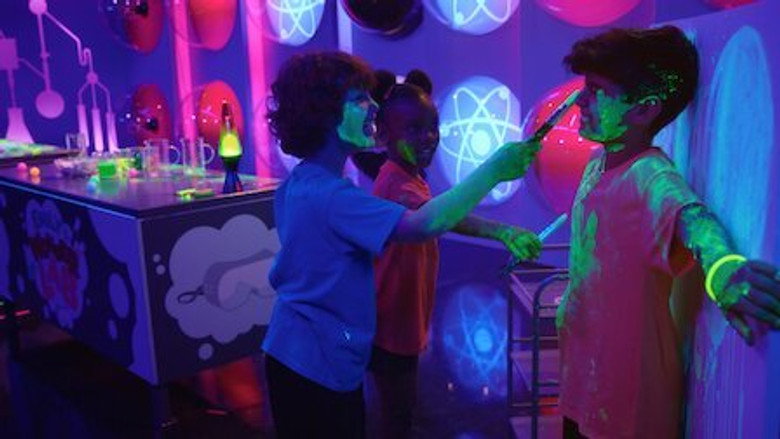
Emily and the crew get curious about ultraviolet light, then mix up their own fluorescent paint. At-home experiment: lava lamp.
| Runtime (min) | 12 |
|---|---|
| TMDB Rating | 10.0 (1 votes) |
| Air Date | 2020-08-25 |
| Genres | Family, Kids |
| TV Rating | TV-G |
| Network(s) | Netflix |
Storyline
In the premiere episode of Emily's Wonder Lab, host Emily Calandrelli introduces her young crew to the science of ultraviolet light and fluorescence. The team explores how UV light reveals hidden properties in everyday materials, setting the stage for hands-on discovery. Emily guides the kids through observations that demonstrate how certain substances absorb invisible UV wavelengths and re-emit them as visible light, creating the glowing effects they'll harness for their project.
The crew then mixes their own fluorescent paint using materials that react under blacklight. They experiment with different formulations, testing which ingredients produce the brightest glow and discussing the chemistry behind their creations. The episode wraps with an at-home experiment segment that teaches viewers how to build a simple lava lamp, connecting the concepts of density and liquid behavior to the hands-on fun families can replicate in their own kitchens.
What parents say
Parents have praised Emily's Wonder Lab for making science accessible and exciting for elementary-aged children. Many appreciate Emily Calandrelli's enthusiastic hosting style and her ability to explain concepts without talking down to young viewers. Parents note that the show strikes a good balance between entertainment and education, holding kids' attention while delivering real scientific content.
Parents have complimented the series for its short runtime, which fits well into busy schedules and matches younger children's attention spans. The at-home experiments included in each episode are frequently mentioned as a highlight, with parents reporting that the activities use common household items and are straightforward enough for families to replicate without special equipment or extensive preparation.
Some parents have expressed appreciation for the diverse group of kids featured on the show, noting that children see peers who look like them engaging with STEM topics. Parents also mention that the series works well for a range of ages, with preschoolers enjoying the visual demonstrations and older elementary students grasping the deeper scientific principles Emily presents.
What kids learn
Children learn foundational concepts about light and the electromagnetic spectrum in this episode. They discover that ultraviolet light exists beyond what human eyes can see, yet it interacts with certain materials in observable ways. The episode demonstrates that science isn't just about memorizing facts but about asking questions, making predictions, and testing ideas through experimentation.
The hands-on paint-mixing activity teaches kids about fluorescence and the chemical properties that cause materials to glow under blacklight. They see that different substances behave differently under UV exposure, introducing the idea that matter has distinct characteristics that scientists can measure and manipulate. This concrete demonstration helps children understand abstract concepts by connecting them to tangible, colorful results they can see and create themselves.
The lava lamp experiment reinforces lessons about density, immiscibility, and chemical reactions. Children observe how oil and water refuse to mix, how effervescent tablets create gas bubbles, and how density differences cause the dramatic rising and falling motion. The episode models scientific thinking by encouraging kids to observe carefully, ask why things happen, and recognize that everyday phenomena follow predictable scientific principles they can explore at home.
Parents' top 5 questions
| Question | Answer |
|---|---|
| Is the fluorescent paint they make in this episode safe for kids to handle? | The episode demonstrates mixing fluorescent paint using materials designed for the controlled studio environment. If you're replicating the activity at home, use non-toxic, washable paints and supervise children during mixing and application. Check product labels to ensure ingredients are age-appropriate, and have kids wear old clothes or smocks since fluorescent pigments can stain. The glowing effect works best with store-bought blacklight-reactive paints formulated for craft use. |
| What exactly is ultraviolet light and why can't we see it? | Ultraviolet light is a form of electromagnetic radiation with wavelengths shorter than visible light. Human eyes have receptors that detect only a specific range of wavelengths we perceive as colors from red to violet. UV wavelengths fall outside that range, making them invisible to us. However, certain materials absorb UV energy and re-emit it at longer wavelengths we can see, which is the fluorescence effect Emily demonstrates in this episode. |
| Do we need special equipment to do the lava lamp experiment at home? | The at-home lava lamp experiment uses common household items: a clear container, water, vegetable oil, food coloring, and effervescent tablets like Alka-Seltzer. No special scientific equipment is required. You'll get the best visual effect with a tall, narrow container like a clear plastic bottle or glass vase. The experiment is safe for young children with supervision, though parents should handle the tablets if kids are prone to putting things in their mouths. |
| How does this episode connect to what my child is learning in school? | This episode aligns with elementary science standards covering light, energy, and properties of matter. The UV light exploration introduces the electromagnetic spectrum, a concept that appears in upper elementary and middle school curricula. The density and immiscibility concepts in the lava lamp experiment connect to physical science units on matter and mixtures. The hands-on approach reinforces the scientific method—observation, prediction, experimentation—that forms the foundation of science education across grade levels. |
| Will my child understand the science if they're on the younger end of the target age range? | Younger viewers may not grasp every scientific detail Emily explains, but the visual demonstrations and hands-on activities engage children across a wide age span. Preschool and early elementary kids enjoy watching the glowing paint and bubbling lava lamp even if the underlying chemistry is beyond them. The episode plants seeds for future learning, and children naturally absorb age-appropriate pieces of the content. Parents can pause to answer questions or simplify concepts as needed. |
Writing
Directing
| Season # | Episode # | Episode Name |
|---|---|---|
| 1 | 1 | Emily and the crew get curious about ultraviolet light, then mix up their own fluorescent paint. At-home experiment: lava lamp. |
| 1 | 2 | The kids learn the science behind non-Newtonian fluids, then try to walk — and dance! — across an ooey-gooey pool. At-home experiment: oobleck. |
| 1 | 3 | Emily takes her scientists outside to get messy, making colorful explosions with chemical reactions. At-home experiment: rainbow bubbles |
| 1 | 4 | The kids learn all about tornados — then Emily shows them how to make one indoors! At-home experiment: tornado in a bottle. |
| 1 | 5 | How do you test the strength of ordinary chicken eggs? By walking across a whole floor of them ... barefoot. At-home experiment: egg in a bottle |
| 1 | 6 | A pool filled with glue helps the gang learn all about cross-linking polymers. (Hint: They're making slime!) At-home experiment: meteorite slime. |
| 1 | 7 | Brace yourself! The kids are making high-powered air cannons out of shower curtains, bungee cords and trash cans. At-home experiment: cloud in a bottle. |
| 1 | 8 | Inspired by Newton's third law of motion, the kids build balloon-powered cars, then race them to see who wins. At-home experiment: hovercraft. |
| 1 | 9 | The scientists scare up flying ghosts and bubbling witch’s brew with rising heat and acid-base reactions. At-home experiment: barfing pumpkin. |
| 1 | 10 | Aluminum foil, plastic wrap and a pizza box are the perfect ingredients for a solar-powered oven. At-home experiment: static electricit |
This product uses the TMDB API but is not endorsed or certified by TMDB.