
Emily's Wonder Lab - Walking on Oobleck (S1E2)
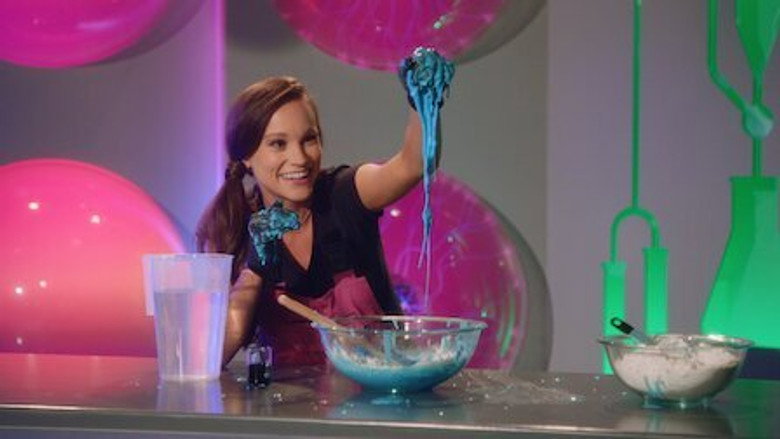
The kids learn the science behind non-Newtonian fluids, then try to walk — and dance! — across an ooey-gooey pool. At-home experiment: oobleck.
| Runtime (min) | 14 |
|---|---|
| Air Date | 2020-08-25 |
| Genres | Family, Kids |
| TV Rating | TV-G |
| Network(s) | Netflix |
Storyline
In this episode, Emily Calandrelli introduces a group of enthusiastic kids to the fascinating properties of non-Newtonian fluids, with a special focus on oobleck—a mixture of cornstarch and water that behaves like both a liquid and a solid. The children observe how oobleck flows slowly when handled gently but becomes firm when struck or squeezed quickly. Emily explains the science behind this unusual behavior, demonstrating how the cornstarch particles interact under different types of pressure.
The episode builds to an exciting challenge: the kids attempt to walk and even dance across a large pool filled with oobleck. They discover that moving quickly allows them to stay on top of the mixture, while hesitating or moving slowly causes them to sink. The hands-on experiment reinforces the scientific concepts introduced earlier, and Emily encourages viewers to try making their own oobleck at home using simple kitchen ingredients. The episode wraps up with the kids celebrating their successful crossing and reflecting on what they learned about this unique substance.
What parents say
Parents have praised Emily's Wonder Lab for making complex scientific concepts accessible and exciting for young children. Many appreciate Emily Calandrelli's enthusiastic and clear teaching style, noting that she breaks down ideas like non-Newtonian fluids into language that elementary-aged kids can understand without talking down to them. The hands-on experiments featured in each episode, including the oobleck activity in this installment, are frequently mentioned as a highlight that inspires children to explore science at home.
Parents note that the oobleck experiment is particularly popular because it requires only two common household ingredients—cornstarch and water—making it easy and inexpensive to replicate. Some parents have mentioned that the activity can get messy, so they recommend setting up outdoors or on surfaces that are easy to clean. Overall, parents appreciate that the show encourages curiosity and experimentation while keeping episodes short enough to maintain younger viewers' attention spans.
What kids learn
Children learn about the unique properties of non-Newtonian fluids through direct observation and experimentation with oobleck. They discover that not all liquids behave the same way and that some substances can change their properties depending on how much force is applied to them. This introduces kids to the concept that matter can exhibit characteristics of multiple states under different conditions, challenging their assumptions about how liquids and solids should behave.
The episode also teaches the scientific method in action. Kids see how hypotheses are tested when the children predict whether they can walk across the oobleck pool, then observe the results and adjust their approach. They learn that moving quickly creates enough pressure to make the oobleck act solid, while moving slowly allows them to sink, demonstrating cause and effect in a memorable, physical way.
Beyond the science content, children learn that experimentation involves trial and error. Some kids in the episode struggle or sink at first, but they persist and eventually succeed, modeling resilience and problem-solving. The at-home experiment invitation empowers kids to become scientists themselves, reinforcing that science is something they can do, not just watch.
Parents' top 5 questions
| Question | Answer |
|---|---|
| What exactly is oobleck and why does it behave so strangely? | Oobleck is a non-Newtonian fluid made from cornstarch and water. Unlike normal liquids, it doesn't have a constant viscosity. When force is applied quickly, the cornstarch particles jam together and the mixture acts like a solid. When handled gently or left still, the particles can slide past each other and it flows like a liquid. This property makes it possible to walk across a pool of oobleck if you move quickly enough to keep the pressure constant. |
| Is the oobleck experiment safe for my child to try at home? | Yes, oobleck is completely safe and non-toxic since it's made only from cornstarch and water. There are no harmful chemicals involved. The main consideration is mess management—oobleck can be slippery and will leave a powdery residue when it dries. It's best to do the experiment in a contained area like a large tray, outside, or over surfaces that are easy to wipe clean. The mixture can be disposed of in the trash once dried. |
| How much cornstarch and water do we need to make oobleck at home? | A good starting ratio is about two parts cornstarch to one part water, though you may need to adjust slightly to get the right consistency. For a small batch that one child can explore, try one cup of cornstarch mixed with half a cup of water. Add the water gradually and mix with your hands, as the texture is part of the experience. The mixture should flow slowly when poured but feel solid when punched or squeezed quickly. |
| What should my child do if they can't walk across their oobleck pool? | Walking on oobleck requires quick, confident steps that maintain constant pressure. If your child is sinking, they're likely moving too slowly or hesitating. Encourage them to take faster steps and keep moving without pausing. For a home experiment with a smaller amount of oobleck, they can practice by quickly pressing down with their palm versus slowly pushing their fingers in to feel the difference in resistance and understand the principle before attempting to walk. |
| What other experiments can we do to explore non-Newtonian fluids further? | After mastering basic oobleck, try variations like adding food coloring to make it more visually interesting, or placing oobleck on a speaker to watch it dance to vibrations. You can also compare it to other substances: ketchup is a non-Newtonian fluid that becomes less viscous when shaken. Experimenting with different cornstarch-to-water ratios helps kids understand how changing variables affects results, reinforcing scientific thinking and observation skills introduced in the episode. |
Writing
Directing
| Season # | Episode # | Episode Name |
|---|---|---|
| 1 | 1 | Emily and the crew get curious about ultraviolet light, then mix up their own fluorescent paint. At-home experiment: lava lamp. |
| 1 | 2 | The kids learn the science behind non-Newtonian fluids, then try to walk — and dance! — across an ooey-gooey pool. At-home experiment: oobleck. |
| 1 | 3 | Emily takes her scientists outside to get messy, making colorful explosions with chemical reactions. At-home experiment: rainbow bubbles |
| 1 | 4 | The kids learn all about tornados — then Emily shows them how to make one indoors! At-home experiment: tornado in a bottle. |
| 1 | 5 | How do you test the strength of ordinary chicken eggs? By walking across a whole floor of them ... barefoot. At-home experiment: egg in a bottle |
| 1 | 6 | A pool filled with glue helps the gang learn all about cross-linking polymers. (Hint: They're making slime!) At-home experiment: meteorite slime. |
| 1 | 7 | Brace yourself! The kids are making high-powered air cannons out of shower curtains, bungee cords and trash cans. At-home experiment: cloud in a bottle. |
| 1 | 8 | Inspired by Newton's third law of motion, the kids build balloon-powered cars, then race them to see who wins. At-home experiment: hovercraft. |
| 1 | 9 | The scientists scare up flying ghosts and bubbling witch’s brew with rising heat and acid-base reactions. At-home experiment: barfing pumpkin. |
| 1 | 10 | Aluminum foil, plastic wrap and a pizza box are the perfect ingredients for a solar-powered oven. At-home experiment: static electricit |
This product uses the TMDB API but is not endorsed or certified by TMDB.