
Emily's Wonder Lab - Rainbow Horse Toothpaste (S1E3)
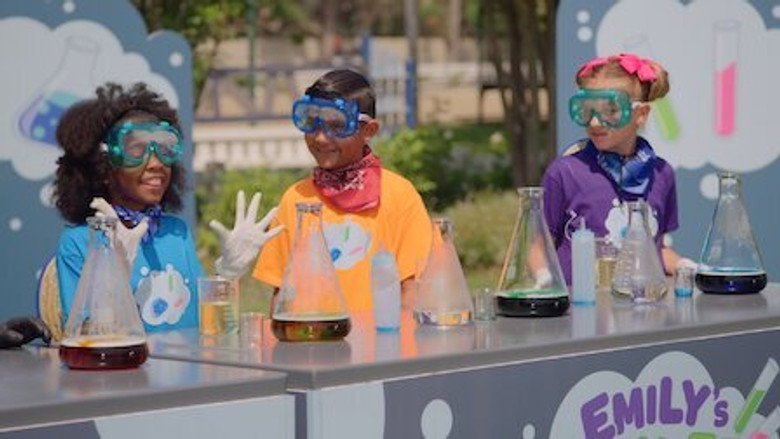
Emily takes her scientists outside to get messy, making colorful explosions with chemical reactions. At-home experiment: rainbow bubbles
| Runtime (min) | 13 |
|---|---|
| Air Date | 2020-08-25 |
| Genres | Family, Kids |
| TV Rating | TV-G |
| Network(s) | Netflix |
Storyline
In this episode, Emily and her team of young scientists head outdoors to explore the exciting world of chemical reactions. The main experiment involves creating dramatic, colorful foam eruptions commonly known as "elephant toothpaste" or, as Emily calls it, "rainbow horse toothpaste." The kids combine hydrogen peroxide, dish soap, food coloring, and a catalyst to produce towering columns of foam in multiple vibrant colors, demonstrating how certain substances can react rapidly to produce gas and heat.
Throughout the episode, Emily emphasizes safety and the science behind the spectacle, explaining how the catalyst speeds up the breakdown of hydrogen peroxide into water and oxygen gas. The trapped oxygen creates the foamy eruption that delights the young scientists. The at-home experiment segment guides families through making rainbow bubbles using simple household materials, allowing children to continue exploring color mixing and surface tension in a safe, parent-supervised setting.
What parents say
Parents have praised "Emily's Wonder Lab" for making science accessible and exciting for elementary-aged children. Many appreciate that Emily Calandrelli presents experiments with clear safety guidelines and age-appropriate explanations, making it easier for families to replicate activities at home. The show's emphasis on diverse young scientists has been noted positively by parents who value representation in STEM programming.
Some parents have mentioned that while the experiments are visually engaging, adult supervision is essential for the at-home activities, particularly those involving chemical reactions. Parents recommend watching episodes together first to assess whether younger children are ready for certain experiments. The short runtime has been complimented as ideal for maintaining attention spans without overwhelming kids with information.
Parents on forums like Reddit's r/ScienceParents have shared that the rainbow toothpaste experiment specifically generates enthusiasm but requires careful setup and cleanup. They advise having towels and outdoor space ready, as the foam can be messy despite being non-toxic.
What kids learn
Children learn fundamental chemistry concepts through this episode's focus on chemical reactions and catalysts. They discover that mixing certain substances can produce dramatic physical changes, and that a catalyst is a special ingredient that speeds up a reaction without being consumed itself. The visual spectacle of the foam eruption helps kids understand that gases can be trapped in liquids to create foam, and that chemical reactions can release energy in the form of heat.
The episode also teaches scientific observation and prediction skills. Emily encourages the young scientists to hypothesize what will happen before conducting the experiment, then observe and describe the results. Kids learn that science involves both careful planning and hands-on experimentation, and that safety precautions are an essential part of any scientific investigation.
The rainbow bubbles segment reinforces lessons about color mixing and introduces the concept of surface tension in a playful, accessible way. Children see how soap molecules interact with water to create stable bubbles, and how adding different colors can produce beautiful effects. The episode demonstrates that science is creative, collaborative, and fun, encouraging kids to think like scientists in their everyday lives.
Parents' top 5 questions
| Question | Answer |
|---|---|
| Is the elephant toothpaste experiment safe for kids to do at home? | The experiment shown in the episode uses hydrogen peroxide and a catalyst, which require adult supervision and careful handling. Emily demonstrates proper safety measures, including wearing protective gear. For at-home versions, parents should use lower-concentration hydrogen peroxide (3% household strength) and ensure children do not touch the foam immediately after creation, as the reaction produces heat. The resulting foam is non-toxic but should not be ingested, and the experiment is best conducted outdoors or in an easy-to-clean area. |
| What age is appropriate for trying this experiment at home? | The rainbow toothpaste experiment is most appropriate for children ages six and up with direct adult supervision. Younger children can observe and help with safe steps like adding food coloring, while older elementary students can take more active roles in measuring and mixing under guidance. The key is ensuring children understand they must follow safety rules and wait for adult approval before handling any materials. The at-home rainbow bubbles activity is gentler and suitable for slightly younger children with supervision. |
| What is Emily actually teaching about chemical reactions in this episode? | Emily explains that chemical reactions occur when substances interact to create something new. In the elephant toothpaste demonstration, hydrogen peroxide breaks down into water and oxygen gas when a catalyst is added. The oxygen gets trapped by dish soap, creating foam, while the reaction releases heat. Kids learn that catalysts speed up reactions, that gases can be captured in liquids, and that chemical changes often produce observable effects like temperature changes, color changes, or gas production. |
| Where can I find the materials for the at-home rainbow bubbles experiment? | The rainbow bubbles experiment uses common household items that most families already have or can easily purchase at grocery or drug stores. You'll need dish soap, water, food coloring, and bubble solution or the ingredients to make it (more dish soap, water, and optionally glycerin or corn syrup for stronger bubbles). Emily provides clear instructions during the episode, and the materials are inexpensive and non-hazardous, making this an accessible follow-up activity for families who want to continue exploring after watching. |
| Why does Emily call it 'horse toothpaste' instead of 'elephant toothpaste'? | Emily uses the playful name "rainbow horse toothpaste" to make the experiment feel fresh and engaging for her young audience while emphasizing the colorful, rainbow aspect of their multi-colored version. The experiment is traditionally called "elephant toothpaste" because the foam resembles toothpaste being squeezed from a giant tube, but Emily's variation focuses on creating multiple colors simultaneously. The name change adds whimsy and helps children remember this specific version of the classic chemistry demonstration they're conducting together. |
Writing
Directing
| Season # | Episode # | Episode Name |
|---|---|---|
| 1 | 1 | Emily and the crew get curious about ultraviolet light, then mix up their own fluorescent paint. At-home experiment: lava lamp. |
| 1 | 2 | The kids learn the science behind non-Newtonian fluids, then try to walk — and dance! — across an ooey-gooey pool. At-home experiment: oobleck. |
| 1 | 3 | Emily takes her scientists outside to get messy, making colorful explosions with chemical reactions. At-home experiment: rainbow bubbles |
| 1 | 4 | The kids learn all about tornados — then Emily shows them how to make one indoors! At-home experiment: tornado in a bottle. |
| 1 | 5 | How do you test the strength of ordinary chicken eggs? By walking across a whole floor of them ... barefoot. At-home experiment: egg in a bottle |
| 1 | 6 | A pool filled with glue helps the gang learn all about cross-linking polymers. (Hint: They're making slime!) At-home experiment: meteorite slime. |
| 1 | 7 | Brace yourself! The kids are making high-powered air cannons out of shower curtains, bungee cords and trash cans. At-home experiment: cloud in a bottle. |
| 1 | 8 | Inspired by Newton's third law of motion, the kids build balloon-powered cars, then race them to see who wins. At-home experiment: hovercraft. |
| 1 | 9 | The scientists scare up flying ghosts and bubbling witch’s brew with rising heat and acid-base reactions. At-home experiment: barfing pumpkin. |
| 1 | 10 | Aluminum foil, plastic wrap and a pizza box are the perfect ingredients for a solar-powered oven. At-home experiment: static electricit |
This product uses the TMDB API but is not endorsed or certified by TMDB.