
Emily's Wonder Lab - Bowling With Air (S1E7)
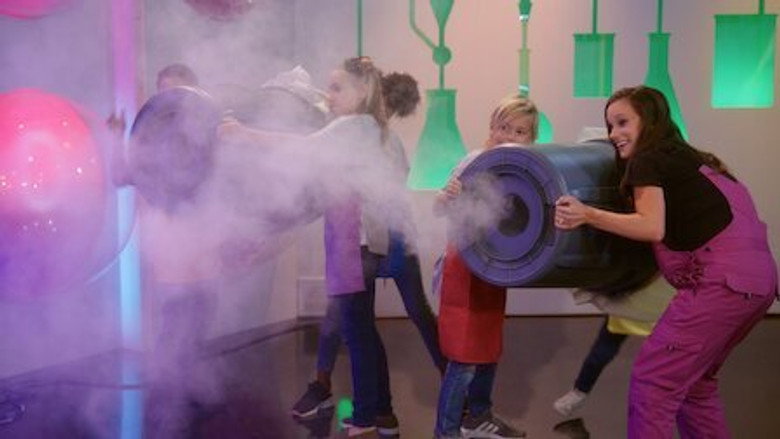
Brace yourself! The kids are making high-powered air cannons out of shower curtains, bungee cords and trash cans. At-home experiment: cloud in a bottle.
| Runtime (min) | 13 |
|---|---|
| Air Date | 2020-08-25 |
| Genres | Family, Kids |
| TV Rating | TV-G |
| Network(s) | Netflix |
Storyline
In this episode of Emily's Wonder Lab, host Emily Calandrelli introduces young scientists to the power of air pressure by building high-powered air cannons. Using everyday materials including shower curtains, bungee cords, and trash cans, Emily and the kids construct devices capable of launching objects across the lab. The episode demonstrates how air, when compressed and released quickly, can generate surprising force—enough to knock down targets and propel lightweight objects significant distances.
The hands-on construction process allows the children to see engineering principles in action as they assemble their cannons and test different variables. Emily guides them through understanding how pulling back the shower curtain creates a vacuum that fills rapidly with air when released, creating a powerful burst. The episode concludes with the kids using their completed air cannons in a bowling-style challenge, aiming to knock down pins or targets. The at-home experiment extends the learning by showing families how to create a cloud inside a bottle using air pressure and temperature changes.
What parents say
Parents have praised Emily's Wonder Lab for making complex scientific concepts accessible and exciting for elementary-aged children. Many appreciate Emily Calandrelli's enthusiastic hosting style and her ability to break down physics and engineering principles into language that young viewers can understand without talking down to them. The hands-on approach of the series, where real kids participate in experiments rather than just watching demonstrations, has been highlighted as particularly engaging.
Parents note that the show strikes a good balance between entertainment and education, holding children's attention while delivering genuine learning content. The short runtime of around thirteen minutes per episode is frequently mentioned as ideal for younger attention spans and for fitting into busy family schedules. Some parents have commented that the experiments inspire their children to ask questions about science and want to try similar activities at home, though a few note that replicating some experiments requires adult supervision and specific materials that may not always be readily available.
What kids learn
Children learn fundamental principles of air pressure and physics through this episode's air cannon construction. They discover that air is not empty space but a substance that can be compressed, moved, and used to generate force. By seeing how pulling back the shower curtain creates lower pressure inside the cannon and how the rushing air equalizes that pressure when released, kids gain an intuitive understanding of how pressure differences create movement and power.
The episode also teaches basic engineering and problem-solving skills as the children work through the construction process. They learn that everyday materials can be repurposed to create functional devices and that scientific principles apply to real-world applications. The bowling challenge at the end reinforces concepts of aim, trajectory, and force, showing how the amount of pull-back affects the power of the air blast.
Beyond the specific science content, children observe collaboration and experimentation in action. They see that building and testing prototypes is part of the scientific process, and that adjusting variables leads to different outcomes. The at-home cloud experiment extends their understanding of air pressure to weather phenomena, connecting the lab activity to the natural world around them.
Parents' top 5 questions
| Question | Answer |
|---|---|
| Is the air cannon activity safe for kids to try? | The air cannons built in the episode use soft materials and launch lightweight objects, making them relatively safe under adult supervision. However, the force generated can be significant, so parents should ensure kids aim away from faces, fragile items, and pets. The construction process involves bungee cords that could snap back if not secured properly, so adult assistance is important during assembly and initial testing. |
| What age group is this episode most appropriate for? | This episode works well for children ages five to ten, the show's target demographic. Younger elementary students will enjoy the hands-on building and the excitement of launching objects, while older kids in the range can better grasp the underlying physics concepts Emily explains. The visual demonstrations and energetic presentation keep the content accessible across this age span, though very young viewers may need help understanding the scientific explanations. |
| Can we safely do the cloud-in-a-bottle experiment at home? | The cloud-in-a-bottle experiment is one of the safer at-home activities, typically requiring just a plastic bottle, warm water, a match, and quick pressure changes by squeezing the bottle. The main safety consideration is the brief use of a match to create smoke particles, which should be handled by an adult. The experiment effectively demonstrates condensation and air pressure principles with minimal risk when proper precautions are followed. |
| What scientific concepts will my child actually understand from this episode? | Children will grasp that air takes up space and can push objects when compressed and released quickly. They'll understand that creating a vacuum or low-pressure area causes surrounding air to rush in forcefully. While younger viewers may not articulate these principles in scientific terms, the visual demonstrations make the concepts concrete and memorable, building foundational knowledge for future physics learning. |
| Do we need special materials to build an air cannon at home? | The episode uses a plastic trash can, shower curtain, and bungee cords—items that many households have or can obtain inexpensively. However, parents should note that the construction requires some assembly skill and the right size components to work effectively. Simpler versions using smaller containers and plastic wrap can demonstrate the same principles if the full-scale version isn't practical for your space or budget. |
Writing
Directing
| Season # | Episode # | Episode Name |
|---|---|---|
| 1 | 1 | Emily and the crew get curious about ultraviolet light, then mix up their own fluorescent paint. At-home experiment: lava lamp. |
| 1 | 2 | The kids learn the science behind non-Newtonian fluids, then try to walk — and dance! — across an ooey-gooey pool. At-home experiment: oobleck. |
| 1 | 3 | Emily takes her scientists outside to get messy, making colorful explosions with chemical reactions. At-home experiment: rainbow bubbles |
| 1 | 4 | The kids learn all about tornados — then Emily shows them how to make one indoors! At-home experiment: tornado in a bottle. |
| 1 | 5 | How do you test the strength of ordinary chicken eggs? By walking across a whole floor of them ... barefoot. At-home experiment: egg in a bottle |
| 1 | 6 | A pool filled with glue helps the gang learn all about cross-linking polymers. (Hint: They're making slime!) At-home experiment: meteorite slime. |
| 1 | 7 | Brace yourself! The kids are making high-powered air cannons out of shower curtains, bungee cords and trash cans. At-home experiment: cloud in a bottle. |
| 1 | 8 | Inspired by Newton's third law of motion, the kids build balloon-powered cars, then race them to see who wins. At-home experiment: hovercraft. |
| 1 | 9 | The scientists scare up flying ghosts and bubbling witch’s brew with rising heat and acid-base reactions. At-home experiment: barfing pumpkin. |
| 1 | 10 | Aluminum foil, plastic wrap and a pizza box are the perfect ingredients for a solar-powered oven. At-home experiment: static electricit |
This product uses the TMDB API but is not endorsed or certified by TMDB.