
Emily's Wonder Lab - Eggs! Eggs! Eggs! (S1E5)
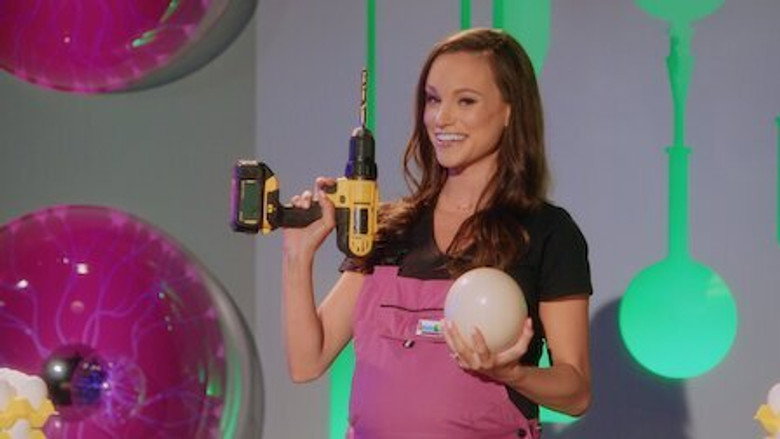
How do you test the strength of ordinary chicken eggs? By walking across a whole floor of them ... barefoot. At-home experiment: egg in a bottle
| Runtime (min) | 14 |
|---|---|
| Air Date | 2020-08-25 |
| Genres | Family, Kids |
| TV Rating | TV-G |
| Network(s) | Netflix |
Storyline
In this episode of Emily's Wonder Lab, host Emily Calandrelli explores the surprising structural strength of chicken eggs through hands-on experiments. The central demonstration involves Emily and her young assistants attempting to walk barefoot across a floor covered entirely with ordinary eggs. Despite the eggs' reputation for fragility, the experiment reveals how their dome-shaped architecture distributes weight evenly, allowing them to support significant pressure without breaking when force is applied from the top.
Throughout the episode, Emily explains the science behind egg strength, discussing how the curved shell design makes eggs remarkably resilient under certain conditions. The show also features an at-home experiment where viewers learn to create a vacuum that pulls a peeled hard-boiled egg into a bottle, demonstrating principles of air pressure. The episode combines physical demonstrations with clear explanations, making concepts of structural engineering and physics accessible to young viewers through the familiar object of an everyday egg.
What parents say
Parents have praised Emily's Wonder Lab for making science engaging and accessible for elementary-aged children. Many appreciate Emily Calandrelli's enthusiastic hosting style and her ability to break down complex concepts into understandable demonstrations. Parents note that the show successfully balances entertainment with education, holding children's attention while teaching genuine scientific principles.
Parents have specifically complimented the egg-walking experiment as memorable and exciting for kids, with several noting that their children were eager to discuss the science behind it afterward. Some parents appreciate that the at-home experiments are simple enough to replicate with common household items, making it easy to extend the learning beyond screen time. A few parents have mentioned that the show's short runtime is ideal for younger attention spans while still delivering substantive content.
Parents have also noted that the series features diverse young assistants and presents science as accessible to all children, which many find valuable for encouraging STEM interest regardless of gender or background.
What kids learn
Children learn fundamental principles of structural engineering through the egg-walking demonstration. The episode teaches that shape matters in construction and design—the dome structure of an eggshell distributes force across its surface, making it much stronger when pressure comes from above than from the side. Kids discover that objects they perceive as fragile can actually withstand significant weight when forces are applied in specific ways, introducing them to concepts they'll encounter later in physics and architecture.
The vacuum experiment with the egg and bottle introduces children to air pressure and how differences in pressure can create powerful forces. Kids learn that air takes up space and exerts pressure, and that heating and cooling air changes that pressure. This hands-on demonstration makes an invisible force tangible and understandable, helping children grasp that the air around them is not empty space but matter that behaves according to scientific laws.
Beyond specific scientific concepts, the episode encourages observational skills and scientific thinking. Children learn to question everyday assumptions—why don't the eggs break?—and to seek explanations through experimentation. The show models how to test hypotheses safely and systematically, fostering curiosity and the understanding that science is about asking questions and discovering answers through careful investigation.
Parents' top 5 questions
| Question | Answer |
|---|---|
| Is the egg-walking experiment safe to try at home? | The egg-walking experiment requires careful setup and supervision. Eggs must be arranged properly with the pointed ends up or down to distribute weight correctly, and the surface must be stable. There is a significant mess risk if eggs break, and slipping hazards exist. Parents should consider the cleanup involved and whether their child can follow instructions carefully. The bottle experiment is generally safer and more practical for home replication with appropriate adult supervision. |
| What age child will understand and enjoy this episode? | This episode is most appropriate for children ages five to ten. The visual demonstrations are engaging enough for younger elementary students, while the scientific explanations provide substance for older children in this range. Preschoolers may enjoy watching the egg-walking spectacle but might not grasp the underlying physics concepts. The fourteen-minute runtime is well-suited to the attention spans of early elementary-aged viewers, and the hands-on nature keeps the content concrete rather than abstract. |
| Does the episode explain why eggs are stronger in one direction? | Yes, Emily explains that the curved dome shape of the eggshell distributes pressure evenly across the entire surface when force comes from the top or bottom. This architectural principle is why eggs can support weight when stood upright but crack easily when squeezed from the sides. The episode makes this concept visual and tangible through the walking demonstration, helping children understand that geometry and shape affect strength. This introduces basic engineering concepts in an age-appropriate way. |
| What materials do we need for the at-home bottle experiment? | The bottle experiment requires a hard-boiled egg that has been peeled, a glass bottle with an opening slightly smaller than the egg, matches or a small piece of burning paper, and adult supervision. The experiment demonstrates air pressure by creating a vacuum that pulls the egg into the bottle. Parents should handle all aspects involving fire and ensure the bottle is heat-safe glass. The experiment is relatively quick and uses common household items, making it accessible for most families. |
| Are there any scary or upsetting moments in this episode? | This episode contains no frightening content. The egg-walking segment builds mild suspense about whether the eggs will break, but the tone remains playful and educational throughout. Some children might feel anxious watching someone walk on eggs, anticipating a mess, but the demonstration is conducted calmly. The bottle experiment involves briefly lighting a match or paper, which should be handled by adults. Overall, the episode maintains an upbeat, curious tone without any elements designed to startle or upset young viewers. |
Writing
Directing
| Season # | Episode # | Episode Name |
|---|---|---|
| 1 | 1 | Emily and the crew get curious about ultraviolet light, then mix up their own fluorescent paint. At-home experiment: lava lamp. |
| 1 | 2 | The kids learn the science behind non-Newtonian fluids, then try to walk — and dance! — across an ooey-gooey pool. At-home experiment: oobleck. |
| 1 | 3 | Emily takes her scientists outside to get messy, making colorful explosions with chemical reactions. At-home experiment: rainbow bubbles |
| 1 | 4 | The kids learn all about tornados — then Emily shows them how to make one indoors! At-home experiment: tornado in a bottle. |
| 1 | 5 | How do you test the strength of ordinary chicken eggs? By walking across a whole floor of them ... barefoot. At-home experiment: egg in a bottle |
| 1 | 6 | A pool filled with glue helps the gang learn all about cross-linking polymers. (Hint: They're making slime!) At-home experiment: meteorite slime. |
| 1 | 7 | Brace yourself! The kids are making high-powered air cannons out of shower curtains, bungee cords and trash cans. At-home experiment: cloud in a bottle. |
| 1 | 8 | Inspired by Newton's third law of motion, the kids build balloon-powered cars, then race them to see who wins. At-home experiment: hovercraft. |
| 1 | 9 | The scientists scare up flying ghosts and bubbling witch’s brew with rising heat and acid-base reactions. At-home experiment: barfing pumpkin. |
| 1 | 10 | Aluminum foil, plastic wrap and a pizza box are the perfect ingredients for a solar-powered oven. At-home experiment: static electricit |
This product uses the TMDB API but is not endorsed or certified by TMDB.