
Emily's Wonder Lab - Balloon Power (S1E8)
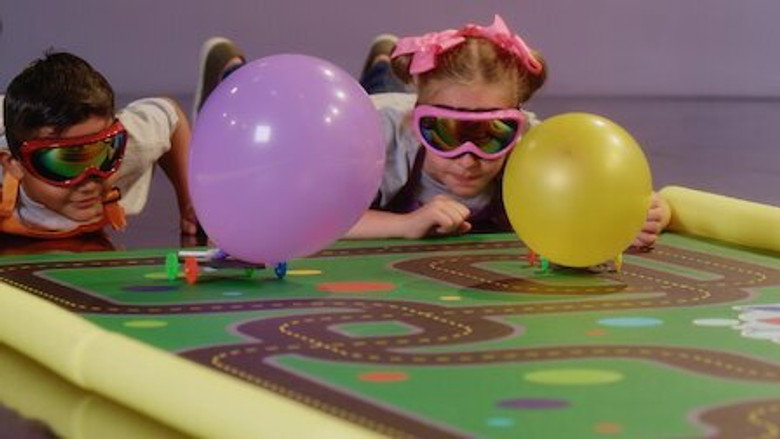
Inspired by Newton's third law of motion, the kids build balloon-powered cars, then race them to see who wins. At-home experiment: hovercraft.
| Runtime (min) | 13 |
|---|---|
| Air Date | 2020-08-25 |
| Genres | Family, Kids |
| TV Rating | TV-G |
| Network(s) | Netflix |
Storyline
In this episode of Emily's Wonder Lab, host Emily Calandrelli introduces Newton's third law of motion—for every action, there is an equal and opposite reaction—through hands-on experimentation with balloons. Emily and the kid scientists explore how releasing air from an inflated balloon creates thrust, propelling objects in the opposite direction. The group discusses the science behind action-reaction force pairs and how this principle applies to everything from rockets to everyday movement.
The main activity challenges the kids to design and build their own balloon-powered cars using simple materials like plastic bottles, straws, wooden skewers, and wheels. After constructing their vehicles, the young scientists test their creations in a race to see whose car travels the farthest and fastest. The episode wraps up with an at-home experiment that shows families how to create a simple hovercraft using a balloon and a CD, demonstrating how air pressure can reduce friction and allow objects to glide smoothly across surfaces.
What parents say
Parents have praised Emily's Wonder Lab for making complex scientific concepts accessible and exciting for elementary-aged children. Many appreciate Emily Calandrelli's enthusiastic teaching style and her ability to break down physics principles without talking down to young viewers. Parents note that the hands-on experiments keep kids engaged and inspire them to try similar projects at home.
Parents have complimented the series for its short runtime, with episodes clocking in around thirteen minutes, making it easy to fit into busy schedules or use as an educational screen-time option. Some parents mention that the balloon-powered car activity in this episode is particularly appealing because the materials are inexpensive and readily available in most households, allowing families to replicate the experiment without special purchases.
Parents have also noted that the show does an excellent job of featuring diverse young scientists and promoting STEM learning for all children. The collaborative, non-competitive atmosphere of the lab segments has been highlighted as a positive aspect, though some parents mention that the racing element in this episode adds a fun competitive twist that their kids enjoyed.
What kids learn
Children learn about Newton's third law of motion through direct experimentation, discovering that when air rushes out of a balloon in one direction, it pushes the balloon—and anything attached to it—in the opposite direction. This foundational physics concept helps kids understand how rockets launch into space, how jets propel airplanes forward, and even how they themselves move when walking or swimming. The episode makes abstract physics tangible by connecting the principle to observable, repeatable results.
The engineering challenge of building balloon-powered cars teaches children about design thinking and problem-solving. Kids see that small changes in wheel size, weight distribution, or the angle of the balloon can dramatically affect performance. They learn that experimentation often involves trial and error, and that failure is a natural part of the scientific process. Observing different car designs helps children understand that there are multiple solutions to engineering problems.
The hovercraft demonstration introduces the concept of air pressure and friction reduction. Children discover that a cushion of air can allow objects to move more freely across surfaces, connecting this principle to real-world applications like air hockey tables and actual hovercraft vehicles. The episode encourages curiosity-driven learning and shows that science experiments can be conducted with everyday household items.
Parents' top 5 questions
| Question | Answer |
|---|---|
| Is Newton's third law explanation accurate and age-appropriate for my elementary-aged child? | Yes, the episode presents Newton's third law in a developmentally appropriate way for children ages five to ten. Emily uses simple language and concrete demonstrations with balloons to show that every action has an equal and opposite reaction. The hands-on experiments make the abstract concept visible and understandable, allowing children to grasp the basic principle without needing advanced mathematics or physics background. The visual and tactile learning approach helps solidify comprehension. |
| Can we safely recreate the balloon-powered car experiment at home? | The balloon-powered car activity uses common, safe household materials like plastic bottles, balloons, straws, wooden skewers, and bottle caps or wheels. Adult supervision is recommended, particularly when cutting materials or inserting skewers through bottle caps to create axles. The experiment involves no heat, chemicals, or dangerous tools beyond basic scissors or craft knives. With proper supervision and age-appropriate task delegation, this is an accessible and safe project for families to complete together at home. |
| What materials do I need to build the balloon car with my child? | You will need an empty plastic bottle for the car body, a balloon for propulsion, a flexible straw to direct airflow, four bottle caps or small wheels, two wooden skewers or sturdy straws for axles, and tape or glue to secure components. Optional materials include cardboard for stability and decorative supplies. Most families already have these items at home, or they can be purchased inexpensively at craft or dollar stores, making this an accessible experiment for most households. |
| How does the hovercraft experiment work, and is it safe for kids? | The hovercraft experiment uses a CD, a pop-top bottle cap, a balloon, and glue. The balloon releases air through the bottle cap glued to the CD's center hole, creating an air cushion that reduces friction and allows the CD to glide across smooth surfaces. This experiment is very safe, involving no sharp objects or hazardous materials during operation. Adult help may be needed for gluing the cap securely. The demonstration effectively shows how air pressure can minimize friction in a fun, tangible way. |
| Will this episode keep my child interested in science beyond just watching? | The episode's hands-on approach and achievable experiments are specifically designed to inspire continued exploration. The racing element adds excitement and friendly competition, while the at-home hovercraft project provides immediate extension activity. Many children become motivated to modify their car designs, test different balloon sizes, or create variations on the hovercraft concept. The episode's short runtime and clear explanations make the science feel accessible rather than intimidating, encouraging kids to see themselves as capable young scientists and engineers. |
Writing
Directing
| Season # | Episode # | Episode Name |
|---|---|---|
| 1 | 1 | Emily and the crew get curious about ultraviolet light, then mix up their own fluorescent paint. At-home experiment: lava lamp. |
| 1 | 2 | The kids learn the science behind non-Newtonian fluids, then try to walk — and dance! — across an ooey-gooey pool. At-home experiment: oobleck. |
| 1 | 3 | Emily takes her scientists outside to get messy, making colorful explosions with chemical reactions. At-home experiment: rainbow bubbles |
| 1 | 4 | The kids learn all about tornados — then Emily shows them how to make one indoors! At-home experiment: tornado in a bottle. |
| 1 | 5 | How do you test the strength of ordinary chicken eggs? By walking across a whole floor of them ... barefoot. At-home experiment: egg in a bottle |
| 1 | 6 | A pool filled with glue helps the gang learn all about cross-linking polymers. (Hint: They're making slime!) At-home experiment: meteorite slime. |
| 1 | 7 | Brace yourself! The kids are making high-powered air cannons out of shower curtains, bungee cords and trash cans. At-home experiment: cloud in a bottle. |
| 1 | 8 | Inspired by Newton's third law of motion, the kids build balloon-powered cars, then race them to see who wins. At-home experiment: hovercraft. |
| 1 | 9 | The scientists scare up flying ghosts and bubbling witch’s brew with rising heat and acid-base reactions. At-home experiment: barfing pumpkin. |
| 1 | 10 | Aluminum foil, plastic wrap and a pizza box are the perfect ingredients for a solar-powered oven. At-home experiment: static electricit |
This product uses the TMDB API but is not endorsed or certified by TMDB.