
Emily's Wonder Lab - Spooky Science (S1E9)
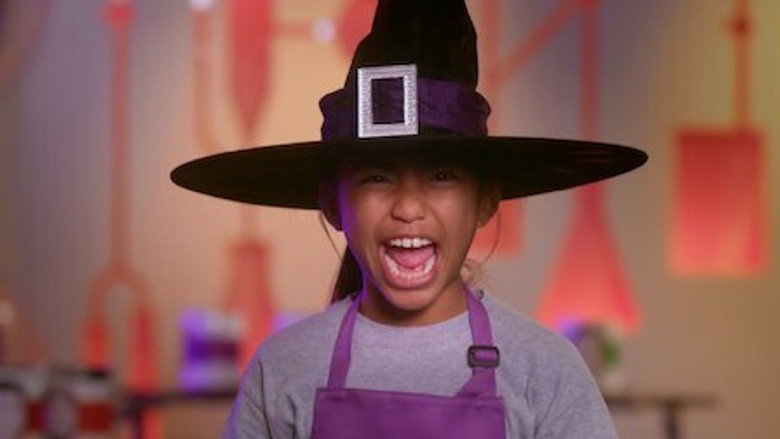
The scientists scare up flying ghosts and bubbling witch’s brew with rising heat and acid-base reactions. At-home experiment: barfing pumpkin.
| Runtime (min) | 14 |
|---|---|
| Air Date | 2020-08-25 |
| Genres | Family, Kids |
| TV Rating | TV-G |
| Network(s) | Netflix |
Storyline
In this Halloween-themed episode of Emily's Wonder Lab, host Emily Calandrelli and her team of young scientists explore the chemistry and physics behind spooky phenomena. The episode centers on two main experiments that demonstrate scientific principles through seasonal fun. First, the team creates flying ghosts using the concept of rising heat and convection currents, showing how warm air rises and can lift lightweight materials. The scientists observe how temperature differences create movement and learn about air density in an engaging, hands-on way.
The second major experiment involves making a bubbling witch's brew that demonstrates acid-base reactions. The young scientists mix ingredients that react chemically to produce fizzing, foaming concoctions that look appropriately spooky while teaching fundamental chemistry concepts. The episode concludes by introducing an at-home experiment called the barfing pumpkin, which uses similar acid-base reaction principles to create a festive, erupting effect. Throughout the fourteen-minute runtime, Emily connects the spooky visual effects to real scientific concepts, making chemistry accessible and entertaining for elementary-aged viewers.
What parents say
Parents have praised Emily's Wonder Lab for making science approachable and exciting for young children, particularly appreciating Emily Calandrelli's enthusiastic hosting style and her ability to explain concepts clearly without talking down to kids. Many parents note that the show successfully balances entertainment with education, holding children's attention while teaching genuine scientific principles.
Parents have specifically commented on the show's practical value, noting that the at-home experiments are doable with common household items and don't require expensive kits or hard-to-find materials. Several parents mention using episodes like this one as inspiration for family science activities, especially around holidays when themed experiments add extra excitement. The short runtime is frequently mentioned as a positive feature, fitting well into busy schedules and maintaining focus without overwhelming younger viewers.
Some parents appreciate that the show features diverse young scientists as Emily's assistants, providing positive representation and showing that science is for everyone. The Halloween episode's spooky theme has been noted as particularly engaging for kids who might otherwise be hesitant about science content, using seasonal interest as a gateway to learning.
What kids learn
Children learn fundamental chemistry concepts through this episode's focus on acid-base reactions. By creating the bubbling witch's brew and the barfing pumpkin experiment, kids observe firsthand what happens when acids and bases combine, seeing the production of carbon dioxide gas that creates fizzing and foaming effects. This hands-on demonstration makes abstract chemical reactions concrete and memorable, establishing foundational knowledge they'll build on in future science education.
The flying ghost experiment teaches important physics principles about heat, air density, and convection. Children discover that warm air is less dense than cool air and therefore rises, creating movement that can lift lightweight objects. This concept connects to everyday phenomena like hot air balloons, weather patterns, and why smoke rises from fires, helping kids understand the world around them through scientific observation.
Beyond specific scientific concepts, the episode reinforces the scientific method and experimental thinking. Children see how scientists test ideas, observe results, and connect cause and effect. The spooky theme also demonstrates that science can explain things that might seem magical or mysterious, encouraging critical thinking and curiosity about natural phenomena rather than fear of the unknown.
Parents' top 5 questions
| Question | Answer |
|---|---|
| Are the acid-base reaction experiments safe for young children to try at home? | The experiments featured in this episode use common household ingredients like baking soda and vinegar, which are safe for children when used properly. The barfing pumpkin and witch's brew activities produce non-toxic reactions that create foam and bubbles. Parents should supervise to ensure children don't ingest the mixtures and should help with any carving or preparation of pumpkins. The reactions are mild and don't produce heat or dangerous byproducts, making them appropriate for elementary-aged children with adult guidance. |
| What materials will we need to do the barfing pumpkin experiment at home? | The barfing pumpkin experiment typically requires a small pumpkin or large gourd, baking soda, vinegar, dish soap, and food coloring for effect. You'll need to hollow out the pumpkin first, which requires adult supervision and help. The basic supplies are inexpensive and likely already in your kitchen. Emily's Wonder Lab is designed to make at-home experiments accessible, so the materials list is intentionally simple and doesn't require specialty science equipment or hard-to-find ingredients. |
| Is this episode too scary for sensitive younger children? | This episode uses Halloween imagery like ghosts, witches' brew, and pumpkins, but presents them in a playful, educational context rather than a frightening one. The focus is on the science behind the effects, not on creating genuine scares. The tone remains upbeat and enthusiastic throughout, with Emily and the young scientists clearly having fun. Children who enjoy mild Halloween themes and aren't frightened by decorative seasonal imagery should be comfortable with the content, though very sensitive preschoolers might prefer non-themed episodes. |
| What age group will get the most educational value from this episode? | This episode is most appropriate for children in the early elementary range, roughly ages five through nine. The concepts are introduced at a level that kindergarteners and first-graders can grasp through observation and hands-on activity, while older elementary students can understand the underlying scientific principles being demonstrated. The fourteen-minute runtime is well-suited to younger attention spans. Preschoolers can enjoy watching and participating in supervised experiments, while children ten and older might want more detailed scientific explanations than the show provides. |
| Does the episode explain why the reactions happen or just show the effects? | Emily Calandrelli explains the science behind each experiment in age-appropriate terms throughout the episode. For the acid-base reactions, she discusses how the ingredients interact chemically to produce gas bubbles. For the flying ghosts, she explains the concept of rising heat and how warm air behaves differently than cool air. The explanations are simplified for young viewers but scientifically accurate, providing real educational content rather than just entertainment. Children come away understanding the cause-and-effect relationship, not just seeing a cool visual trick. |
Writing
Directing
| Season # | Episode # | Episode Name |
|---|---|---|
| 1 | 1 | Emily and the crew get curious about ultraviolet light, then mix up their own fluorescent paint. At-home experiment: lava lamp. |
| 1 | 2 | The kids learn the science behind non-Newtonian fluids, then try to walk — and dance! — across an ooey-gooey pool. At-home experiment: oobleck. |
| 1 | 3 | Emily takes her scientists outside to get messy, making colorful explosions with chemical reactions. At-home experiment: rainbow bubbles |
| 1 | 4 | The kids learn all about tornados — then Emily shows them how to make one indoors! At-home experiment: tornado in a bottle. |
| 1 | 5 | How do you test the strength of ordinary chicken eggs? By walking across a whole floor of them ... barefoot. At-home experiment: egg in a bottle |
| 1 | 6 | A pool filled with glue helps the gang learn all about cross-linking polymers. (Hint: They're making slime!) At-home experiment: meteorite slime. |
| 1 | 7 | Brace yourself! The kids are making high-powered air cannons out of shower curtains, bungee cords and trash cans. At-home experiment: cloud in a bottle. |
| 1 | 8 | Inspired by Newton's third law of motion, the kids build balloon-powered cars, then race them to see who wins. At-home experiment: hovercraft. |
| 1 | 9 | The scientists scare up flying ghosts and bubbling witch’s brew with rising heat and acid-base reactions. At-home experiment: barfing pumpkin. |
| 1 | 10 | Aluminum foil, plastic wrap and a pizza box are the perfect ingredients for a solar-powered oven. At-home experiment: static electricit |
This product uses the TMDB API but is not endorsed or certified by TMDB.