
Emily's Wonder Lab - Tornado Chasers (S1E4)
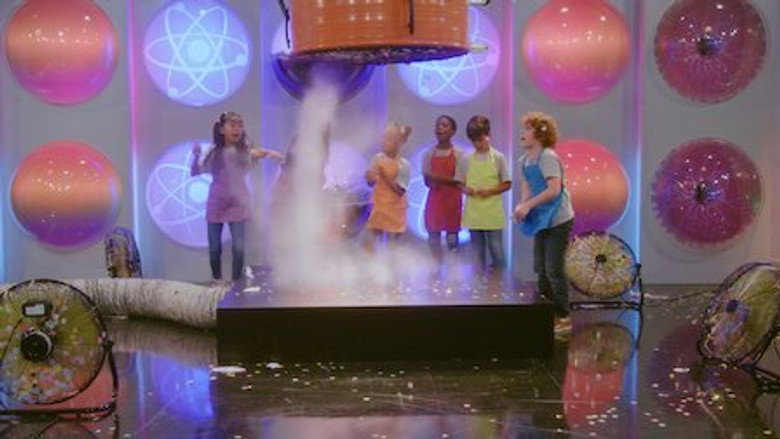
The kids learn all about tornados — then Emily shows them how to make one indoors! At-home experiment: tornado in a bottle.
| Runtime (min) | 13 |
|---|---|
| TMDB Rating | 7.0 (1 votes) |
| Air Date | 2020-08-25 |
| Genres | Family, Kids |
| TV Rating | TV-G |
| Network(s) | Netflix |
Storyline
In this episode of Emily's Wonder Lab, host Emily Calandrelli introduces a group of enthusiastic kids to the science behind tornadoes. The episode begins with an exploration of what tornadoes are, how they form in nature, and why they can be so powerful and destructive. Emily uses accessible explanations and visual aids to help the young participants understand the atmospheric conditions that create these swirling vortexes, including the role of warm and cool air masses colliding.
After establishing the foundational science, Emily guides the kids through a hands-on experiment where they create their own miniature tornado indoors using simple materials. The children observe how the spinning motion and air pressure differences generate a visible vortex, mirroring the natural phenomenon on a much smaller scale. The episode concludes with an invitation for viewers to try the "tornado in a bottle" experiment at home, reinforcing the lesson that science can be explored safely and creatively in everyday settings.
What parents say
Parents have praised Emily's Wonder Lab for making complex scientific concepts accessible and exciting for elementary-aged children. Many appreciate Emily Calandrelli's enthusiastic and clear teaching style, noting that she strikes a good balance between education and entertainment without talking down to young viewers. Parents have mentioned that the hands-on experiments featured in each episode inspire their children to ask questions and want to try science activities at home.
Some parents have highlighted the show's short runtime as a positive feature, making it easy to fit into busy schedules and appropriate for younger attention spans. The at-home experiment suggestions at the end of each episode have been particularly well-received, with parents noting that the materials required are typically household items, making the activities accessible without special trips to the store.
A few parents have noted that while the show is excellent for sparking curiosity, very young children may need some additional explanation or supervision during the experiments to fully grasp the concepts being demonstrated. Overall, parents recommend the series as a quality educational option that encourages STEM learning in an engaging, age-appropriate format.
What kids learn
Children learn the fundamental science behind tornadoes, including how these powerful weather phenomena form when warm and cold air masses collide and create rotating columns of air. The episode breaks down complex meteorological concepts into age-appropriate explanations, helping kids understand the conditions necessary for tornado formation and why these storms behave the way they do. This knowledge demystifies a weather event that many children find both fascinating and frightening.
Through the indoor tornado experiment, kids discover important principles of physics, including air pressure, rotational motion, and vortex dynamics. They see firsthand how spinning motion can create a visible funnel shape, connecting abstract scientific concepts to concrete, observable results. This hands-on approach reinforces the scientific method: observing a phenomenon, understanding the underlying principles, and then recreating it in a controlled environment.
The episode also teaches children that science is something they can explore safely at home with everyday materials. By encouraging the tornado-in-a-bottle experiment, Emily empowers young viewers to become active participants in their own learning rather than passive observers, building confidence in their ability to conduct experiments and think like scientists.
Parents' top 5 questions
| Question | Answer |
|---|---|
| Is the tornado experiment safe for my child to do at home? | Yes, the tornado-in-a-bottle experiment featured in this episode uses common household items like plastic bottles, water, and dish soap, making it very safe for children to perform with basic supervision. There are no hazardous materials or dangerous procedures involved. Younger children may need help securing bottle caps tightly to prevent spills, but the activity itself poses minimal risk and provides a great opportunity for hands-on learning in a controlled, safe environment. |
| Will this episode frighten my child about real tornadoes? | The episode approaches tornadoes from a scientific and educational perspective rather than focusing on their destructive power or danger. Emily explains how tornadoes form in a matter-of-fact way that emphasizes understanding rather than fear. The hands-on experiment helps demystify the phenomenon by showing children they can recreate the basic principle safely indoors. For most children, this scientific approach reduces anxiety by replacing fear of the unknown with knowledge and understanding of natural processes. |
| What materials do we need for the at-home experiment? | The tornado-in-a-bottle experiment requires simple materials that most households already have: two clear plastic bottles, water, dish soap, and duct tape or a tornado tube connector if available. Some versions also use glitter or small pieces of paper to make the vortex more visible. All of these items are inexpensive and easy to obtain, making this an accessible activity that doesn't require a trip to a specialty store or significant financial investment. |
| Is this episode appropriate for preschoolers or just older kids? | While the episode is designed for elementary-aged children, preschoolers can still enjoy watching and participating with parental guidance. Younger children may not grasp all the scientific explanations about air pressure and atmospheric conditions, but they will be captivated by the visual demonstration of the tornado forming. Parents can simplify the concepts and focus on the hands-on fun of creating the vortex, making it an engaging experience even for children who aren't ready for the full scientific explanation. |
| How can I extend the learning from this episode? | After watching, you can explore related weather phenomena with your child, such as looking up videos of real tornadoes, discussing local weather patterns, or reading age-appropriate books about storms. You can also experiment with variations of the tornado-in-a-bottle activity by changing the amount of water, the spinning speed, or adding different materials to observe how they move in the vortex. Connecting the episode to real-world weather reports or discussing tornado safety procedures helps children apply their new knowledge practically. |
Writing
Directing
| Season # | Episode # | Episode Name |
|---|---|---|
| 1 | 1 | Emily and the crew get curious about ultraviolet light, then mix up their own fluorescent paint. At-home experiment: lava lamp. |
| 1 | 2 | The kids learn the science behind non-Newtonian fluids, then try to walk — and dance! — across an ooey-gooey pool. At-home experiment: oobleck. |
| 1 | 3 | Emily takes her scientists outside to get messy, making colorful explosions with chemical reactions. At-home experiment: rainbow bubbles |
| 1 | 4 | The kids learn all about tornados — then Emily shows them how to make one indoors! At-home experiment: tornado in a bottle. |
| 1 | 5 | How do you test the strength of ordinary chicken eggs? By walking across a whole floor of them ... barefoot. At-home experiment: egg in a bottle |
| 1 | 6 | A pool filled with glue helps the gang learn all about cross-linking polymers. (Hint: They're making slime!) At-home experiment: meteorite slime. |
| 1 | 7 | Brace yourself! The kids are making high-powered air cannons out of shower curtains, bungee cords and trash cans. At-home experiment: cloud in a bottle. |
| 1 | 8 | Inspired by Newton's third law of motion, the kids build balloon-powered cars, then race them to see who wins. At-home experiment: hovercraft. |
| 1 | 9 | The scientists scare up flying ghosts and bubbling witch’s brew with rising heat and acid-base reactions. At-home experiment: barfing pumpkin. |
| 1 | 10 | Aluminum foil, plastic wrap and a pizza box are the perfect ingredients for a solar-powered oven. At-home experiment: static electricit |
This product uses the TMDB API but is not endorsed or certified by TMDB.