
Emily's Wonder Lab - Slime Time (S1E6)
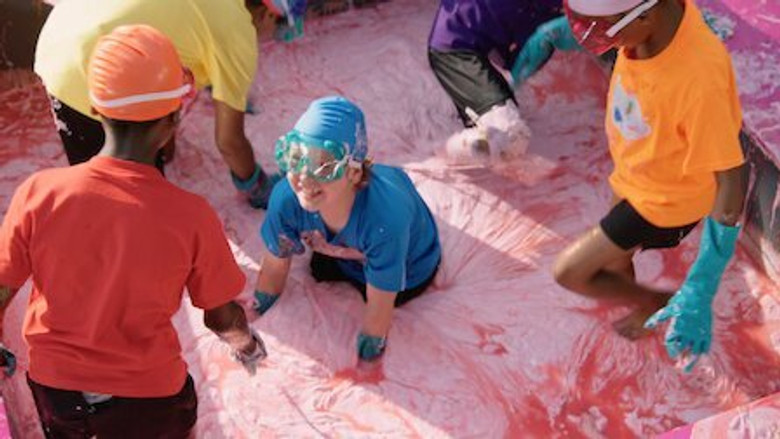
A pool filled with glue helps the gang learn all about cross-linking polymers. (Hint: They're making slime!) At-home experiment: meteorite slime.
| Runtime (min) | 12 |
|---|---|
| Air Date | 2020-08-25 |
| Genres | Family, Kids |
| TV Rating | TV-G |
| Network(s) | Netflix |
Storyline
In this episode, Emily and her young lab assistants explore the science of polymers by creating slime. The adventure begins with a dramatic demonstration: a pool filled with glue that illustrates how long polymer chains behave before cross-linking occurs. Emily explains that slime forms when these polymer chains connect to one another, transforming a liquid into a stretchy, moldable substance.
The kids get hands-on experience mixing their own slime batches, observing how different ratios of ingredients affect the final texture and consistency. Emily guides them through the chemistry of cross-linking, showing how activator solutions cause the polymer chains to bond together. The episode concludes with an at-home experiment called meteorite slime, which adds glitter and special effects to the basic slime recipe, encouraging young viewers to experiment with their own variations while reinforcing the polymer concepts they've just learned.
What parents say
Parents have praised Emily's Wonder Lab for making complex scientific concepts accessible to young children without dumbing down the actual science. Many appreciate that Emily Calandrelli presents chemistry and physics principles with enthusiasm and clarity, using demonstrations that hold kids' attention while teaching real STEM content.
Parents note that the slime episode is particularly engaging because it connects to an activity many children already love, giving them a deeper understanding of why slime works the way it does. Several parents have mentioned that the show inspires their kids to ask more questions about everyday materials and chemical reactions. Some parents appreciate that the at-home experiments are clearly explained and use relatively common household materials, making it easy to extend the learning beyond screen time.
A few parents have commented that the show's short runtime is perfect for younger attention spans, and the hands-on approach encourages children to see themselves as scientists rather than passive observers.
What kids learn
Children learn fundamental chemistry concepts through this episode, specifically understanding that polymers are long chains of molecules and that cross-linking is the process that connects these chains together. By seeing glue transform into slime, kids grasp how chemical reactions can change the physical properties of materials. They learn that the texture and stretchiness of slime depends on how tightly the polymer chains are connected, which is determined by the ratio of ingredients used.
The episode also teaches the scientific method through hands-on experimentation. Kids observe how changing one variable, such as the amount of activator, produces different results. This encourages critical thinking about cause and effect relationships in chemistry. The meteorite slime experiment reinforces that science can be creative and fun while still following specific chemical principles.
Beyond the chemistry lessons, children learn that everyday materials like glue are made of complex molecules with interesting properties. The episode demystifies a popular craft activity, showing kids that understanding the science behind slime makes the experience richer and more meaningful. This approach helps young viewers see science as something they can explore and understand in their daily lives.
Parents' top 5 questions
| Question | Answer |
|---|---|
| Is the slime made in this episode safe for young children to handle? | The episode demonstrates slime-making using standard craft materials like glue and activator solutions. While Emily's demonstrations are conducted in a controlled lab setting with supervision, the at-home meteorite slime experiment is designed for family participation. Parents should supervise young children during slime-making, ensure kids don't ingest the materials, and watch for any skin sensitivities to the ingredients. Handwashing after play is always recommended. |
| Will my child actually understand the polymer science, or is it too advanced? | Emily presents polymer chemistry using visual demonstrations and simple language appropriate for elementary-aged children. The glue pool demonstration makes the abstract concept of polymer chains concrete and memorable. While young children may not grasp every technical detail, they'll understand the basic idea that slime forms when long chains connect together. The hands-on approach helps cement these concepts through direct observation and experimentation. |
| What materials do we need for the at-home meteorite slime experiment? | The meteorite slime experiment requires basic slime-making ingredients: white or clear glue, an activator solution such as contact lens solution with boric acid or liquid starch, and baking soda. The meteorite effect comes from adding glitter or metallic pigments. Emily provides clear instructions during the episode, and these materials are generally available at craft stores or online. The experiment is designed to be accessible without requiring specialized scientific equipment. |
| Does this episode just encourage messy play, or is there real educational value? | This episode uses slime as a vehicle to teach genuine chemistry concepts about polymers and cross-linking reactions. Children learn why slime behaves the way it does at a molecular level, not just how to make it. Emily explains the science behind the transformation from liquid glue to stretchy slime, helping kids understand chemical reactions and material properties. The educational content goes well beyond craft activity, introducing foundational chemistry in an engaging, age-appropriate way. |
| Is the twelve-minute runtime long enough to cover the topic thoroughly? | The short runtime is intentionally designed to match young children's attention spans while delivering focused scientific content. Emily concentrates on one core concept—cross-linking polymers—and illustrates it through memorable demonstrations and hands-on activities. The concise format prevents information overload and keeps kids engaged throughout. Parents can extend the learning by pausing to discuss concepts or by conducting the at-home experiment together, which reinforces what children watched. |
Writing
Directing
| Season # | Episode # | Episode Name |
|---|---|---|
| 1 | 1 | Emily and the crew get curious about ultraviolet light, then mix up their own fluorescent paint. At-home experiment: lava lamp. |
| 1 | 2 | The kids learn the science behind non-Newtonian fluids, then try to walk — and dance! — across an ooey-gooey pool. At-home experiment: oobleck. |
| 1 | 3 | Emily takes her scientists outside to get messy, making colorful explosions with chemical reactions. At-home experiment: rainbow bubbles |
| 1 | 4 | The kids learn all about tornados — then Emily shows them how to make one indoors! At-home experiment: tornado in a bottle. |
| 1 | 5 | How do you test the strength of ordinary chicken eggs? By walking across a whole floor of them ... barefoot. At-home experiment: egg in a bottle |
| 1 | 6 | A pool filled with glue helps the gang learn all about cross-linking polymers. (Hint: They're making slime!) At-home experiment: meteorite slime. |
| 1 | 7 | Brace yourself! The kids are making high-powered air cannons out of shower curtains, bungee cords and trash cans. At-home experiment: cloud in a bottle. |
| 1 | 8 | Inspired by Newton's third law of motion, the kids build balloon-powered cars, then race them to see who wins. At-home experiment: hovercraft. |
| 1 | 9 | The scientists scare up flying ghosts and bubbling witch’s brew with rising heat and acid-base reactions. At-home experiment: barfing pumpkin. |
| 1 | 10 | Aluminum foil, plastic wrap and a pizza box are the perfect ingredients for a solar-powered oven. At-home experiment: static electricit |
This product uses the TMDB API but is not endorsed or certified by TMDB.